
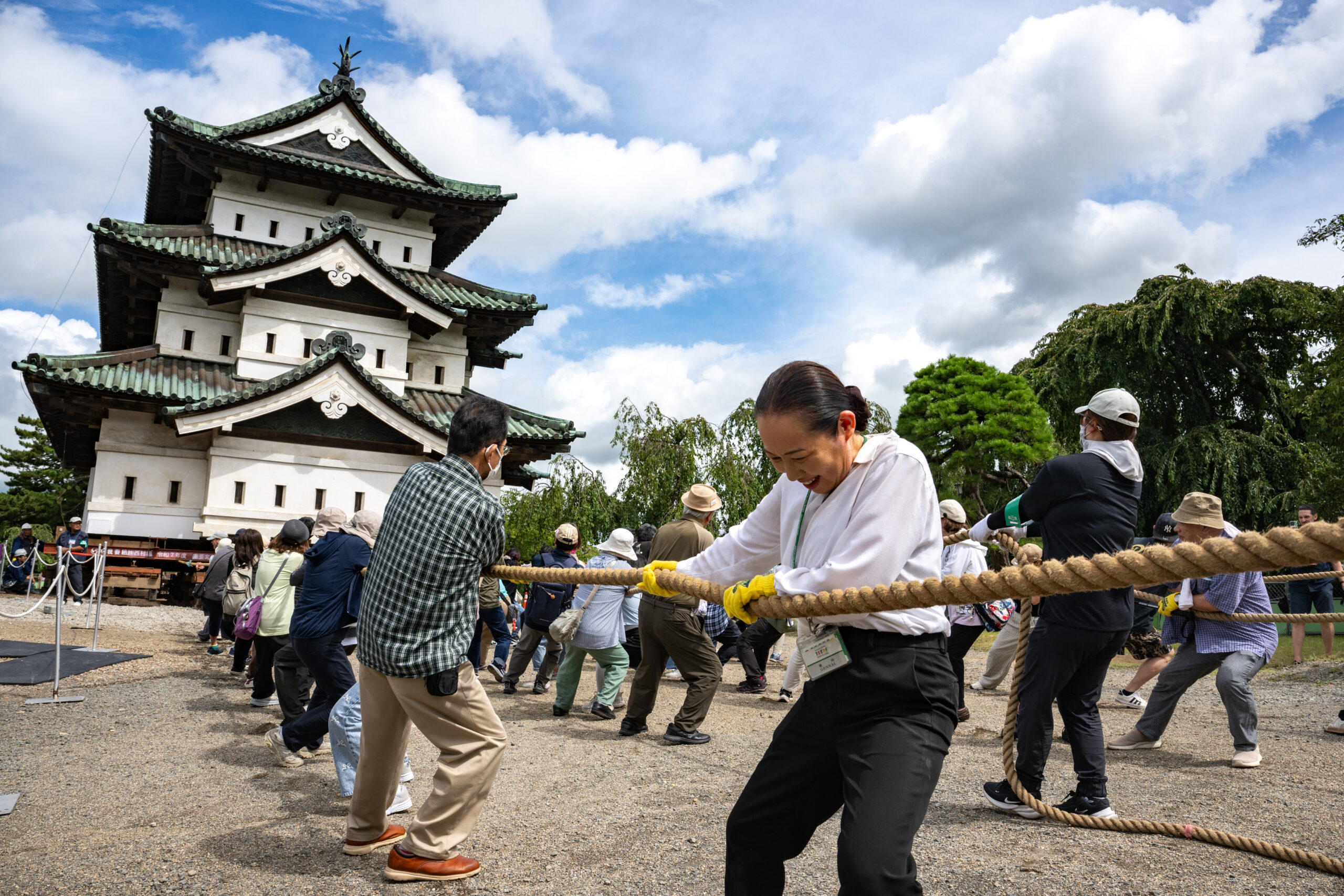
The Hirosaki Castle is a Edo period castle located in Hirosaki City, Aomori Prefecture, Japan, with a history of over 400 years. The main tower of the castle, also known as the tenshukaku, was relocated years ago due to restoration work. Now, the restoration project has been completed, allowing the tenshukaku to return to its original position. Thousands of Japanese people recently used traditional methods to pull the 400-ton tenshukaku a short distance to assist in its relocation.
The tenshukaku of Hirosaki Castle is a three-story wooden tower, which was at risk of collapse due to damage to the supporting stone walls during earthquakes. In order to repair the stone walls, in 2015, the city of Hirosaki moved the tower out of its original position without dismantling it. The engineers at that time hoisted the entire tower onto metal rails and then moved it to a temporary platform.
The restoration work on the stone walls began the following year and was completed in December 2024. All 2,185 stones were stacked back in their original positions. Authorities initiated the task of returning the tenshukaku to its place in July of this year, aiming to move it 78 meters back to its original position by the end of the year.
In late August, authorities recruited thousands of people to participate in the traditional “hikiya” method, where they used ropes to pull the tenshukaku, placed on rollers, to move it. These individuals worked in groups of 80, taking turns to pull a few centimeters at a time before handing over to the next group.
Local officials estimated that approximately 4,000 people took part in this activity, with participants of all ages and genders, including some from overseas. Through their combined efforts, the tenshukaku moved approximately 5 meters in just a few days.
One 56-year-old resident of Hirosaki City told Agence France-Presse, “It’s like trying to move a mountain.” After minutes of effort, sweat beads dripped down his forehead.
A 46-year-old history and castle enthusiast traveled from Shimane Prefecture specifically to contribute to the event. She told Agence France-Presse, “This is a rare experience, a precious and unique memory.”
Authorities plan to install heavy machinery in September to move the remaining 73 meters and complete the permanent placement of the tenshukaku by November.
Next, authorities will conduct further repairs on the copper roof and exterior of the tenshukaku until it fully reopens to the public by 2033.
Kensuke Hayasaka, the chief of Hirosaki City’s Park and Greenery Division responsible for the tenshukaku restoration project, said in an interview with Agence France-Presse, “By involving the public, we hope that everyone can experience this history firsthand.”
He added, “In passing down the history of Hirosaki to future generations, this holds great significance.”
Speaking of the traditional “hikiya” method they employed, he said, “Our goal is to preserve this unique heritage while ensuring the main tower is securely fixed to its base before the first snowfall.”
He also mentioned the emotional satisfaction and sense of accomplishment from seeing the methods envisioned by their predecessors and team come to fruition this year.
According to the Japan National Tourism Organization website, the Hirosaki Castle, built in 1611, is the only castle in the Tohoku region of Japan constructed during the Edo period (1603-1867). The castle’s construction style is known as “Hirayagura-style Hira-jokaku,” positioning the main tower on the mountaintop for defense, surrounded by walls, moats, and corner turrets for protection.
The Hirosaki Castle is encompassed by the Hirosaki Park, filled with cherry blossoms. In spring, the beautiful cherry blossoms bloom, attracting countless visitors for cherry blossom viewing.
The Hirosaki Castle serves as the cultural and historical center of Hirosaki City. Apart from the Cherry Blossom Festival, events like the Hirosaki Snow Lantern Festival and Hirosaki Nebuta Festival are held in or near the Hirosaki Park.
The Hirosaki Nebuta Festival, one of the four major festivals in Hirosaki City, typically takes place in early August and has strong ties to the Aomori Nebuta Festival but is more elegant and subdued.
The term “Nebuta” refers to giant lanterns installed on floats, the main highlight of the festival. Teams consisting of floats, drummers, and dancers parade around, with the magnificent Hirosaki Castle as the backdrop.
The tenshukaku of Hirosaki Castle is one of the 12 remaining tenshukaku in Japan. Originally a five-story tower, it was destroyed by lightning in 1627. The current three-story tenshukaku was rebuilt in 1811.