
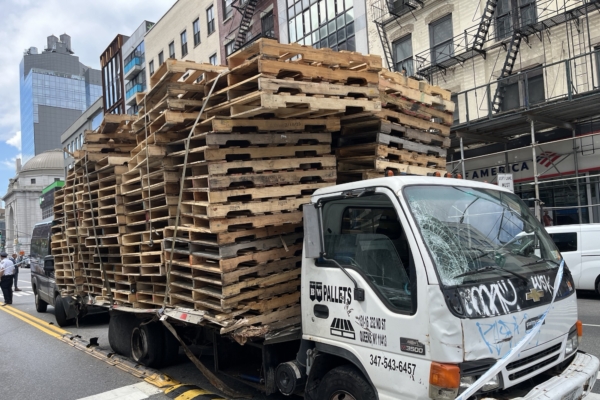
Last Thursday, a fatal car accident occurred at the intersection of Canal Street and Bayard Street in Manhattan’s Chinatown. A 77-year-old man died, and two women were injured in the accident. Following the incident, the family members of the deceased spoke about the pain of losing a loved one, while community members once again raised concerns about the road design and traffic safety near the Manhattan Bridge exit.
According to CBS, the deceased, Ting Jun Ye, had a 52-year-old daughter, Yong Wong, who was also injured in the accident and taken to the hospital. Yong Wong is a mother of three children. Kin Fai Wong, the son-in-law of the deceased, described his father-in-law as a strong and caring father who took care of his family, saying, “He was a good man.” He mentioned his wife’s struggle of dealing with her injuries and the loss of her father, expressing, “She is very upset, constantly crying.”
Authorities reported that the accident occurred around 10:20 a.m. when a 66-year-old man driving a flatbed truck carrying a cargo pallet entered Canal Street from the Manhattan Bridge and veered onto the sidewalk, hitting three pedestrians. The truck then made a right turn onto Bayard Street and collided with a blue van before coming to a stop. The driver of the truck claimed brake failure to the police, and the case is still under investigation with no charges filed at the time.
This accident has once again raised concerns in the community about the safety near the Manhattan Bridge exit. Community leader Yu Jinshan pointed out that in front of the Mahayana Temple is where the bridge traffic diverges, with some vehicles making a right turn onto Bayard Street. This section of the road has both a downhill slope and curves.
“This area itself is downhill, and with curves, some drivers tend to accelerate to beat the red light,” said Yu Jinshan. “Once a vehicle loses control, it is easy to go onto the sidewalk or collide with vehicles parked along the road, and there have been multiple severe accidents in the past.”
Following the accident, many residents discussed preventive measures in WeChat groups, including installing steel crash barriers at high-risk locations on Canal Street and Bayard Street, installing speed cameras and red-light cameras, pedestrian safety islands, and extending curbs, as well as further reducing the speed at the bridge exit.
The transportation safety advocacy group “Transportation Alternatives” stated that since 2014, there have been 10 pedestrian deaths on Canal Street, with an average age of about 75 years old for the deceased. The organization pointed out that the speed limit on the Manhattan Bridge is 35 miles per hour, while on Canal Street, it is 20 miles per hour. Vehicles leaving the bridge and entering Chinatown have to significantly reduce their speed in a short distance.
Councilman Ma Tai expressed concern that this is the third life lost in a little over a year in that area. He criticized the Department of Transportation (DOT) for the slow progress in redesigning Canal Street and starting improvements from the end with fewer fatal accidents.
In fact, after a fatal accident in July 2025, DOT had narrowed the lanes at the lower exit of the Manhattan Bridge, expanded the buffer zone between lanes and pedestrian safety islands, installed Jersey barriers and sand barrels, and started to lower the speed limit to 20 miles per hour on the approach to Canal Street and Bayard Street intersection while studying the addition of pedestrian safety island crash barriers.
However, despite the round of safety improvements, another fatality occurred at the same bridgehead this year. Community members are urging DOT to review the existing measures once again, especially the speed reduction and crash prevention designs at the bridge exit, to prevent runaway vehicles from entering pedestrian areas.