
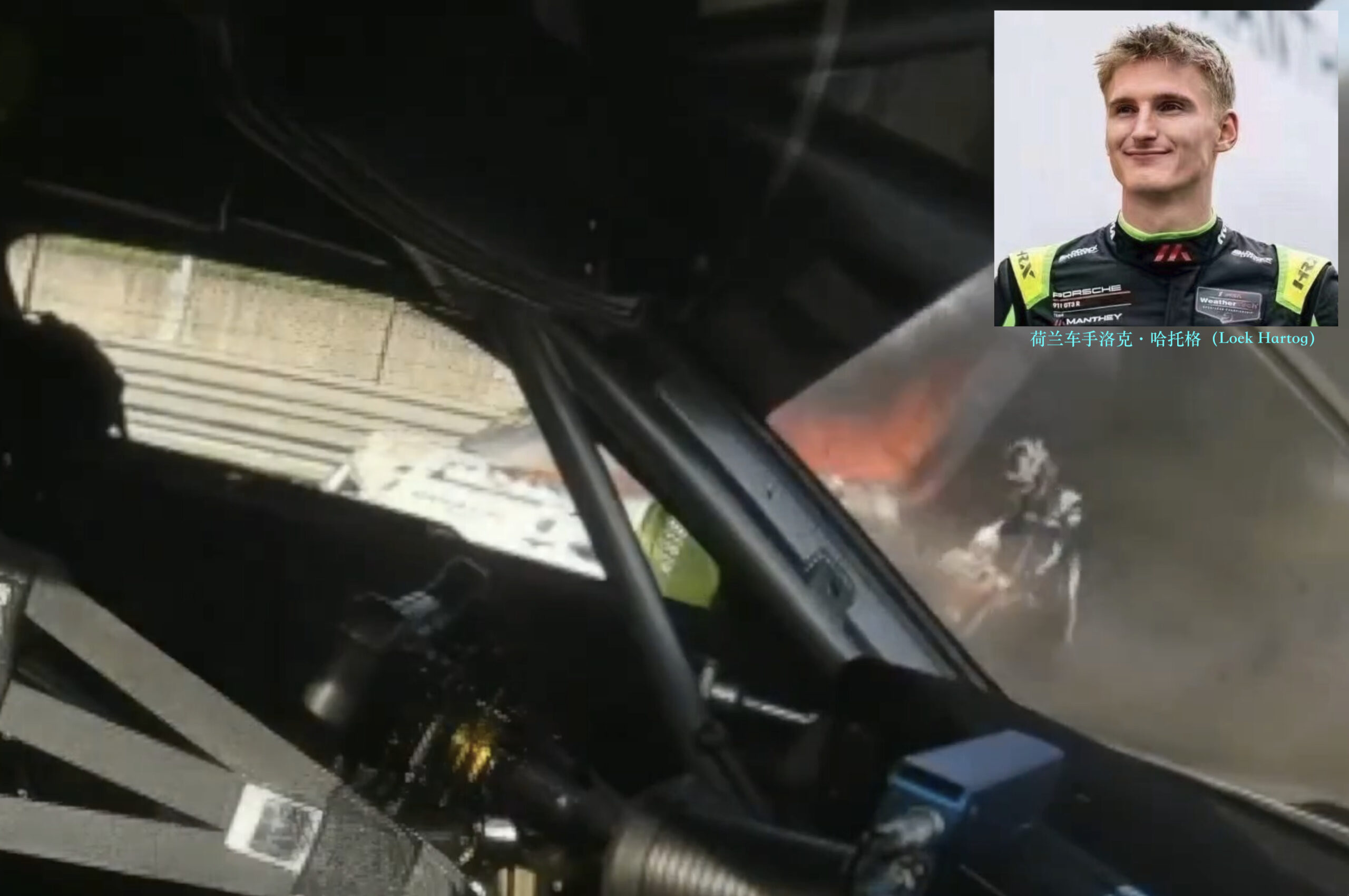
In a recent supercar race held in Shanghai, a thrilling scene unfolded when a car crashed and caught fire, trapping a British driver in the cockpit for nearly a minute. In the absence of official rescue efforts, a Dutch driver timely intervened to rescue the trapped driver, averting a tragedy. Following the accident, questions arose about the organization of the event, information dissemination, and assignment of responsibility. Commentators argued that meeting standards is not the core issue, but rather why the emergency mechanism failed at a critical moment.
On September 5, during the China GT Super Car Championship GT3 race in Shanghai, car number 91, a Ferrari, caught fire after a fierce collision on the track, with British driver Oliver Millroy trapped inside the cockpit.
The accident occurred approximately 20 minutes into the race when two cars collided, causing one of them to lose control and collide with the Ferrari driven by Millroy. Subsequently, the Ferrari crashed into a guardrail and caught fire.
Video footage from the scene showed that after the car caught fire, Millroy was unable to free himself, and no one came to his rescue until Dutch driver Loek Hartog arrived and promptly pulled Millroy out of the car, taking about 1 minute for the entire rescue process.
More astonishingly, a Chinese staff member arrived with a fire extinguisher but handed it to Hartog before leaving the scene, and another staff member in a reflective vest also brought a fire extinguisher but seemed unsure how to use it, leaving Hartog to handle the fire rescue alone.
After being rescued, Millroy was taken to the hospital and diagnosed with five broken ribs, a broken collarbone, fractures in his arm and fingers, along with lung contusions.
Following the accident, the event organizers issued a statement stating, “The event setup complies with national-level standards, but there are deficiencies in detailed management.”
The incident stirred widespread controversy, with public figures also expressing their opinions.
Recently, male star Wu Yan Zhu, who participated in the China GT race in Shanghai, publicly criticized the organizers as “shameful,” noting that after the severe accident involving the British driver, not only was the rescue effort inadequate, but there was also a lack of acknowledgment or apology.
Wu revealed that after the crash and fire, the live broadcast was immediately cut, and it took 30 seconds to 1 minute for the control center to display the red flag to halt the race, causing drivers behind to continue speeding through the accident zone filled with smoke and fire. He expressed anger that 36 hours after the incident, the authorities attempted to cover up the accident without issuing a public apology.
Under the criticism from Wu Yan Zhu and numerous fans, the China GT official later issued an apology.
In light of the event, Chinese-American writer Sheng Xue emphasized the significant gap between the set standards and their actual implementation, questioning why such a substantial disparity exists.
She noted that in China, when facing sudden events, the first consideration often revolves around whether it will affect the reputation of the Chinese Communist Party, the positions of officials, and the responsibilities of individuals, rather than focusing on rescue efforts.
Regarding whether this incident is an isolated case, she drew parallels with the 2021 Gansu Baiyin Mountain Marathon 100k cross-country race accident, which resulted in the deaths of 21 participants due to extreme weather conditions. Though the nature of the two incidents differs, she believes they reveal similar flaws in safety management logic.
Sheng Xue suggested that the choice to continue hosting international sports events in China should be reassessed because the existing system may lack the capacity to effectively handle unforeseen accidents.
The China GT Super Car Championship is an annual GT event approved by the Chinese National Sports Administration and the Chinese Automobile and Motorcycle Sports Federation, organized by China Vision Apes Cultural Development Co., Ltd., featuring a station-based race format.
After the incident, authorities attempted to shift the blame onto on-site personnel. According to a recruitment ad disclosed by NetEase News, some on-site staff at the event were temporary workers earning only 60 RMB per day. The job description included simply observing the scene and maintaining order.
Additionally, a netizen revealed that the official security staff were offered 3,000 RMB per day, but those responsibilities were then transferred to a security company, which paid each person 300 RMB per day, resulting in the company finding individuals to fill the positions for 60 RMB per day. However, the authenticity of this information could not be independently verified by reporters from Da Ji Yuan.