
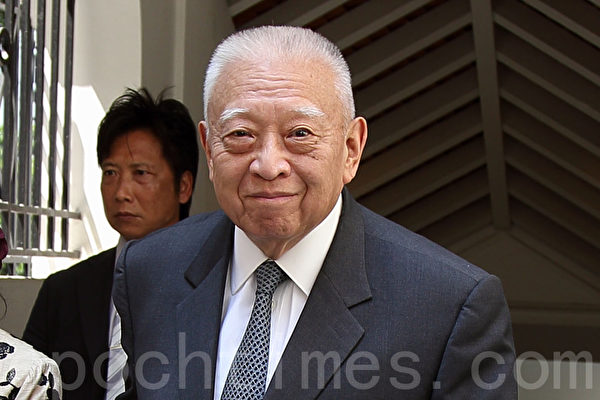
Former Chief Executive of the Hong Kong Special Administrative Region and former Vice Chairman of the National Committee of the Chinese People’s Political Consultative Conference, Tung Chee-hwa, passed away on September 8, 2026, at the age of 89. His office issued a statement announcing that Tung Chee-hwa passed away in the company of his loved ones. Tung Chee-hwa was the first Chief Executive of Hong Kong after the handover of sovereignty and also the first former Chief Executive of Hong Kong to pass away.
Tung Chee-hwa was born on May 29, 1937, in Shanghai, as the eldest son of Hong Kong shipping magnate Tung Hao-yun, and he had a younger brother and three sisters. The Tung family settled in Hong Kong in 1947. Tung Chee-hwa completed his secondary education in Hong Kong before pursuing his studies in the United Kingdom, graduating from the University of Liverpool in 1960 with a Bachelor’s degree in Marine Engineering.
Subsequently, Tung Chee-hwa lived in the United States and worked at both General Electric Company and the Tung Group for about 9 years before returning to Hong Kong in 1969 to assist in managing the family business. The Tung family business was one of the world’s largest shipping entities at the time, involved in container ships, dry bulk carriers, and oil tankers.
In 1982, after the passing of Tung Hao-yun, Tung Chee-hwa took over the family business. The company soon faced financial difficulties and required a $120 million rescue plan. Reports indicated that this funding was arranged by prominent pro-Beijing businessman, Sir Y.K. Pao; during Tung Chee-hwa’s candidacy for Chief Executive of Hong Kong, he acknowledged that some of the rescue funds came from mainland China.
Sir Y.K. Pao had significant influence in the political and business circles in Beijing. Since 1993, he had served as Vice Chairman of the National Committee of the Chinese People’s Political Consultative Conference, not the “Vice Chairman of the Standing Committee of the National People’s Congress”. According to a Reuters obituary report on Sir Y.K. Pao, it was him who introduced Tung Chee-hwa to the then paramount leader of the Communist Party of China and President, Jiang Zemin, paving the way for Tung Chee-hwa to become Beijing’s favored candidate for the first Chief Executive of Hong Kong.
In December 1996, the Chinese government established a 400-member Selection Committee to elect the first Chief Executive of Hong Kong after its return to China. Tung Chee-hwa won the election by an overwhelming majority and subsequently served as the first Chief Executive of the Hong Kong Special Administrative Region.
On July 1, 1997, following the transfer of sovereignty of Hong Kong to China, Tung Chee-hwa officially took office as the Chief Executive, serving a first term of 5 years. In 2002, he was re-elected unopposed to embark on his second term.
During Tung Chee-hwa’s tenure, Hong Kong experienced various challenges including the Asian financial crisis, avian flu, the SARS epidemic, and economic downturn, leading to a noticeable decline in his popularity in both Hong Kong and Beijing. In December 2004, during a meeting with the then President of China, Hu Jintao, in Beijing, Tung Chee-hwa was publicly asked to “summarize his experiences” and improve his governance performance.
In 2003, the Hong Kong government proposed legislation for Article 23 of the Basic Law, sparking protests with approximately 500,000 people taking to the streets on July 1, becoming one of the most iconic political crises during Tung Chee-hwa’s tenure.
On March 10, 2005, Tung Chee-hwa resigned from his position as Chief Executive halfway through his second term, citing poor health and old age, at the age of 67. It was widely believed that Beijing had lost confidence in his governance performance, a significant factor leading to his early departure.
After stepping down as Chief Executive, Tung Chee-hwa was appointed as Vice Chairman of the National Committee of the Chinese People’s Political Consultative Conference, serving for about 18 years until his retirement at the 2023 leadership transition.
During the National People’s Congress in 2021, Tung Chee-hwa fell while leaving the closing ceremony. He was standing at the rostrum of the Great Hall of the People, waiting for the presiding members to depart when he stumbled down the steps.
Following his retirement as Vice Chairman of the National Committee of the Chinese People’s Political Consultative Conference, Tung Chee-hwa made few public appearances. He was notably absent from the flag-raising ceremony and reception commemorating the handover of Hong Kong for six consecutive years.
In 2008, Tung Chee-hwa spearheaded the establishment of the China-United States Exchange Foundation (CUSEF). The foundation was identified by U.S. congressional investigators as a tool for the Communist Party of China’s political strategy and part of Beijing’s broader united front influence system.
In 2014, Tung Chee-hwa founded the Our Hong Kong Foundation. The foundation, comprised of participation from Hong Kong tycoons, aimed to uphold and promote Beijing’s implementation of the “One Country, Two Systems” policy in Hong Kong.
Following Tung Chee-hwa’s passing, there is immediate interest in how and where official commemorations will take place, and whether the current paramount leader of the Chinese Communist Party, Xi Jinping, will attend. As the first former Chief Executive of Hong Kong to pass away, there is no established precedent for official mourning and commemoration arrangements.