
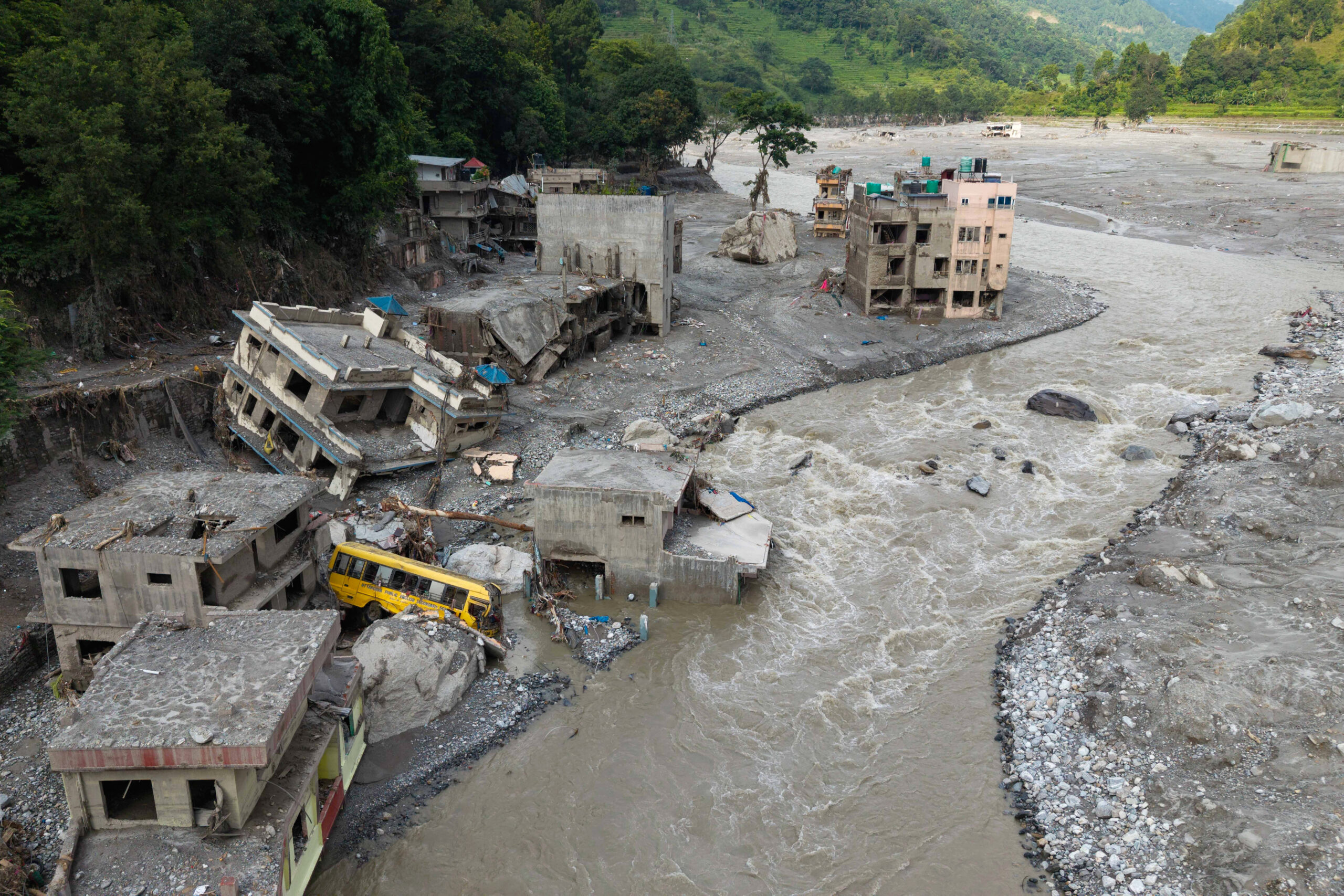
After the flood in Jilong, Tibet occurred, the Chinese Communist Party used “Clean Net-2026” as an excuse to delete or restrict the dissemination of related posts. As of September 3rd, at least 19 netizens who posted about the disaster or questioned official numbers have been punished, summoned, or warned, and a complete list of the deceased and missing persons has yet to be made public.
According to a report from The Guardian in the UK, the Chinese Communist Party, through the “Clean Net-2026” campaign, deleted and restricted the spread of unofficial information about the Jilong flood, and punished netizens who posted different opinions. The report stated that this is a pattern repeatedly used by the authorities in response to major events: strengthening the official stance, suppressing independent information, and preventing outside inquiry into the disaster and its causes.
Within hours of the flood, topics related to it briefly trended on mainland social media platforms; however, some comments were immediately deleted in real-time, leading to a rapid decrease in attention to the related topics. Screenshots seen by The Guardian showed that a post about the flood on WeChat was deleted for involving “politically sensitive content,” while another post was unable to be reposted due to allegedly “violating policies” and containing “prohibited content.”
“Clean Net-2026” is the latest version of a long-term internet special action by the Chinese Ministry of Public Security. The earlier actions primarily targeted cybercrime and hacker activities, but eventually expanded to what the authorities termed as “rumors,” including information about disasters not officially released.
The international human rights organization, Human Rights Watch, based in New York, stated that while multiple Jilong flood topics appeared on Weibo, the voices of survivors and their families were largely absent, with the main focus being on official casualty figures, rescue operations, and police propaganda.
According to the Associated Press, some mainland reporters received instructions not to interview the families of the deceased or missing persons, but to use content provided by Xinhua News Agency instead. The Associated Press’s request to enter the Tibet disaster area for coverage was also not granted.
As of September 7th, the Chinese authorities have only confirmed the identities of some of the deceased, but have not released their names; as of September 8th, the complete list of the deceased and missing persons has not been made public.
The International Tibet Support Movement in the United States has reported that as of September 3rd, at least 19 people have been punished, summoned, or warned for posting information or questioning official data regarding the Jilong flood.
Just four days after the flood, the Tibet police cited netizens spreading messages such as “over 1000 people washed away” and “missing persons increased to 826” to announce 10 so-called “disaster rumor” cases.
Among them, a netizen from Jiangxi who posted a video stating the number of missing persons as 826 was subjected to “administrative penalties” by the police, without specifying the exact measures taken. According to the Associated Press, some netizens were administratively detained for 5 to 10 days, while others were fined 1000 yuan and required to delete their posts.
The International Tibet Support Movement also mentioned that the Party Secretary of the Tibet Autonomous Region, Wang Junzheng, emphasized the need to strengthen so-called “online sentiment guidance” and “stability maintenance” at a disaster relief meeting on September 1st. At that time, several hundred people were still missing.
A former official Chinese media journalist told The Guardian that official reports focused extensively on the authorities’ relief efforts but provided little information on who remained missing, where they were last seen, or which buildings had been searched.
David Bandurski, director of the China Media Project, stated that this was not a one-time post-deletion act but a part of the long-term “opinion guidance” by the Chinese Communist Party, aimed at ensuring the dominance of official narratives.
Political commentator Li Linyi previously told Epoch Times that some punished netizens may have simply shared overseas information back to mainland China. In a situation where official information is consistently blocked, any deviations in unofficial information are also related to the lack of transparency in the information.
He pointed out that by blocking information during major disasters, the Chinese Communist Party hinders people’s right to information, making it difficult to learn from the disaster and prepare for future calamities under the guise of “dispelling rumors” while punishing netizens, ultimately making it challenging for people to draw lessons and mitigate risks for the next disaster.