
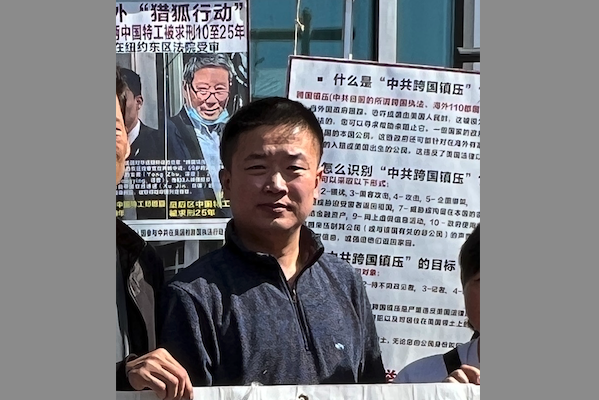
On August 27, Li Chengsong, a former member of the underground church in China – the Beijing Zion Church, who holds a C8 asylum work card, was detained by Immigration and Customs Enforcement (ICE) on Interstate 80 in Pennsylvania. Li Chengsong’s wife, Zhou Mei, explained that he entered the United States in October 2022 on a tourist visa, later applied for political asylum and obtained a C8 work card. In July 2024, he obtained a commercial driver’s license (CDL) and started working as a truck driver.
Li Chengsong was stopped for inspection along with his driving partner at a weighing station on I-80 in Pennsylvania after they entered the state from New Jersey. Li Chengsong was resting while his partner was driving when ICE officers requested his driver’s license. After inspecting his documents for about 10 minutes, they took him into custody. His driving partner, who is a U.S. permanent resident, was not detained.
Mrs. Zhou had advised her husband previously to avoid traveling out of state due to the increasing immigration enforcement and commercial driver checks. However, Li Chengsong believed his English skills were sufficient to handle inspections related to commercial driving, so he continued working.
A truck driver holding a C8 asylum work card informed reporters on September 3 that a CDL obtained with a C8 work card would indicate “Non-domiciled”, drawing attention to the non-resident status when enforcement officers examine the documents.
Li Chengsong, a former member of the Beijing Zion Church, revealed that after the church was closed by the Chinese authorities, they continued worshiping through “walking worship,” changing the way of worship and sometimes moving the gatherings to parks.
After coming to the United States, Li Chengsong continued to participate in protests against the Communist Party’s tyranny, commemorating the June 4th incident, advocating for Chinese democracy and human rights. According to Epoch Times, during 2023, he frequently assisted in setting up and maintaining order at the “Centennial Crimes of the Communist Party of China” photo exhibition held in front of the Flushing Library every Saturday, and he also participated in the “Jasmine” rallies organized by the China Democracy Party in Times Square, New York.
Zhou Mei publicly appealed to the U.S. government to fairly process Li Chengsong’s case, avoid prolonged detention before the completion of the asylum process, and consider the risks he might face if deported back to China.
Lawyer Chen Chuangchuang stated that Li Chengsong has been living in the U.S. for several years without a criminal record. “The government should go through due process before depriving someone of their liberty,” he said, emphasizing the right of the individual to know the basis of their detention and present a defense.
Regarding ICE’s recent arrests, Chen suggested that legal challenges to the legitimacy of detentions could be made through the habeas corpus process in federal courts. Considering Li Chengsong’s current situation, he believes there is a “good chance” of court support.
According to Zhou Mei, Li Chengsong’s asylum case has been referred to an immigration court with no further discussions with immigration authorities scheduled. The initial Master Calendar Hearing is set for September 14.
Chen Chuangchuang mentioned that Li Chengsong has substantial materials related to religious beliefs and his anti-Communist activities in the U.S., indicating that with sufficient evidence, obtaining asylum at the immigration court is still possible even under ICE detention, as seen in the cases of Guan Heng and Zhang Zhenzhen.
Chen cautioned that ICE is now targeting individuals with expired visas awaiting asylum processing and holding C8 work cards, dispelling the misconception that holding a work card guarantees immunity from ICE arrests. He advised asylum applicants to prepare comprehensive evidence, including experiences in their home country and relevant activities since coming to the U.S., keep trusted friends informed about their case, and retain contact information for their attorney and important immigration documents for quick assistance in case of detention.
Observing law enforcement practices, Chen noted more collaboration between ICE and local law enforcement in Pennsylvania. Truck drivers who transport goods across states and who are non-permanent residents passing through Pennsylvania should be cautious and aware of potential risks to protect themselves.