
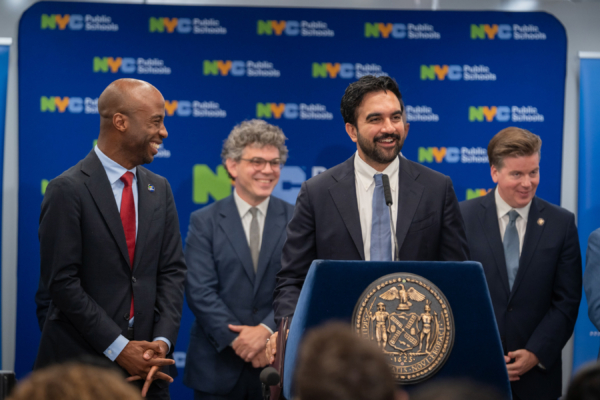
New York City Mayor Zohran Mamdani and the city’s Education Director Kamar Samuels announced on September 2 that for the 2026-2027 school year, students from 2-K to 8th grade will temporarily pause direct use of Generative Artificial Intelligence (AI) for one year, and screen time for students will be restricted. The new policy will impact nearly 600,000 public school students, approximately two-thirds of the total number of public school students in the city.
The city government stated that this is currently the widest-scope pause policy for student use of AI in the United States. Students from 2-K to 8th grade will not be allowed to use student-oriented generative AI software; AI “companion chatbots” simulating interpersonal communication will also be prohibited across all grade levels.
“Children need the connection between teachers and human interaction to learn and grow,” Mamdani stated, emphasizing that while the tech industry promotes the inevitability and even necessity of AI early childhood education, the city government does not share the same view. Over the next year, the city will conduct research on the impacts of relevant technology on students.
In addition to the AI restrictions, the new policy also sets regulations for screen time for students of different age groups. Students in second grade and below will be limited to one device per person (1:1 screen time); it is recommended that students in grades three to five not exceed 30 minutes per day, and grades six to eight not exceed 45 minutes per day.
Governor Kathy Hochul also supports this policy, stating that rapidly evolving technology should aid children’s learning rather than hinder it.
High school students are not included in the comprehensive AI pause. The city plans to involve up to 50,000 high school students in five limited AI pilot programs, which accounts for about 5% of the total number of public school students in the city.
Up to five classes per high school will participate, and students can only use approved AI tools under the direct supervision of trained teachers.
The five pilot programs include: using Quill in English classes to assist with reading, text analysis, and evidence application; using Edia in math classes for step-by-step problem-solving; Brisk Teaching for teacher-designed exercises; Playlab for students to analyze biases and reasoning in AI outputs; and Intel AI-Ready Schools for students to research community issues and attempt to design AI solutions through semester projects.
The usage time for each tool is also limited. For example, Quill should not exceed 15 minutes per week, Edia should not exceed 20 minutes per week, and the Intel project should use one class period per week.
All high school students will also undergo two 45-minute AI literacy courses each year, covering topics such as “what AI is and is not,” AI biases and risks, ethics, and the impact of AI on future careers and skills.
The city government aims to equip students with critical thinking skills and the ability to judge AI information before relying on AI.
Teachers can still use AI for instructional planning and administrative work, but the related tools must meet the safety standards of New York City public schools. Exceptions are granted for disabled students using assistive technology, multilingual learners, and students participating in computer science and career readiness programs.
During the 2026-2027 school year, the city government will establish the “Technology in Schools Coalition” to evaluate the impact of the one-year pause policy and the high school AI pilots, and make policy recommendations for future school years.
Additionally, the technology tools used in New York City public schools will undergo a comprehensive review. If a tool is ultimately deemed non-essential for teaching, it will not be allowed to continue. Review criteria include data security, transparency, ethics, instructional effectiveness, existing research, and user feedback.