
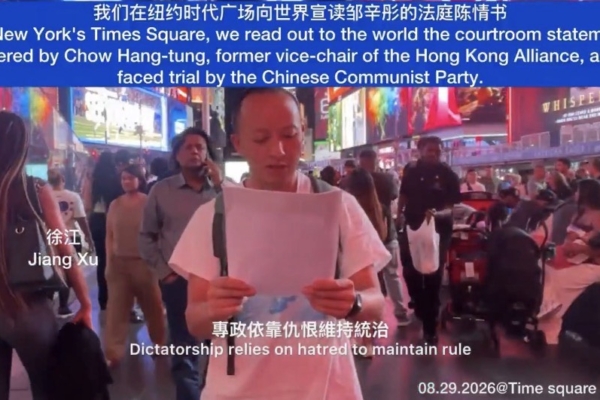
On August 29th, five Chinese democracy activists spontaneously gathered at Times Square in New York to publicly read a plea made by Hong Kong barrister and democracy advocate Zou Xing Tong prior to her sentencing at the High Court in Hong Kong. The day before, Zou Xing Tong was repeatedly interrupted by Judge Li Yun Teng while presenting her plea in court, preventing her from presenting it in its entirety.
For these five Chinese democracy activists, Times Square is not only a famous tourist landmark in New York, but also a public space to voice their concerns to the international community. Bringing Zou Xing Tong’s plea to New York is a way to take an event that unfolded in a Hong Kong courtroom and bring it to a public space outside of Hong Kong, allowing more people to hear about it.
Behind this relay reading is the national security law case that Zou Xing Tong is facing in Hong Kong.
The Hong Kong Alliance in Support of Patriotic Democratic Movements of China (Hong Kong Alliance) was established in 1989, advocating for democratization in China and organizing candlelight vigils annually on June 4th in Victoria Park to commemorate the Tiananmen Square protests. Its five main goals are to “release democratic activists, vindicate the 1989 democratic movement, investigate responsibilities for the Tiananmen Massacre, end one-party rule, and build a democratic China.”
Following the implementation of the National Security Law in Hong Kong by the Chinese Communist Party in 2020, the political and civic space in Hong Kong rapidly contracted. The Hong Kong Alliance was forced to disband in 2021, with several core members being arrested.
On August 21st of this year, the High Court of Hong Kong ruled that the Hong Kong Alliance, along with Zou Xing Tong and Jimmy Lai, were guilty of “inciting subversion of state power”; vice-chairman Albert Ho had previously pleaded guilty. One of the key points of the case was the Hong Kong Alliance’s persistent advocacy for “ending one-party rule.” The court considered this advocacy as aiming to terminate the Communist Party’s leadership, violating the National Security Law in Hong Kong by inciting subversion.
On August 28th, Zou Xing Tong made a plea before her sentencing. She summed up the 206-page court ruling as “being guilty for pursuing democracy.” She stated that she would not apologize for upholding democratic ideals and that she “does not regret at all” the path she has walked alongside the Hong Kong Alliance and the people of Hong Kong.
She further expressed that one’s thoughts and beliefs should not be dictated by laws, and even if the law cannot accommodate her beliefs, she would rather be a “criminal” than betray her conscience. When asked if she still believed her actions were correct and had no regrets, she replied, “Absolutely.”
This case has drawn attention from the international community. The United States, European Union, United Kingdom, Australia, France, and Germany have expressed concerns or criticisms regarding the verdict, with the governments of France and Germany demanding the release of Zou Xing Tong and others in Hong Kong.
Currently, the sentences of Zou Xing Tong and others have not been announced, with the judge aiming to deliver the sentencing within two weeks. Under the National Security Law in Hong Kong, if the offense of “inciting subversion of state power” is deemed to be “severe,” the punishment could range from a minimum of 5 years to a maximum of 10 years of imprisonment.
Meanwhile, in New York, the plea that was not fully read in the Hong Kong courtroom was delivered at Times Square. On August 29th, Li Yonghong, Yang Ling, Lin Shengquan, Xu Jiang, and Du Hairong took turns reading out paragraphs of Zou Xing Tong’s plea, sharing the words she was unable to fully express in the Hong Kong courtroom with the world in New York.