
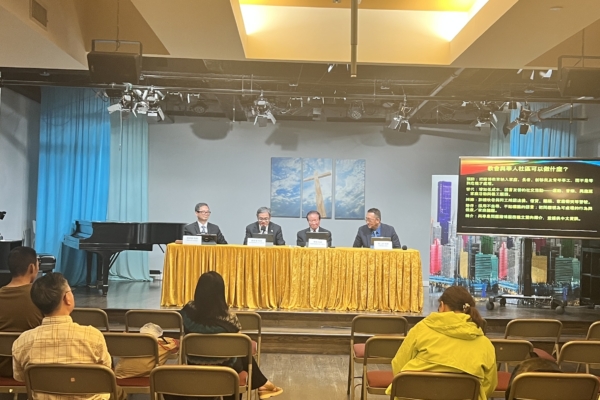
The gambling industry in New York is expanding, and the long-standing penchant for gambling among the Chinese community is raising concerns about the impact it may have on Chinese immigrant neighborhoods and how to prevent its negative effects. Recently, the New York Chinese Workers’ Union’s Ethics and Religious Freedom Committee and the New York Gospel Outreach jointly organized a political and community forum titled “The Influence and Consequences of Gambling in the Chinese Community” in Flushing on August 29. Four pastors analyzed the negative impacts of gambling from the perspectives of families, immigrants, youth, and the community.
Chairman of the Ethics and Religious Freedom Committee and former U.S. immigration officer, Chen Chi, shared a recent case involving a Chinese woman studying in the United States on an expired F1 visa. She was arrested by ICE at the airport and awaits deportation. During her plea for help, she revealed that her husband, who had developed a gambling addiction, had squandered all their wealth, leaving her alone and desolate. Had it not been for her husband’s gambling that led to financial ruin, she would not have faced such a predicament. As she faces deportation, her husband and child, who are on dependent F2 visas, also face the risk of being deported.
Citing data from the New York State Office of Addiction Services and Supports (OASAS), the forum highlighted that New York has more varieties of legal gambling activities than any other state, with the expansion of commercial casinos since 2013 and the legalization of mobile sports betting in 2022, which has transformed gambling from “going to a casino” to “betting on phones anytime.” OASAS’s risk framework also indicates that Asian populations, low-income individuals, those with lower educational levels, unemployed individuals, and those in resource-deprived areas may be more vulnerable to gambling harm.
Gu Qiwai, the chairman of the Chinese Workers’ Union, mentioned that at the end of last year, three gambling licenses were issued in New York City, bringing substantial tax revenue to the government. He pointed out that the growth of the gambling industry in the U.S. is linked to an increase in immigration, which has provided a customer base for the gambling industry. However, the problems caused by gambling are pervasive, leading to significant social costs.
Committee member Yang Donglong asserted that gambling involves the irrational transfer of money, swiftly depleting the wealth accumulated by a family over years. Gamblers may borrow money under the pretext of investments or family emergencies, and if relatives and friends continue to lend money without understanding the real situation, it could further entrench the gambler in debt. He emphasized, “Gambling reflects the sinful nature of humanity, with many examples of families destroyed and lives lost.”
Chen Chi pointed out that the allure of “getting rich quick without putting in effort” incentivizes some people to turn to gambling. The increasingly blurred line between electronic games and gambling elements poses a risk, especially for young new immigrant adolescents facing language, academic, and adaptation pressures. Once they become addicted to games or gambling, the problems may exacerbate further. He questioned, “Does ‘government approval’ equate to being right? If not, then the government is also complicit in this sin.”
Committee member Zheng Lixin highlighted that greed is the root of all evils, and gambling exemplifies human greed and sinfulness. Parents’ addiction to gambling not only leads to debts and marital conflicts but also results in children lacking companionship and discipline. “The losses are not only personal but also affect the next generation, with society ultimately bearing the costs.”
The forum advocated for raising awareness of the dangers of gambling within family, elderly, new immigrant, and youth services. It suggested increasing low-cost social activities like sports, music, hobby classes, and volunteer work. Additionally, families should be assisted in recognizing signs of “chasing losses,” borrowing, concealment, and family conflicts, with referrals to professional counseling when necessary.