
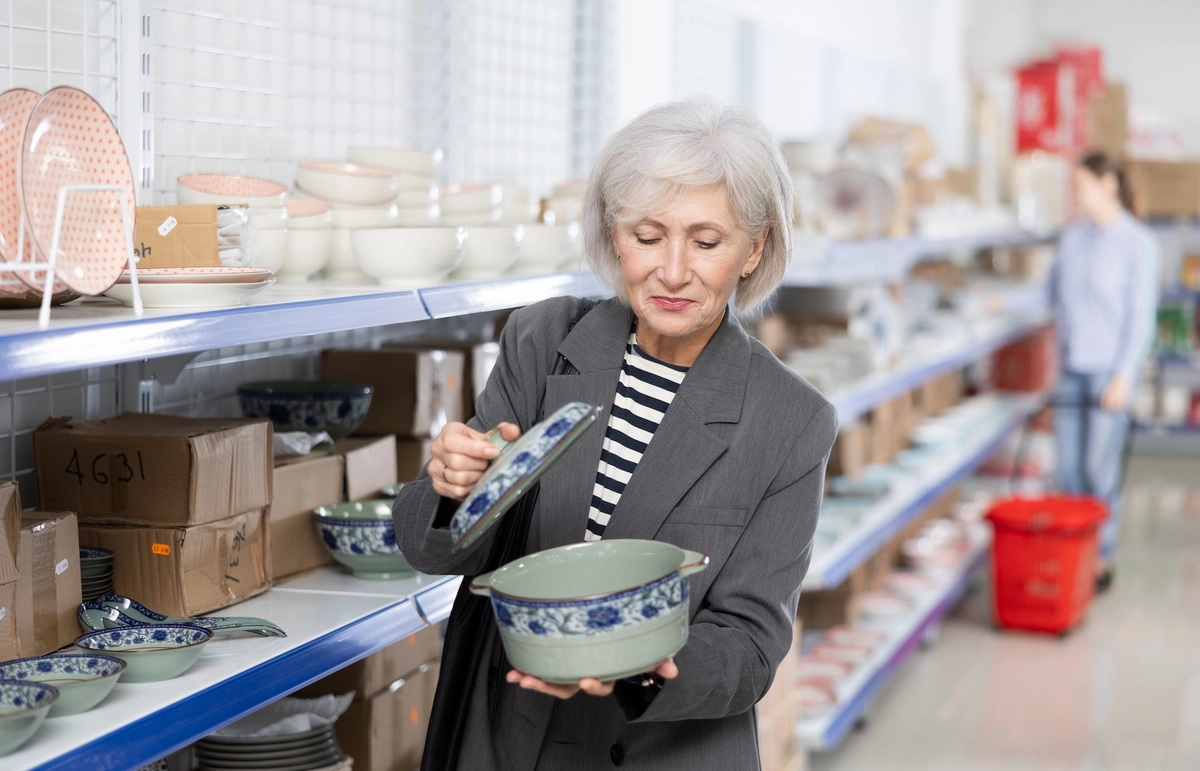
When it comes to “tidying up the room,” for some reason, many otherwise sensible people’s first reaction is not to clean up, but to go shopping. Walking into a home goods store with the intention of buying just a couple of storage boxes, one might end up considering a wicker basket, drawer dividers, stackable transparent containers, and even a label maker that seems like a “must-have” for organizing experts.
After coming back to reality, the credit card bill may suddenly look quite “cluttered.” However, organizing a house doesn’t necessarily require spending a lot of money. The most effective storage solutions are not the ones that look the neatest in photos, but the ones that you actually are willing to use every day.
Some people who are great organizers rarely buy storage products at full price; they prefer browsing second-hand shops. It’s not settling for less, but rather realizing that many items from yesterday can be just as effective for storage as today’s expensive “professional organizing gadgets.”
How much does a nice woven basket cost these days? Sometimes, seeing the price tag might make you consider that using a blanket in a shopping bag could work just fine.
Second-hand shops often offer a variety of sizes of wicker and woven baskets. They may not match in color or shape, but when placed on a bookshelf or under a table to store blankets, miscellaneous items, or children’s toys, they are more than adequate.
A home is meant for living, not to resemble a photo shoot for a home goods catalog. Before “organization” became a popular social media topic, people were already using glass jars to store flour, sugar, buttons, nails, and cotton balls, so some of the so-called organizing wisdom isn’t really new at all.
Glass jars in thrift stores often cost just a few dollars. After cleaning them thoroughly, they can be used to store food or small items like stationery, cotton swabs, and various odds and ends. Moreover, glass is durable, easy to clean, and allows for quick visibility of contents, eliminating the need to open multiple containers when searching for something.
Wooden crates are also worth considering at second-hand shops. While new wooden crates labeled as “vintage” or “country style” can come at a premium, older crates are often plentiful. As long as the structure is sturdy and they are cleaned up nicely, they can be used to store shoes, magazines, gardening supplies, or children’s toys. Some of these have lasted for many years, proving their durability.
Trays don’t have to be strictly for serving breakfast. Placing one next to your coffee maker provides a designated spot for coffee beans, sugar canisters, and cups. In the bathroom, a tray can organize perfumes and skincare products, clearing up counter space. Similarly, at the entrance, keys, sunglasses, and mail no longer need to vanish daily with a tray providing designated spots.
In reality, nothing has gone missing; what used to be called “mess” now looks a bit more like a “set” when placed on a tray. This could be one of the simplest and cheapest visual organization methods.
Lazy Susans used to be common on dining tables, but now they are found in cabinets, refrigerators, bathrooms, and even craft rooms. Particularly in deep cabinets, a Lazy Susan eliminates the need to move multiple items in front to reach something at the back; a simple spin brings out the long-hidden bottle of sauce effortlessly.
Sometimes, organization isn’t about needing more space but about making it easier to access your existing items. One of my favorite thrift store finds for “storage” is not even a storage item—it’s just a beautifully crafted ceramic bowl.
Placed by the entrance, it can hold keys; on a vanity, it can store jewelry and spare change; in the kitchen, it can temporarily hold coupons, receipts, and those little notes of “things to sort out later.”
Often, a messy home is not due to having too many things but because the small items have no fixed place. Providing them with a bowl might solve half the problem.
Browsing second-hand stores comes with a danger: intending to solve clutter issues but ending up bringing back a load of new clutter. So, affordability should not be the sole reason for purchase.
Consider looking at glass, wood, and metal products. These items, often durable and long-lasting, have stood the test of time. If an item is cracked, wobbly, unstable, or impossible to clean thoroughly, even if it’s cheap, it’s best to leave it in the store.
Otherwise, a somewhat awkward outcome may arise: buying a bunch of items that need organizing in the name of organizing your home.
In conclusion, organizing isn’t about cramming everything in the house into boxes of the same color or buying an entire set of “organizing gadgets.” True usefulness in organizing is making items easier to find, grab, and return, creating a more comfortable living space.
Sometimes, the most suitable organizing tool isn’t on the beautifully displayed wall at a home goods store but on an inconspicuous shelf in a thrift shop with a $2 price tag.
The savings will not only be in space but also in money.