
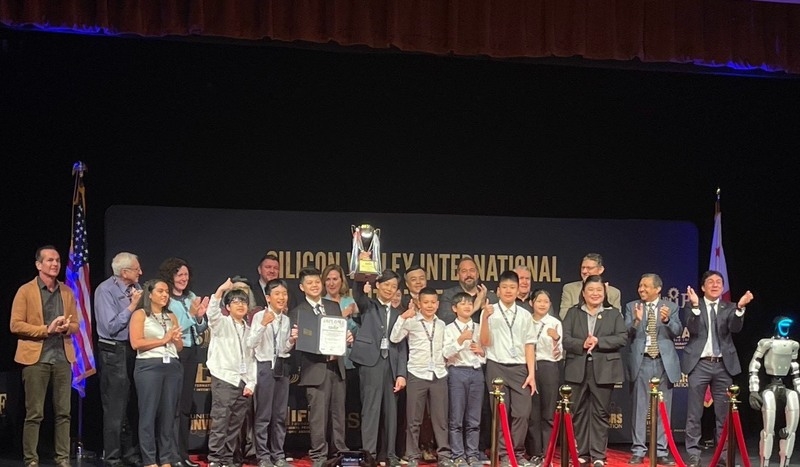
At the Silicon Valley International Invention Expo in the United States, Taiwan entered 35 works, winning 24 golds, 8 silvers, and 1 bronze, setting a new record for the number of gold medals. Among these, the “AI-driven Allergen Detection System” invented by a group of Taiwanese students stood out and won the top prize at the event, the highest honor. Additionally, 10-year-old student Hsu Ting-Wei’s “Artificial Electronic Nose” clinched the Best Invention Award from the International Federation of Inventors Associations (IFIA).
According to reports by the Central News Agency, judge Matt Nuccio stated that many of Taiwan’s inventions have a clear focus on wanting to “help others and protect others” through technology.
The event, formerly known as the Pittsburgh International Invention Expo, was held from the 14th to the 17th of the month at the Santa Clara Convention Center in California, with over 30 countries participating in two categories: general inventors and youth aged 7 to 18.
At the event, the teams were awarded gold, silver, and bronze medals. Taiwan’s 35 entries brought home 24 golds, 8 silvers, and 1 bronze. Nearly every team received an award, and the number of gold medals broke Taiwan’s record since participating in the Silicon Valley International Invention Expo in 2018. In the youth category, the results were particularly impressive, with 16 entries winning 14 golds and 2 silvers, with all entries receiving awards.
During the awards presentation, the host even exclaimed, “The number of gold medals for this team is astonishing.”
Chairperson of the judging panel, Amin Ghafooripour, commented that Taiwanese participants show significant progress every year, and he was honored to witness such growth. He noted that this year, many young inventors from Taiwan achieved what seemed impossible, truly turning the impossible into the possible.
When asked about the differences between Taiwan’s inventions and those of other countries, Ghafooripour observed some interesting aspects, noting a divergence in innovative direction compared to other countries.
Ghafooripour further noted that an invention’s practicality is crucial, emphasizing its application in real life to enhance safety, create a better environment, and ultimately improve quality of life.
Nuccio also expressed that Taiwanese inventors, despite their young age, demonstrate outstanding levels of inventiveness, showing enthusiasm and excellence in their work.
According to Nuccio, the judging panel observed that in the U.S., many team inventions are market-oriented, designed to be sold in the market after creation. Conversely, many inventions from Taiwan focus more on “helping the public and enhancing safety,” such as fire safety and various designs to protect human safety.
The Silicon Valley International Invention Expo concluded on the 17th with the presentation of first prize, second prize, IFIA Best Invention Award, World Intellectual Property Organization (WIPO) Award, and special awards.
The “Sensory Detective GO,” designed by a team of Taiwanese students, received the first prize in the youth category (Junior Innovators Olympics), the only first prize winner selected by the judging panel from numerous entries. The team received cheers as they went on stage to receive the award.
“Sensor Detective GO” is an application designed as an active health protection system for children, the elderly, and individuals with allergies. By integrating detection, warning, recording, and smart home response, it helps users identify allergen risks earlier, reduce accidental exposure, and create a safer daily health protection network.
Additionally, the jointly designed “Rhythmic Tank” by Taiwanese American students and the “Rolling Learning Platform” by the team from Taipei Municipal Jianguo High School were awarded second prizes. In the general inventor category (adult professional category), Bessy Green Energy Technology from Taiwan received the WIPO Award.
Hsu Ting-Wei, a 10-year-old student from Kang Chiao International School, won a gold medal on the 15th with his “New Artificial Electronic Nose.” His invention also received the IFIA Best Invention Award on the 17th.
The “New Artificial Electronic Nose” is an intelligent, non-contact inspection platform that integrates real-time air sampling systems, gas chromatograph-mass spectrometry, and AI-based odor recognition technology. It can be installed, for example, behind X-ray baggage inspection equipment at airports.
Ghafooripour mentioned Hsu Ting-Wei, stating that the judging panel awarded him not because of his age but because they genuinely recognized his efforts, commenting that they believe his invention has practical value and left a profound impression on them.
Hsu Ting-Wei told the Central News Agency that his passion for invention stems from the belief that technology can change lives. He enjoys creating inventions that can be applied in daily life and remarked humorously, “I don’t understand overly complicated ones.”
Hsu Ting-Wei also shared that besides the competition, he was thrilled to visit Stanford University during this trip, hoping to study there in the future.