
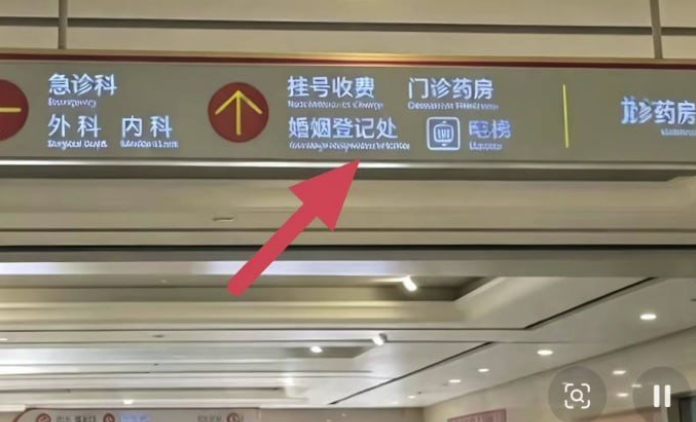
In China, the trend of young people remaining unmarried or marrying late continues, leading local governments to innovate various methods of “promoting marriage” recently. Following the introduction of marriage registration points at tourist attractions, cruise ships, music festivals, and snowy mountains, locations such as banks, hospitals, and subway stations are now also featuring marriage registration points. Officially packaged as the “marriage registration + cultural tourism” new model, a large number of internet users remain skeptical.
The number of marriage registrations among Chinese young people continues to decline. Scholars interviewed believe that authorities have been lowering the “threshold” for marriage registration, but the real-life pressures young people face such as employment, housing, childcare, and education costs have not alleviated, maintaining concerns about marriage.
On August 14, the news “Marriage certificates can now be obtained at subway stations” trended on Weibo. Mainland Chinese media reported that the Fengxi County Marriage Registration Office in Hefei, Anhui, is located at the Happiness Dam Station on the Metro Line 3, being hailed as China’s first marriage registration point inside a subway station. Prior to this, marriage registration points were gradually being established in tourist destinations, shopping malls, and other locations.
Following this news, it sparked discussions. On social media platforms like Douyin and WeChat videos, many netizens questioned whether authorities believed that making marriage registration more convenient would address the fact that young people are reluctant to get married. Some comments ridiculed: “Is not getting married because the registration is hard to find?”, “Is not getting married because you can’t find the Civil Affairs Bureau?”, and some sarcastically remarked: “The low marriage rate must be because the marriage registration office is hard to locate. The country hopes everyone to ‘marry locally’.”
Mr. Zhai, a human rights activist in Wuhan, expressed to reporters that young people’s reluctance to marry is related to economic burdens. Bringing marriage registration points into subways, tourist spots, and even hospitals by the Chinese Communist Party does not touch upon the issue of decreasing marriage numbers. He said, “Do you think showing young people marriage registration points in subway stations would make them get married? Are you taking young people for fools? To encourage young people to consider marriage, you must create conditions for them, provide job opportunities. Current civil servant recruitments favor insiders, creating sham positions.”
On May 10, 2025, the newly revised “Marriage Registration Regulations” by the Chinese Communist Party officially came into effect, achieving “nationwide handling” of marriage registration without the need for a household registration booklet. Despite further streamlining the registration procedures, marriage registration numbers have once again declined this year. Statistics from the Ministry of Civil Affairs indicate that in the first half of 2026, there were 3.275 million couples registered nationwide, a decrease of 264,000 couples compared to the same period last year, representing a decline of about 7.5%.
Scholar Bao Yuning (pseudonym) from Hohhot believes that in recent times, local authorities have been striving to prompt young people to marry by expanding marriage registration points to subways, banks, tourist sites, and hospitals, indicating a lack of alternative solutions to address declining birth rates.
He argues that while the Chinese Communist Party may control many aspects of society, they cannot dictate individual desires for marriage and childbirth. He said, “You can control speech, manipulate public opinion, restrict emigration, but you cannot control marriage and having children. There are aspects they (the government) cannot control, including suicide as a form of protest. The fact that people are not getting married is also a silent resistance against the ruling power of the Chinese Communist Party.”
Bao Yuning added that for many young people, marriage is not just about obtaining a document but signifies a series of long-term burdens concerning housing, weddings, childbirth, childcare, and education. If income and job prospects are unstable, merely increasing marriage registration points is unlikely to significantly alter young people’s marriage choices.
In recent years, issues such as declining birth rates and an aging population continue to worsen in China, prompting a shift in the Chinese authorities’ approach from restricting childbirth to encouraging marriage and childbirth. Mr. Xu, a scholar from Shandong, stated that transitioning from “birth restrictions” to “promoting marriage and childbirth” indicates that China’s population issues have reached a point that must be addressed. He said, “The Chinese Communist Party is attempting to stimulate marriage and childbirth through subsidies and promotions. As you can see, there is widespread mockery online. Netizens have already seen through it, seeing the future, they are unwilling to become tools for the survival of the CCP regime. This generation of young people no longer blindly believe in official propaganda; I see this as a form of awakening in a sense.”
From the early days of family planning to the current encouragement of childbirth and prompting of marriage, Mr. Xu believes that this policy shift clashes with the growing emphasis young people place on personal choice. He concluded, “Any governing method that ignores individual well-being and freedom of choice, viewing life only as a means of developing economic benefits, will ultimately be counteracted in the face of modern civic consciousness awakening.”