
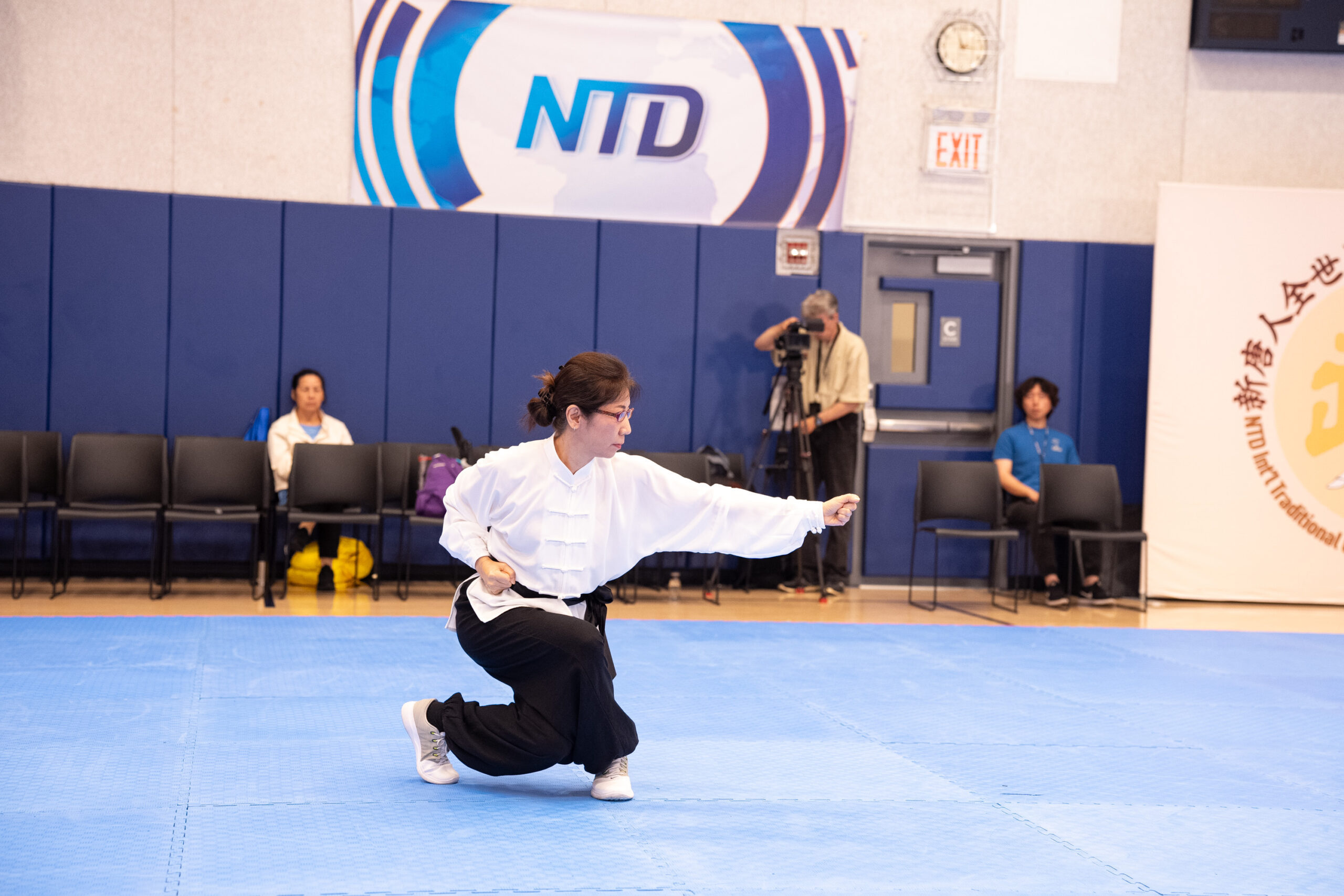
In the just concluded 9th NTD World Chinese Traditional Martial Arts Competition, a female bronze medalist in boxing expressed that traditional things represent a holistic beauty. Another outstanding participant in the tournament believed that traditional martial arts resembled a form of “meditation” within movement, and the pursuit of “martial virtue” was a process of self-dialogue and introspection.
Californian competitor Li Jiexin has been learning martial arts since a young age, but three years ago, she resumed her studies under a new master and began learning a set of traditional Xingyi Quan. Initially, she didn’t grasp much, but through daily practice, she discovered the secrets within.
“The teacher emphasizes the body posture with ‘hands connected to the body, hips connected to the legs.’ I gradually realized that the power is not about the stiff force from your hands or legs. That force feels disconnected. It should come from the entire body – this is something the teacher guides you on, and you understand and comprehend it through practicing, not by just learning a routine online. That would only scratch the surface or maybe even be a modified version of a new martial art,” Li Jiexin shared.
According to Li Jiexin, “Onlookers may enjoy the show, watching how high one jumps or how fast one moves, but all that is just a showy facade. The beauty of traditional things lies in their holistic nature.”
After years of exploration in traditional martial arts, Li Jiexin realized the importance of enduring hardships.
“I never consciously thought about the connection between ‘enduring hardships’ and ‘martial virtue.’ But through years of practice, I gradually came to realize: enduring hardships is crucial. If you want to elevate your level, if you want to raise the standards, enduring hardships is indispensable,” she said.
Taiwanese competitor Gu Kaiwen made it to the finals with her Baguazhang set. Having practiced martial arts for 15 years, with breaks in between, she has now resumed training alongside her work as an architectural designer in the park, which she found greatly beneficial.
“After practicing boxing in the morning, I am more focused at work, and my body feels refreshed and invigorated,” she remarked.
Gu Kaiwen believes that traditional martial arts emphasize efficacy greatly. Although training may seem tedious, it cultivates one’s “mentality,” “endurance,” and “patience.” If you persist, you will definitely reap significant rewards.
“Practicing boxing is somewhat like dynamic meditation, making me gradually pay attention to my body, communicate with it, feel my body, feel that tranquility. I think this aspect is crucial,” she said. “Later, you’ll feel: ‘Oh, I’ve conquered this phase again,’ giving you a sense of achievement.”
Gu Kaiwen believes that “martial virtue” encompasses “introspection” and “self-dialogue.”
“I think the most important aspect of martial virtue is self-dialogue. As long as you know in your heart that you aspire to be good, even if you’re unsure of what ‘good’ entails, you can understand yourself, explain to yourself, figure out where you can improve, or consider someone you dislike, realizing they have their own journey, then you refocus on yourself, paying attention to yourself,” she explained. “I think the ability to introspect is using sports and your body to feel and have a dialogue, which enhances introspective abilities.”
Gu Kaiwen believes that the NTD Martial Arts Competition brings together participants from various places with traditional values, providing an excellent opportunity for mutual exchange and learning.
“Because traditional martial arts schools are all different, unlike modern martial arts that are all standardized and scored,” she said. “Each traditional martial arts school has its unique style. By observing what other participants do, you may find connections or differences, which can be a reference point for you. Therefore, this is a great platform for learning from one another.”