
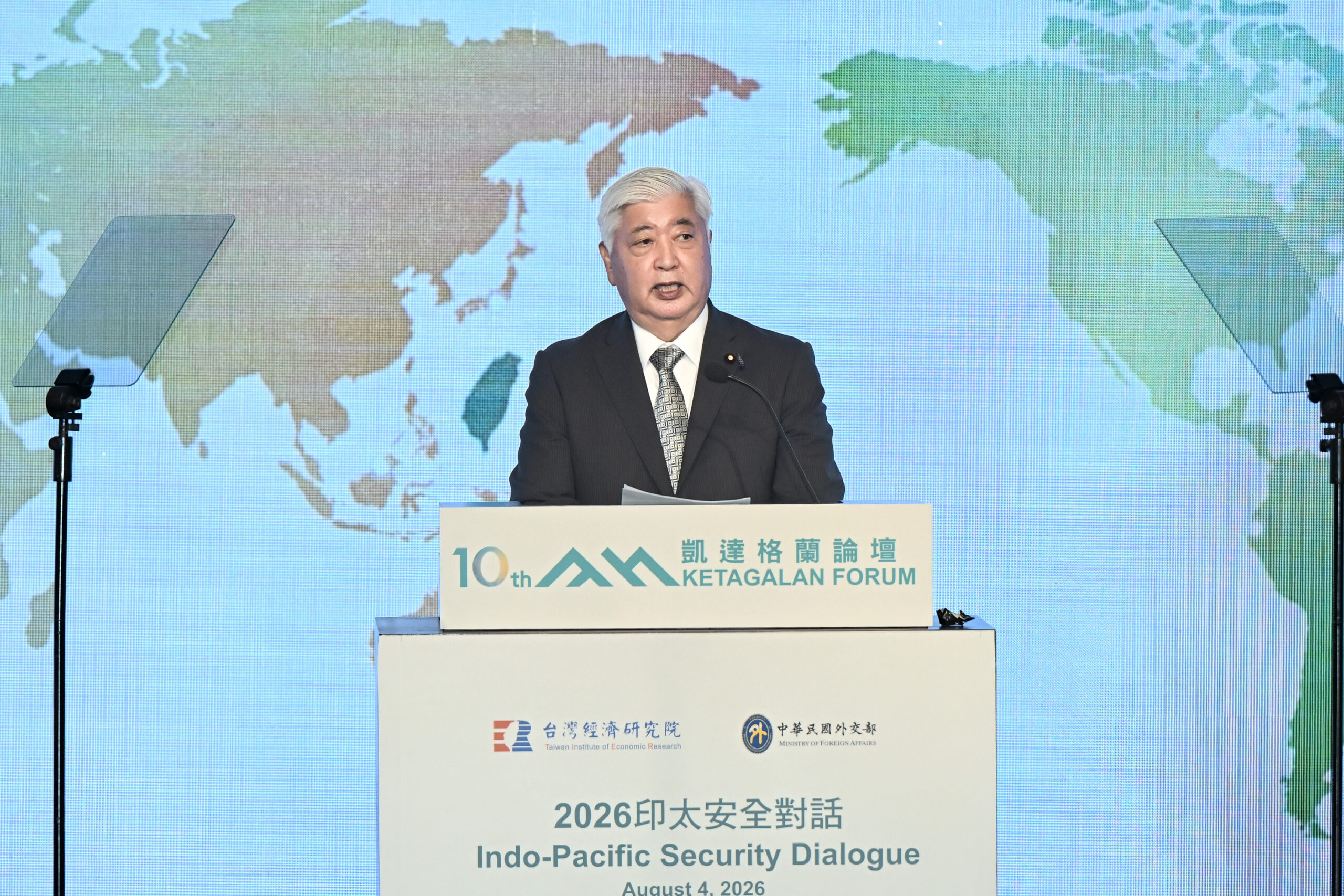
Former Japanese Defense Minister Moto Tanaka recently warned during his attendance at the “Ketagalan Forum: 2026 Indo-Pacific Security Dialogue” in Taipei that the Chinese Communist Party (CCP) is using legal means to carry out “extraterritorial repression,” threatening overseas dissidents, ethnic minorities, and expanding criminal jurisdiction to other countries, which constitutes an infringement on the sovereignty of other nations.
Tanaka urged the international community to pay attention to the threat posed by the CCP’s “extraterritorial repression” to the sovereignty and democratic freedoms of other countries and to counteract it through intelligence sharing, diplomacy, and economic means.
Reported by Japan’s “Nikkei Shimbun” on August 7, former Japanese Defense Minister and senior member of the Liberal Democratic Party, Moto Tanaka, strongly criticized the CCP’s so-called “National Unity and Progress Promotion Law” introduced in July. He pointed out that if measures are not taken now, the CCP may further escalate its exercise of criminal jurisdiction in other countries.
He strongly criticized the CCP’s “National Unity and Progress Promotion Law” for infringing on Japan’s sovereignty and called for it to be addressed as a defense issue.
Tanaka is one of the co-chairs of the Inter-Parliamentary Alliance on China (IPAC), and he attended and spoke at the “Ketagalan Forum: 2026 Indo-Pacific Security Dialogue” held in Taipei.
The 2026 IPAC Summit was organized by the Taiwan Ministry of Foreign Affairs and civil society groups. President Tsai Ing-wen also attended the summit and delivered a speech.
In his speech, Tanaka pointed out that the CCP intimidates ethnic minorities and dissidents who have fled abroad, referring to these actions as “extraterritorial repression.”
He warned that the “extraterritorial repression” would violate the sovereignty of other countries.
Talking about the attack on senior Japanese media personality Akihio Yabe in Taiwan, Tanaka emphasized that the CCP claims criminal jurisdiction over Japan, Taiwan, and even all the speakers at the seminar.
He also stressed the need for IPAC to construct comprehensive strategic measures to counter the CCP’s actions, including intelligence sharing, and employing diplomatic and economic means to protect victims of “extraterritorial repression.”
According to reports from the “Economic Daily News” and other media, Taiwan’s Minister of Foreign Affairs Joseph Wu explained the attack on Akihio Yabe during a meeting with IPAC representatives on July 7.
Wu stated that the CCP uses the so-called “unity” to enforce ideological control and oppress dissenters; they exert oppression through legal frameworks and extend their long-arm jurisdiction overseas, turning it into a tool of tyranny.
He mentioned the violent attack on Akihio Yabe in Taiwan, emphasizing that the incident highlights the CCP’s global transnational repression and its expansion of authoritarian influence through violent means.
Wu stated that threats from the CCP are not limited to military aspects but also include economic reliance, disinformation manipulation, psychological warfare, legal battles, gray-zone operations, and transnational repression. This poses a test to democratic countries’ resilience, and they need to warn each other and support each other.
Implemented on July 1, 2026, the CCP’s “National Unity and Progress Promotion Law” was harshly criticized by IPAC for severe violations of basic human rights and was seen as a means of the CCP’s “red terror.”
BBC reported the attack on Akihio Yabe as the first case of “transnational repression” violence by the CCP since the implementation of the “National Unity and Progress Promotion Law.”
The Inter-Parliamentary Alliance on China (IPAC) is an international organization established on June 4, 2020, composed of more than 300 bipartisan parliament members from 44 countries, including the U.S., UK, Japan, and the EU Parliament. Its objective is to reform and address policies towards China.
US Secretary of State Mike Pompeo, Japanese senior politician Moto Tanaka, among others, are the co-founders and co-chairs of IPAC.
Prominent figures like Chairman of the U.S. House Foreign Affairs Committee Michael McCaul, the former Prime Minister of Finland Sanna Marin, former Deputy Prime Minister of Canada Chrystia Freeland, and Taiwan’s Minister of Foreign Affairs Joseph Wu attended the 2026 summit.
IPAC believes that the CCP poses an unprecedented threat to democratic systems and values and hopes to safeguard international order and human rights through cooperation.
During the 2022 summit on September 14, IPAC issued a statement advocating for Taiwan’s participation in international affairs, such as joining the World Health Organization (WHO).
In 2024, IPAC held its first summit in Taipei, where the CCP used intimidation and pressure tactics to prevent some country representatives, as well as members of Taiwan’s Kuomintang party, from attending.
IPAC’s firm stance against the CCP has made it a thorn in the CCP’s side, facing hundreds of cyberattacks from the CCP.
According to Taiwan’s Presidential Office, President Tsai Ing-wen attended the “Ketagalan Forum: 2026 Indo-Pacific Security Dialogue” on August 4, stating Taiwan’s commitment to defending democratic values amid the relentless expansion of CCP authoritarianism.
President Tsai emphasized Taiwan’s role as a beacon of democracy and freedom in the Indo-Pacific region, pledging to protect shared values and regional peace and stability while enhancing defense capabilities alongside democratic partners to create a “non-red supply chain.”
He also expressed Taiwan’s significance as a pillar of democracy and freedom in the Indo-Pacific region, stressing the importance of safeguarding common values together.
At the summit, IPAC issued a statement regarding the CCP’s “National Unity and Progress Promotion Law,” which was introduced in July 2026. IPAC founder and executive director Luke de Pulford presented the statement to President Tsai Ing-wen.
The statement condemned the CCP for serious violations of fundamental human rights following the enforcement of the “National Unity and Progress Promotion Law.” It praised IPAC’s Japanese co-chair Moto Tanaka, executive director Luke de Pulford, and other members for their firm positions.
The statement underscored that the CCP’s law not only infringes on Taiwan’s sovereignty and persecutes religions and ethnic groups but also subjects the peoples of various countries to political scrutiny through transnational repression, creating a chilling effect and being labeled as an evil law.
De Pulford stated that the CCP’s authoritarianism is expanding, and red terror is spreading worldwide. This year’s forum focused on global democratic resilience, countering the invasion of gray-zone coalitions, reshaping non-red supply chains, etc. These topics further reflect Taiwan’s international standing and responsibilities.
The statement from IPAC pledged to continue safeguarding democratic values. Facing threats from the CCP’s “National Unity and Progress Promotion Law,” IPAC refuses to accept united front infiltration and red terror, nor will it stand idly by as the CCP extends its reach to Taiwan or any behavior towards free countries and globally. IPAC will establish more complete preventive, countermeasure, and protection mechanisms to defend freedom of speech and uphold international order.