
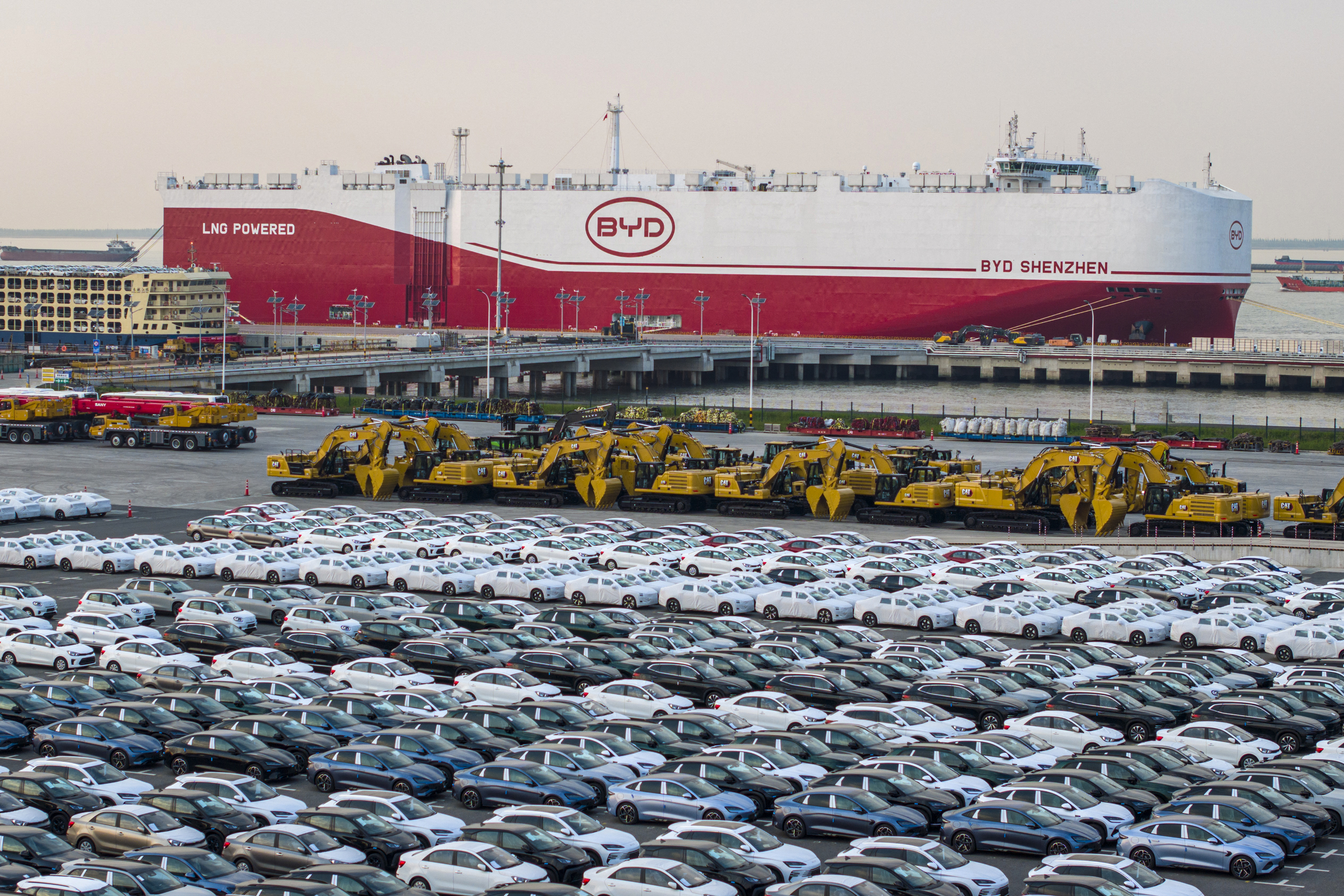
The U.S. military announced on Friday (October 23) that vehicles produced by Chinese electric car manufacturer BYD will be banned from entering the Kadena Air Base in Okinawa, Japan.
According to Yonhap News Agency, the ban will officially take effect on Monday (October 26). It applies to all BYD brand vehicles, including private cars, taxis, delivery trucks, and contractor-operated vehicles.
Security personnel at the base have been instructed to intercept and refuse entry to all BYD vehicles from the effective date.
Lt. Col. Alli Stormer, spokesperson for Kadena Air Base, told Reuters that these vehicles pose “unacceptable and unmitigable risks” to U.S. military personnel and mission execution.
Kadena Air Base is located in Okinawa Prefecture, the southernmost and westernmost part of Japan, adjacent to the East China Sea. It serves as a key hub of U.S. forces in the southwest strategic island chain of Japan and the Asia-Pacific region, deploying a large number of aircraft, radar systems, and ammunition depots, playing a crucial role in regional security operations.
Regarding specific security risks, Anadolu Agency analyzed in a report on Friday that the core concern of the U.S. lies in the cameras and various sensors equipped on modern connected vehicles, which could potentially collect sensitive information around military bases without authorization and transmit military secrets through remote networks.
This move follows the decision by the U.S. Department of Defense in June this year, when BYD, along with Alibaba, Baidu, and NIO, were included in the list of companies that “support the Chinese (Communist Party) military.” BYD subsequently rejected this designation and stated that it would defend its rights through administrative and legal means.
As of the time of publication, BYD has not responded to the ban at Kadena Air Base.
Both South Korea and Japan are core military allies of the United States in East Asia, with approximately 28,500 and 50,000 U.S. troops stationed in each country, respectively. According to Yonhap News Agency, with the deepening concerns of the U.S. military regarding the information security of smart connected vehicles, such bans may not be ruled out from further expanding to other U.S. military bases and facilities in Japan and South Korea in the future.