
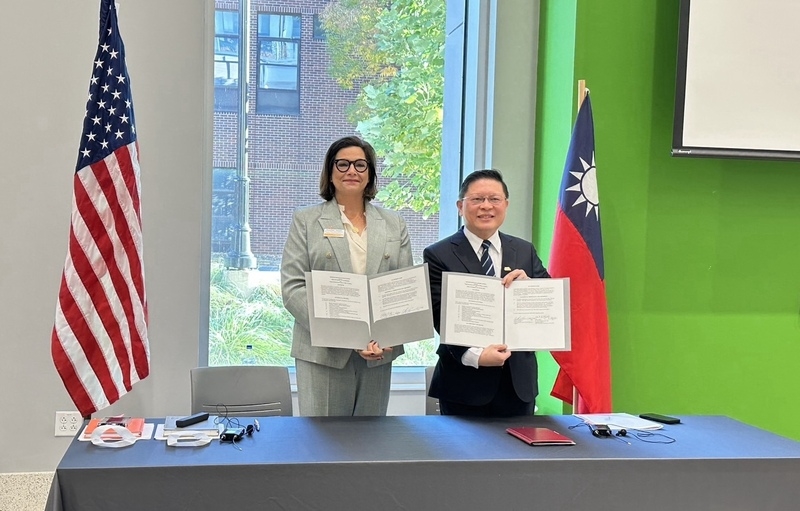
On October 23, 2026, the Representative Office of the Republic of China in Atlanta joined hands with the University of Tennessee Knoxville to hold a seminar and sign an educational cooperation Memorandum of Understanding (MOU). American scholar Bonnie Glaser attended the seminar and called for deeper cooperation between the United States and Taiwan in maritime patrols, cybersecurity, energy resilience, and defense, as well as enhanced coordination with partners such as Japan and the Philippines in the face of the gray zone tactics employed by the Chinese Communist Party.
The Representative Office in Atlanta covers the state of Tennessee. In a press release issued by the Taipei Economic and Cultural Office in Atlanta, it was stated that on the 22nd, the office and the University of Tennessee Knoxville jointly organized a seminar titled “America’s 250th Anniversary and Taiwan’s 30th Anniversary of Direct Presidential Elections: From Shared Values to Strategic Mutual Trust” and signed a Memorandum of Understanding on academic and educational cooperation between Taiwan and the state of Tennessee, paving the way for new opportunities in higher education, academic research, and talent cultivation for both parties.
In his speech, the Director of the Representative Office, Lin Chu-en, emphasized that the partnership between Taiwan and the United States is built on long-term exchanges and mutual trust. Despite the changing international economic and trade situation and regional security challenges, both sides continue to deepen cooperation in economy, technology, and education.
The office pointed out that the first session of the seminar invited former Chairman of the American Institute in Taiwan (AIT) and current Senior Fellow at the Brookings Institution, Richard Bush, to speak on the topic of Taiwan-US strategic mutual trust.
Richard Bush mentioned that although the Taiwan-US relationship is based on common values such as democracy, rule of law, and human rights, the assessment of national interests and risks between the two parties may not always align perfectly. In the face of regional security challenges and the uncertainty of US policy towards Taiwan, Taiwan should continue to strengthen its defense, democratic governance, and societal resilience, and improve policy effectiveness through bipartisan cooperation. Taiwan and the US should also maintain close communication to deepen strategic mutual trust.
The second session featured a special lecture by Bonnie Glaser, Director of the Indo-Pacific Program at The German Marshall Fund, on Indo-Pacific stability and the strategic partnership between Taiwan and the United States.
Bonnie Glaser pointed out that in recent years, China has been continuously using “gray zone” tactics such as maritime patrols, maritime law enforcement, and asserting administrative jurisdiction in the East China Sea, South China Sea, and around Taiwan in an attempt to gradually change the regional status quo without triggering large-scale military conflicts.
She stressed that the US and Taiwan should deepen cooperation in maritime patrols, cybersecurity, energy resilience, and defense, and strengthen coordination with regional partners like Japan and the Philippines to jointly safeguard peace in the Taiwan Strait and maintain stability in the Indo-Pacific region.
The seminar also invited other scholars to discuss topics such as democratic governance in Taiwan, challenges from authoritarian China, threats in the gray zone, deterrence defense, and regional security cooperation.
Furthermore, the Representative Office mentioned that the Memorandum of Understanding on academic and educational cooperation between Taiwan and Tennessee was jointly signed by Lin Chu-en and Gretchen Neisler, Vice Provost for International Affairs at the University of Tennessee. The scope of cooperation covers exchanges of students and researchers, sharing of academic and teaching resources, as well as cooperation in degree programs. In the future, deeper cooperation is expected in areas such as Chinese language education, artificial intelligence, semiconductors, and nurturing high-tech talents.
(Source: Central News Agency)