
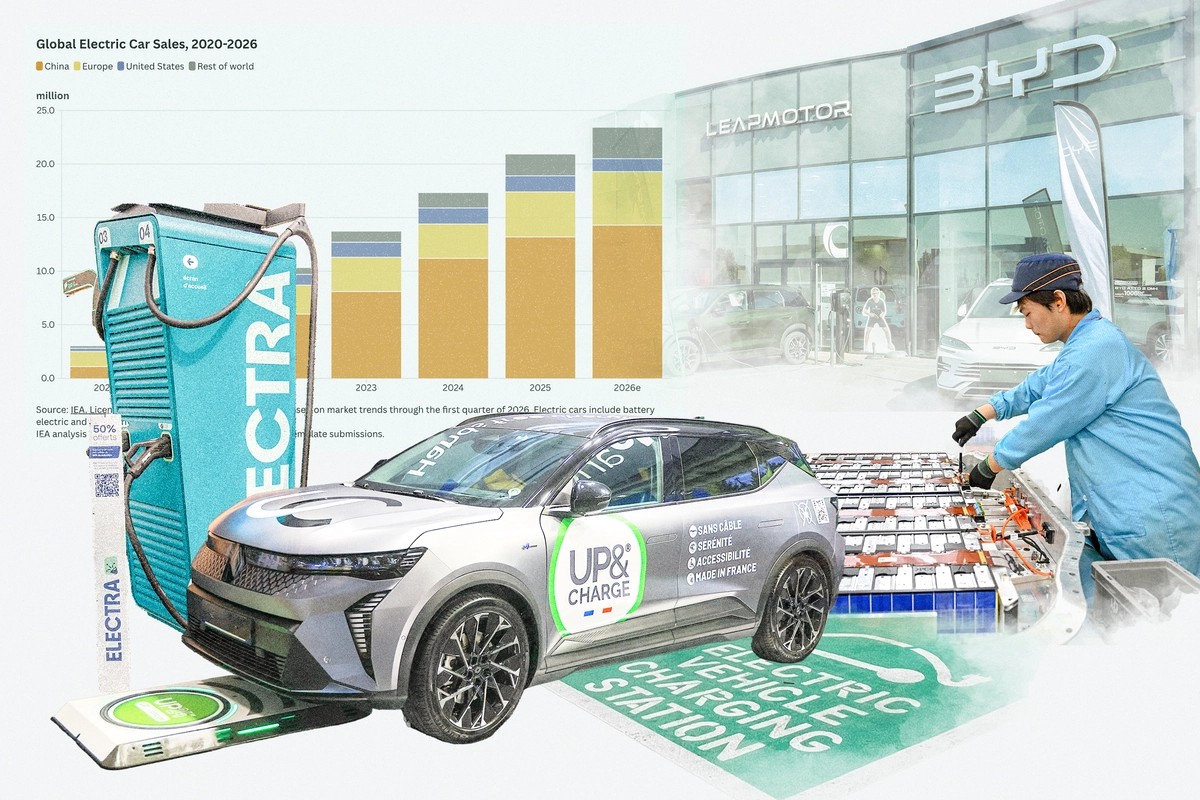
According to data released by the International Energy Agency (IEA) based in Paris, France, global electric vehicle (EV) sales exceeded 20 million in 2025, a 20% increase from 2024, with most of the growth coming from Europe, where sales increased by 30%.
Despite the hot market, European automakers are struggling to profit from the electric vehicle business. Stellantis, the second-largest automaker in Europe based in Amsterdam, Netherlands, reported a write-down of €22 billion ($24.9 billion) of assets as part of its electric vehicle “reset” plan in the latter half of 2025, due to over-investment in electric vehicles.
Europe’s largest automaker, Volkswagen, saw its operating profit margin drop from 5.6% in 2024 to 1.8% in 2025. The company announced an additional layoff of 50,000 employees, accounting for 15% of its total workforce.
European automakers are caught between aggressive Chinese automakers striving to gain market share and lower profit margins, and domestic governments pushing for a comprehensive transition to electric vehicles regardless of consumer preferences.
In response to policy requirements, automakers are investing in new electric vehicle production lines. German Volkswagen alone committed to investing $193 billion in 2023 to electrify its fleet.
Researcher Jeff Degner from the American Institute for Economic Research (AIER) noted that European automakers are more focused on regulatory requirements than customer demand, which is now costing them. The majority of the funds invested in transitioning to electric vehicles are perceived as “government-caused misguided investments.”
Antonio Filosa, CEO of Stellantis, expressed a similar view when announcing the electric vehicle “reset” write-down plan earlier this year. The high estimation of the energy transition speed led to a disconnect between the company’s actual market demands and consumer expectations.
In the United States, automakers Ford and General Motors (GM) have been more cautious in transitioning to electric vehicles, while facing accumulating losses. Both companies have announced significant write-downs, adjusting their commitments to electric vehicles.
Stephanie Valdez Streaty, Industry Insights Director at Cox Automotive in Georgia, pointed out that the pace of electric vehicle adoption and economic benefits in Europe has not met initial expectations. Meanwhile, European automakers are facing increasingly fierce competition in the market.
By May 2026, Chinese automakers had secured 20% of the EU’s pure electric vehicle sales, showing their market share growth and competitive pricing with quality products, notably BYD’s Seagull electric car selling for around $10,000 in China, offering both affordability and quality.
BYD renamed and upgraded the Seagull to Dolphin Surf for the European market, initially priced at $22,400 with a current price of about $25,800. This puts it below similar European models like Citroen ë-C3 starting at around $26,200, but above economy electric models like Romania’s Dacia Spring ($20,100) and France’s Renault Twingo E-Tech ($21,800).
“The most significant trend in the automotive industry this century is the explosive growth of Chinese car exports,” said Garrett Nelson, a stock analyst at the Center for Financial Research and Analysis. China currently exports over 1 million cars per month.
European automakers are facing challenges due to policies driving up production costs. Factors such as shifting from coal to renewable energy sources contribute to high energy costs in Europe, making their cars less competitive in pricing compared to China.
The infrastructure in China for battery raw materials extraction and processing, such as graphite, lithium, and cobalt, has enabled Chinese automakers to dominate the global electric vehicle market, benefiting from economies of scale and the huge domestic market.
The report by Rhodium Group raised questions about the cost advantages of Chinese electric vehicles, highlighting that cost structures involve factors beyond production efficiency, such as vertical integration, supply chain control, domestic market reliance, and supplier financing incentives.
As Europe’s experience showcases, maintaining flexibility is crucial as the electric vehicle adoption rate continues to rise. Automakers can respond to both ongoing consumer demands while investing in electrification.
In the United States, concerns over China encroaching in American markets due to recent trade agreements have raised alarm among industry associations. With the right strategies and resource allocation, American automakers can compete in the electric vehicle market against Chinese counterparts.
The U.S. experienced a significant drop in electric vehicle demand following the expiration of federal tax incentives, indicating that consumer preference for electric vehicles may not align with regulatory expectations. Maintaining flexibility and adapting to market demands will play a crucial role in the electric vehicle industry’s evolution.