
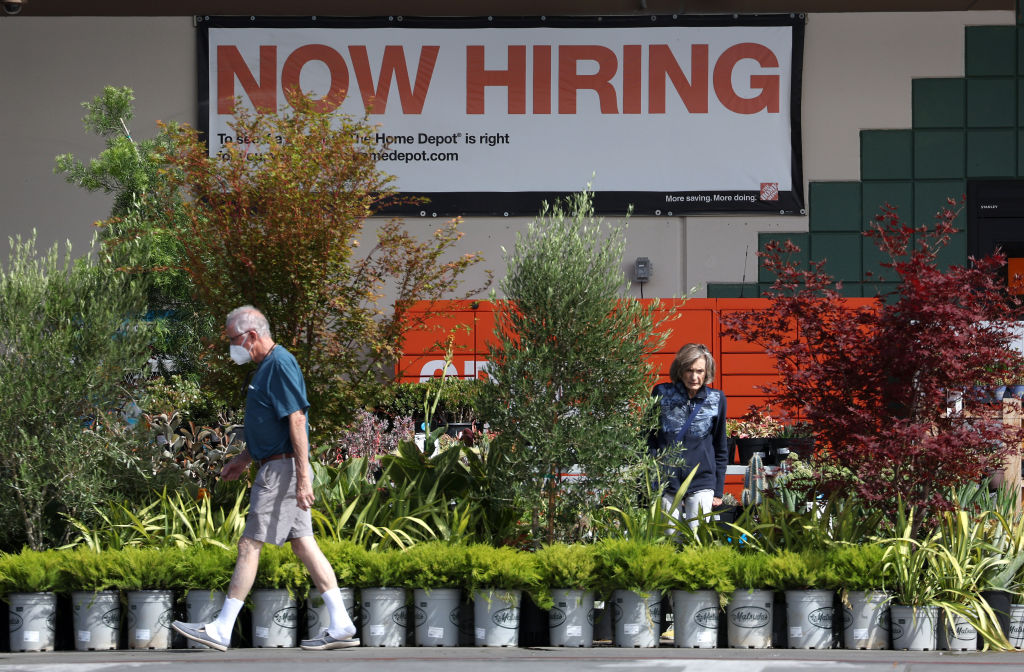
After 18 months of job searching following his unemployment, McCartey, a software engineer in his early 60s, finally took on a part-time cashier job at Home Depot. Data shows that in the United States, unemployed individuals aged 55 to 64 on average remain jobless for about 8 months, nearly 10 weeks longer than the overall average duration of unemployment for all age groups.
According to the Bureau of Labor Statistics (BLS) data from the Household Survey released on October 2nd, there were around 563,000 unemployed individuals aged 55 to 64, with an average unemployment period of 34.9 weeks, compared to the overall average of 25.4 weeks for all unemployed individuals, and 27.6 weeks for those aged 45 to 54. Within this age group, there are about 173,000 individuals unemployed for over 27 weeks, approximately half a year.
Differentiating by gender, the average unemployment duration for males aged 55 to 64 is 40.6 weeks, while for females it is 26.5 weeks.
In the same dataset, the median unemployment duration for individuals aged 55 to 64 is 11.9 weeks, less than 3 months. This means that half of the individuals in this age group end their unemployment within 3 months, while others experience significantly longer periods of joblessness, thereby raising the average above 8 months.
An article by Business Insider on October 12th noted that despite the employment rate, the situation for older job seekers is not as dire, with a lower unemployment rate compared to younger age groups. BLS data shows that the September unemployment rate for individuals aged 55 and above was 2.6% (seasonally adjusted). The report also highlighted the increasing disparity between the averages and medians in recent months, suggesting that the longest job searches might be further extending.
A Workers Displacement Survey published by the BLS on August 27th revealed that between January 2023 and December 2025, there were 3.3 million employees who had worked in the same position for at least 3 years and lost their jobs due to various reasons like company closures, relocations, insufficient work or job eliminations, representing an increase of 746,000 from the previous survey period (2021-2023).
As of January 2026, the re-employment rate for individuals between 25 and 54 years old was at 72.9%, while for those aged 55 to 64, it was 57.3%. In the previous survey conducted in January 2024, the re-employment rate for individuals aged 55 to 64 was 55.3%.
Business Insider interviewed multiple job seekers above the age of 50 who found it challenging to secure equivalent positions after being unemployed.
Cathy Valentine, a 61-year-old resident of Florida, lost her position as a corporate turnaround executive in 2023. Despite three years of job searching, she currently works as a prep cook in a coffee shop, earning approximately one-eighth of her previous salary.
“I feel like I’ve done everything right, but still hit a roadblock,” Valentine remarked.
Jon McCarty, in his early 60s and residing in Virginia, was formerly a software engineer. After being unemployed in 2022, he spent 18 months searching for similar employment before ending up as a part-time cashier at Home Depot. McCarty mentioned that in his youth, switching jobs usually took around a month, but as he aged, the duration of unemployment has extended, leading him to believe he may never return to his original industry.
Thomas Heep, in his 60s from Denver, has been looking for full-time work since losing his role as an operations manager in April 2025. Finding it difficult to cover his bills, he filed for bankruptcy earlier this year.
Several interviewees expressed concerns that their age influenced their job search outcomes. Heep told Business Insider that even if employers appreciated his resume, they might be hesitant due to his proximity to retirement age, unsure of how long he could stay.
Steven Fielding, 58, living in Washington state and working in tech communications, has faced layoffs over five times during his career and began job hunting again in April of the current year. He noted that multiple job losses have left him with minimal savings and suspects that some employers prefer younger individuals willing to accept lower salaries.
While some studies indicate the existence of age discrimination in hiring, proving it in individual cases remains challenging, as highlighted in the Business Insider report.
On the employer front, a survey conducted by the Transamerica Institute in May revealed that about 89% of employers believed they treated employees of all age groups fairly. The survey involved 1,900 employers and 6,153 profit corporate employees in the fall of 2025.
When asked at what age job applicants are considered “too old to hire,” 63% of employers responded with “it varies,” while 8% were uncertain. Around 30% of employers provided specific ages, with a median of 65 years. In the organization’s similar survey in 2023, the median age was 58 years.
The Age Discrimination in Employment Act (ADEA), passed in 1967, prohibits employers with 20 or more employees from discriminating against individuals aged 40 and above in hiring and other decisions. According to statistics from the Equal Employment Opportunity Commission (EEOC), the agency received a total of 16,353 age discrimination complaints in the 2025 fiscal year, accounting for 18.5% of all 88,201 complaints received. Of the 16,937 age discrimination complaints resolved in the same fiscal year, 67.3% were deemed to lack “reasonable cause” for discrimination.
For unemployed individuals who have not yet reached the age of 65 and cannot enroll in Medicare, health insurance can be another financial burden.
Under the Affordable Care Act (ACA), individuals purchasing insurance had their premium subsidies expire at the end of 2025. A report from the Department of Health and Human Services (HHS) on June 26 stated that the number of individuals enrolled in ACA health insurance markets decreased from 22.1 million in 2025 to 19.2 million in February 2026, marking a 13% decrease. HHS mentioned that part of the decline reflected the government’s enhanced scrutiny of subsidy eligibility and removal of improper enrollments.
Given this situation, some financial analysts are now focusing on part-time jobs that offer health insurance. An analysis by the financial website 24/7 Wall St. on October 13 discussed how for older individuals not yet qualified for Medicare and whose primary savings are in retirement accounts, working part-time night shifts with union-backed health insurance at United Parcel Service (UPS) could provide health insurance benefits exceeding the wage itself.
Under the contract signed between UPS and the Teamsters truck drivers union in 2023, new part-time UPS employees start at $21 per hour, which may increase to $23 per hour later on.