
Hello audience, welcome to “Century Truths”.
In the northeastern region of China, there is a place called Fangchuan Village in Hunchun City, Jilin Province, where you can see three countries at a glance – Russia on the left, North Korea on the right, and not far ahead, the Pacific Ocean known as the “Sea of Japan”.
The Tumen River, which serves as the border between China and North Korea, flows out from Fangchuan Village, and only 15 kilometers to the mouth of the river to the Pacific Ocean. However, these last 15 kilometers of the river are the border between North Korea and Russia, preventing Chinese merchant ships from truly reaching the ocean from here.
An incident on April 21, 2026, once again struck a nerve with the Chinese people.
On that day, the cross-border highway bridge linking Russia and North Korea over the Tumen River officially connected, and this new bridge, lower than an old railway bridge previously built by Russia and North Korea, almost completely blocked the path for Chinese merchant ships to reach the Pacific Ocean via the Tumen River.
Just two years ago, Beijing once proclaimed to start “constructive dialogue” with Russia and North Korea on the issue of “Chinese ships going to sea through the Tumen River”. But what happened? The dialogue had no result, yet Russia and North Korea managed to finish a new lower bridge across the river.
Why did Russia and North Korea lock down China’s only northeastern seaway?
Today, let’s take a look at the hidden truths of Northeast Asia geopolitics within the last 15 kilometers of the Tumen River.
To understand China’s current predicament at the Tumen River, we need to go back to the mid-19th century.
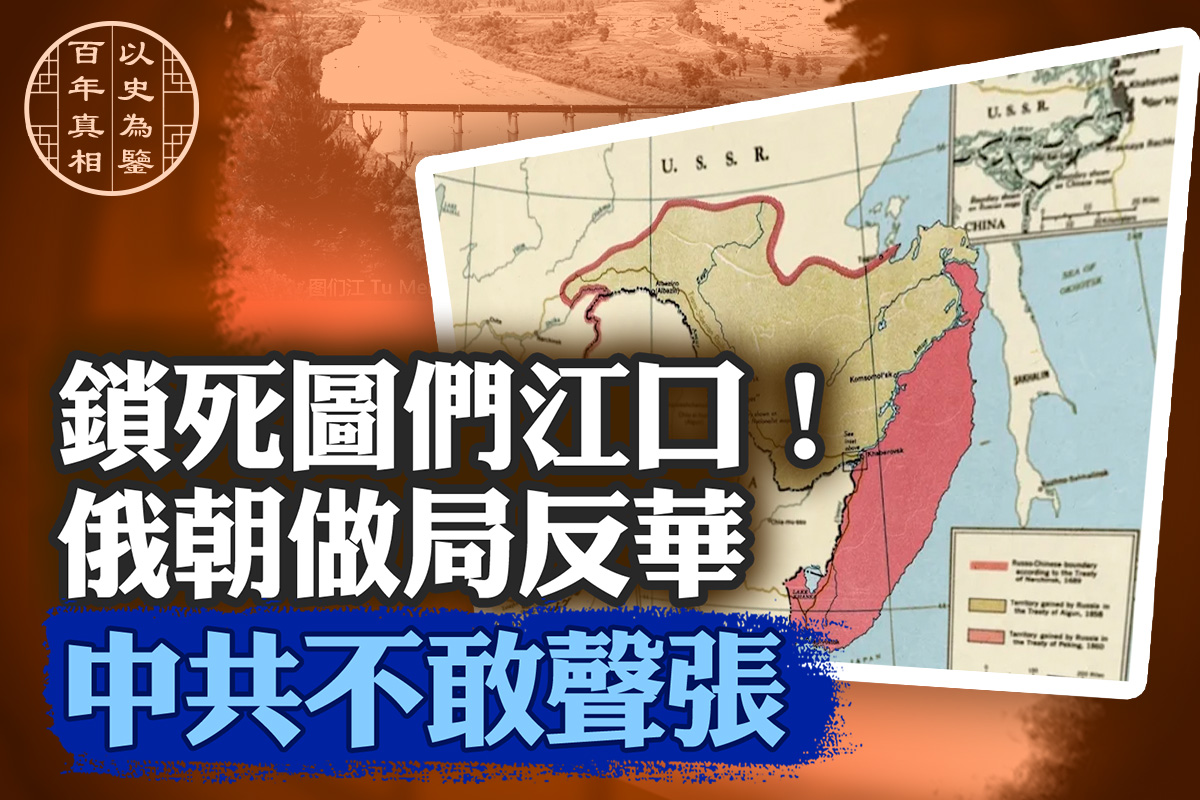
During the Qing Dynasty, Northeast China originally had a vast coastal area, including what is now Vladivostok, known as Primorsky Krai, Russia’s Far East region. However, fundamental changes happened in the mid to late 19th century.
From 1858 to 1860, Tsarist Russia forced the Qing government to sign unequal treaties like the Aigun Treaty and the Beijing Treaty, seizing a large area of northeastern Chinese territory, including about 600,000 square kilometers north of the Heilongjiang River, south of the Wusuli River, and about 400,000 square kilometers east of the Ussuri River. Critically, the northern bank of the mouth of the Tumen River’s last 15 kilometers was also ceded to Russia under the Beijing Treaty.
Although the Qing government later regained the right for Chinese ships to pass through the mouth of the Tumen River through the Treaty of Peking in 1886, the sovereignty along the last 15 kilometers of both riverbanks belonged to Russia and North Korea, respectively.
The direct result of these treaties was that China lost its natural outlet to the Sea of Japan. This was not just a change in territory, but a profound alteration in the geostructural landscape.
Moving into the 20th century, after the collapse of the Russian Empire, the Soviet Union inherited this geostructure.
During the entire Soviet era, the Sino-Soviet border issue had long-standing and complex disputes. Despite negotiations and communications between the two sides in different historical periods, control over the lower reaches of the Tumen River did not fundamentally change.
With the outbreak of the Korean War in 1950, the Soviet government built a railway bridge named the “Sino-Soviet Friendship Bridge” on the Tumen River to deliver military supplies to North Korea. This bridge only had three navigable arches, with a height of about 9.6 meters, allowing only small fishing boats weighing under 300 tons to pass through, effectively blocking large Chinese merchant ships, essentially sealing off the only seaway for Chinese goods in Northeast China.
After the Soviet Union dissolved in 1991, China entered a rapid development phase following reforms and opening up. In the 1990s, Jilin Province hoped to open the mouth of the Tumen River to the sea to achieve a “maritime passage”.
Data shows that if the Tumen River were opened, logistics costs in Jilin Province could be reduced by 50%, and trade volume could potentially increase from the existing 20 billion to over 100 billion.
To implement the sea access plan sooner, over the years, the Jilin provincial authorities invested heavily in improving municipal, road, and railway infrastructure in and around Hunchun City and engaged in negotiations with the Russian side. Hoping to cooperate with Russia to jointly operate the mouth of the Tumen River for maritime trade.
Here, we need to introduce a historical background: After the establishment of the People’s Republic of China, it never acknowledged the unequal treaties signed by the late Qing Dynasty with foreign powers. So, until the mid-1990s, the People’s Republic of China and the former Soviet Union, as well as Russia, had never signed any border treaties.
Against this backdrop, after more than three years of negotiations, the Jilin Province and the Russian Far Eastern border region on the opposite side had shown genuine willingness to cooperate and jointly develop a port for sea access.
However, just as the negotiations were progressing smoothly and about to enter the decision-making phase, a piece of news in late 1999 completely reversed the situation.
In December 1999, the then Chinese Communist Party leader Jiang Zemin signed a new border treaty with Russia in secret, recognizing all the unequal treaties signed between the Qing government and Russia, including the transfer of the northern bank of the mouth of the Tumen River to Russia.
A Chinese representative who had participated in negotiations on the Tumen River mouth issue multiple times said in anger, “Every negotiation, we cited historical facts and argued with reason, putting in tremendous effort. Unexpectedly, during that critical meeting, the Russian representatives initially behaved as usual, with a relatively mild attitude, but midway through received an urgent phone call, and upon return, they changed their demeanor, adamantly refusing to cooperate, turning an extremely favorable negotiation for us into a stalemate.”
This representative later found out that Jiang Zemin had signed a territorial treaty with Russia, but at that time, no one from the central Chinese government informed them promptly. Meanwhile, the Russians immediately informed their negotiating team of the news, shifting the Russians from a passive to an active role in the negotiations.
After five years of shouting and massive investment of manpower, resources, and finances into the “Opening-Up and Seaport Development Strategy”, it all turned out to be futile.
Entering the 2020s, there have been new geopolitical changes in the Tumen River region. Russia’s relationship with North Korea has notably strengthened, particularly in energy, security, and border cooperation. According to multiple publicly available reports, Russia and North Korea have advanced new infrastructure projects in the Tumen River area, including highway bridge construction projects.
At the same time, China is also working to cooperate with Russia on the issue of the Tumen River mouth.
On May 16, 2024, Russian President Putin visited Beijing, and in a joint statement released by China and Russia, they proposed “conducting constructive dialogue with North Korea on the issue of Chinese ships sailing from the lower reaches of the Tumen River into the sea”. The statement was seen as a new hope for the “maritime passage” in Northeast China.
However, just as the ink had barely dried on this statement, in June of the same year, Putin visited Pyongyang and reached an agreement with the North Korean authorities, launching the Tumen River cross-border highway bridge project.
The new highway bridge broke ground at the end of April 2025, and on April 21, 2026, the bridge structure was officially connected. According to rumors online, the clearance height of this new bridge is only about 8 meters, 1.6 meters lower than the old railway bridge. This means that the design of the new bridge is even less favorable for large vessels passing under it, further restricting the navigational capacity of the mouth of the Tumen River.
Superficially, it seems like mutual cooperation among China, Russia, and North Korea; however, it actually formed a “double bridge chokehold” where the two low bridges built by North Korea and Russia physically block the maritime passage for Northeast China.
Many Chinese people have long believed that Russia is China’s most crucial strategic partner. Nevertheless, Russia has always harbored deep suspicions toward China, particularly in the Far East region. Because the one thing Russia fears most is a large-scale entry of Chinese power into the Far East.
If the Tumen River were truly opened, what would happen? Chinese cargo ships would directly enter the Sea of Japan. The economic influence of Northeast China would rapidly penetrate into the Russian Far East. The importance of ports like Vladivostok might also decline.
For Russia, this represents a significant strategic pressure. Therefore, from the era of the Russian Empire, to the Soviet Union, to today’s Russia, they have maintained a high alertness toward China’s “maritime dream” in Northeast China.
On the other hand, North Korea is also wary of China. Many Chinese people have a misconception that North Korea entirely relies on China. However, the core survival logic of the Kim regime has always been to avoid being controlled by any major power, including China.
Therefore, in recent years, North Korea has been playing a very typical balancing strategy: relying on the Chinese economy while getting closer to Russia, and attempting direct negotiations with the United States.
The rapid bridge construction by Russia and North Korea is, in fact, a geopolitical statement. Because North Korea does not want a large number of Chinese ships passing through its border waters. Once Chinese merchant ships frequently navigate through, funds, people, and information could massively enter North Korea’s borders, something the highly secluded North Korean regime is sensitive about.
Moreover, the Russia-Ukraine war has rapidly improved Russian-North Korean relations. North Korea is sending troops to support Russia, while Russia is providing energy, food, and military technology to North Korea. Both parties are now entering a state of “quasi-military alliance”.
Although the CCP also supports Russia, it has never dared to openly commit to a “downfall”. This has left Moscow with some dissatisfaction toward Beijing. Thus, the situation today has become very delicate: on the surface, there is “strategic cooperation among China, Russia, and North Korea”; in reality, Russia and North Korea are teaming up against the CCP.
The Tumen River truly pains the Chinese people, not just in terms of geography but also symbolizes a significant historical disparity.
Today, China is already the world’s second-largest economy. It leads globally in high-speed railways, shipbuilding, and port throughput.
The CCP promotes “the rise of a great power” daily. However, in the core position of Northeast Asia, China is still tightly sealed inland.
Surprisingly, blocking China are two countries that the CCP has long supported and assisted. This image seems incredibly absurd.
In fact, behind the Tumen River issue lies the future of the entire Northeast China.
Today, the Northeast is facing severe decline with population outflow, industrial hollowing, economic stagnation, and a massive migration of young people to the south. Northeast revival has been echoed for over twenty years with limited results, primarily due to the geographical bottleneck. Northeast lacks a genuinely free seaport, and goods heavily rely on Liaoning ports for transit, keeping logistics costs high.
If the Tumen River were truly opened, the entire economic landscape of Northeast Asia could be transformed. This is not just a shipping issue but a Northeast Asia power structure issue. Whoever controls the sea outlet, who holds the passage, and who possesses the strategic initiative in geopolitics.
Many Chinese people have been indoctrinated with the belief: “China, Russia, and North Korea share blood as comrades.” But the two bridges on the Tumen River have allowed many to see for the first time: in international politics, there are no permanent friends, nor free friendships. When interests truly clash, even the closest “comrades” might immediately turn against each other.
The Tumen River is like a mirror, reflecting the most genuine geopolitics of Northeast Asia and exposing the huge chasm between China’s foreign narrative and reality.
What is most regrettable is that – China is only 15 kilometers away from the Sea of Japan, yet may never truly reach it.
Well, that concludes today’s program. If you enjoyed “Century Truths,” please like, subscribe, and share with more friends. See you in the next episode.