
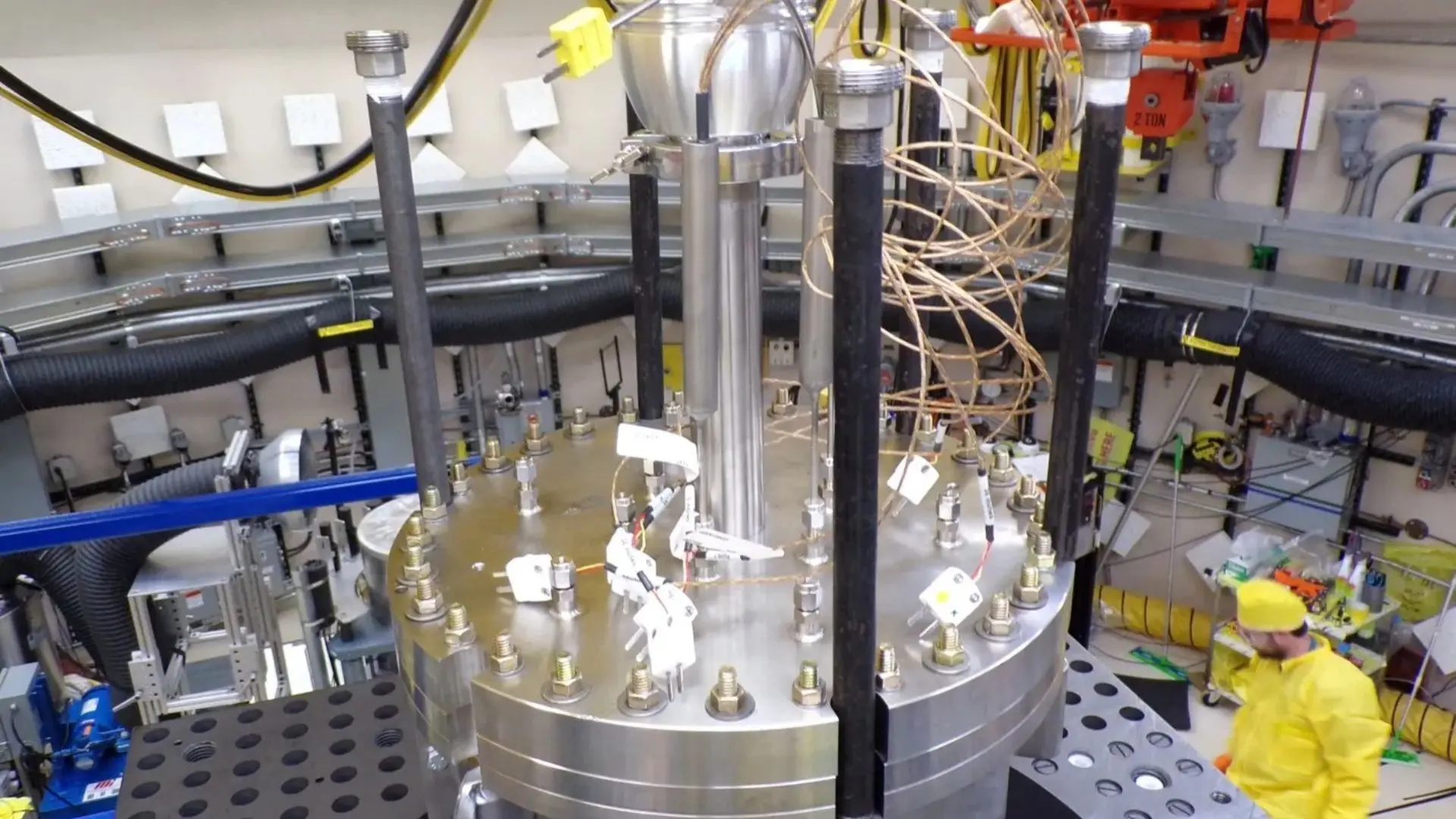
The Los Alamos National Laboratory (LANL) in the United States recently announced the successful achievement of criticality in its ZiaCore advanced nuclear microreactor design under high temperature, near-zero power conditions, marking a significant milestone in experimental verification.
This testing took place at the National Criticality Experiments Research Center (NCERC) in Nevada. Researchers were able to establish and maintain a controlled nuclear fission chain reaction at over 800°C (1472°F), while keeping the generated power at extremely low levels.
LANL stated that this achievement provided crucial reactor physics data for the ZiaCore design and contributed to verifying the new generation microreactor technology that uses low-enriched uranium.
Christopher Stanek, Director of the LANL Nuclear Energy Program Office, mentioned that this experiment would provide valuable data for low-enriched uranium reactor technology, including LANL-developed components, and allow verification under representative reactor temperature conditions.
The concept of “criticality” refers to the ability to maintain a stable number of neutrons in a nuclear reactor, allowing for a self-sustaining nuclear fission chain reaction.
However, “zero power criticality” does not imply the absence of nuclear reactions in the reactor. It means that researchers were able to establish and maintain a nuclear fission chain reaction at extremely low power levels before measurable heat generation occurs from nuclear fission.
Therefore, experiments of this nature do not generate power or indicate commercial operation of the reactor. Their primary purpose is to measure and verify the neutron behavior, reactivity, and other key physical characteristics of the reactor.
The ZiaCore system achieved near-zero power criticality under high-temperature conditions during a series of experiments lasting approximately four weeks from April to May 2026.
What sets this test apart is that researchers conducted the criticality experiments not only under low-temperature conditions but also heated the system to over 800°C to obtain data closer to the actual high-temperature operating environment of the reactor.
ZiaCore, a microreactor concept developed by LANL since 2021, aims to design a reactor that can use commercially available “low-enriched uranium” (LEU) fuel, with a uranium-235 isotope enrichment ranging from 2% to 20%, compact structure, and ease of manufacturability.
This design utilizes low-enriched uranium dioxide fuel, zirconium hydride as a moderator, and heat pipes for heat transfer. In a nuclear reactor, the moderator slows down neutrons to make them more efficient at triggering subsequent nuclear fission. Heat pipes efficiently transfer heat generated by the reactor core using phase change and thermal conduction mechanisms. Unlike traditional large nuclear power plants that require complex cooling loops and large circulation pumps, ZiaCore employs passive heat pipe technology for cooling, simplifying the system structure and enhancing safety.
As the supply chain matures, the ZiaCore design could also adapt to using “high-assay low-enriched uranium” (HALEU). HALEU has a uranium-235 enrichment higher than the low-enriched uranium commonly used in traditional commercial nuclear plants but below 20%, providing more options for fuel utilization and reactor design in some advanced reactors.
For this experiment, the research team designed a vacuum chamber specifically to accommodate the ZiaCore fuel assembly along with its heat pipes, zirconium hydride moderator, fuel, and custom electric heaters.
Subsequently, they installed this experimental system on the Deimos critical experiment platform at NCERC to conduct a series of high-temperature, near-zero power criticality tests.
One of the critical pieces of data obtained from the experiment is the “temperature coefficients of reactivity.” Simply put, this parameter measures how the reactor’s ability to sustain a nuclear fission chain reaction changes with variations in reactor temperature. Such data is crucial for verifying reactor physics models, improving computer simulations, and future safety analysis and engineering design.
Since the nuclear fission scale in zero power criticality experiments is extremely low, the concentration of fission products produced is also very low. Thus, the experiment does not consume fuel in the same way high-power nuclear reactors do. Officials mentioned that the radiation levels generated in such experiments are relatively low, enabling researchers to resume laboratory operations quickly after completion, while the fuel can be preserved for future research.
However, the completion of the high-temperature, zero power criticality verification by ZiaCore does not indicate the construction and power generation testing of commercialized microreactors. The primary value of this experiment lies in confirming the reactor physics predictions on which the design is based and obtaining experimental data under representative high-temperature conditions.
To develop a deployable microreactor, further testing is needed, such as higher power operation, thermal management, system integration, safety analysis, regulatory licensing, and engineering reliability.
LANL mentioned that the ZiaCore project integrates the laboratory’s expertise in heat pipes, material development, manufacturing, and critical experiments. This success not only aids in further ZiaCore research but could also serve as a reference for the development of other microreactors using low-enriched uranium, zirconium hydride moderator, and heat pipe technology.
In late August 2026, the U.S. Army and Defense Innovation Unit (DIU) announced the “Project Janus,” offering a total of up to $2.2 billion in funding to develop, construct, and operate “Micro Modular Reactors” (MMR) at five military facilities. The U.S. military aims to enhance the energy resilience of military bases, ensuring continued operations of critical military missions in the event of commercial grid disruptions or attacks.
Among the five winning contractors, most adopt the same technology verified by ZiaCore. Commercial designs chosen (such as Radiant’s Kaleidos reactor or Westinghouse’s eVinci) incorporate a similar cooling mechanism of “low-enriched uranium + passive heat pipe cooling.” The data obtained by ZiaCore at 800°C high temperature effectively endorses the foundational physics safety for these contractors.
The output power of the ZiaCore reactor is equivalent to that of a large diesel generator and is expected to run continuously for 8 years without the need for refueling. Its compact size allows for containerized installation, making it suitable for deployment in remote communities, critical infrastructure, disaster relief, or military bases. This aligns with the U.S. military’s MMR specifications, requiring transportability by trucks or C-17 transport aircraft to remote bases or battlefields, with fuel-free operation for 3 to 8 years.
In conclusion, ZiaCore serves as a scientific breakthrough in verification, while the military’s “Project Janus” acts as a super catalyst to translate its technical achievements into military and commercial products.