
The culture of prediction has seeped into various aspects of our daily lives, from weather forecasts to gambling. However, are these predictions really as accurate or beneficial as they seem? A philosopher from the University of Oxford in the UK has warned that from election outcomes to mundane daily affairs, gamblers are now betting on everything in profit-driven prediction markets, which could have disastrous consequences for those making decisions about their future.
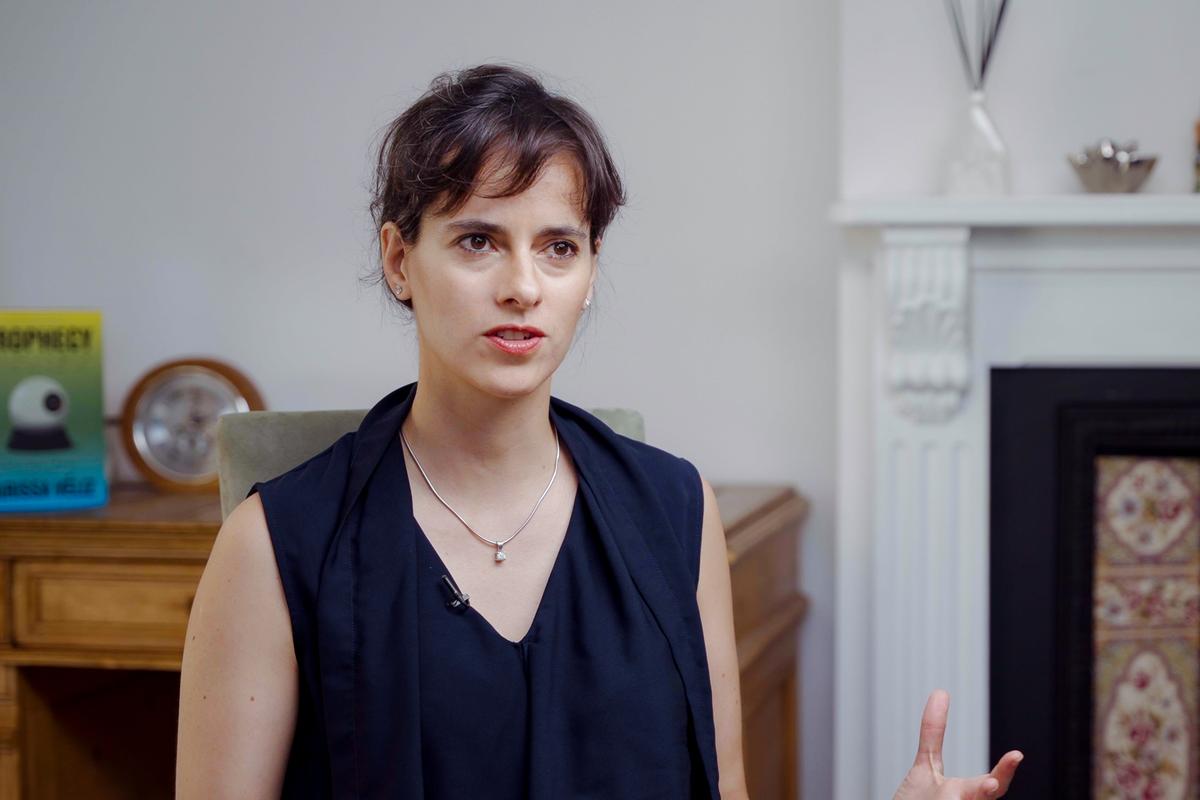
In a recent interview on the “American Thought Leaders” program on Epoch TV, Carissa Véliz, Associate Professor of Philosophy at the Institute for Ethics in AI at Oxford University, discussed the risks of blind faith in public predictions about the future and how these predictions can either drive or disrupt individual lives.
“If you uncritically take my prediction to be true and act upon it, then you’re obeying. And when it comes to social predictions, things get even trickier,” Véliz told the host of the “American Thought Leaders” program, Jan Jekielek.
“If I tell you… ‘Artificial intelligence will replace you tomorrow’ and you quit your job because you feel it’s not worth doing anymore, then you’re obeying. If I’m a tech company executive selling this AI product, then you’re helping me out.”
Discussing her new book “Prophecy: Prediction, Power, and the Fight for the Future” (2026), Véliz stated that public predictions not only drive unethical factors in human behavior, but many widely accepted predictions have also never come to fruition.
“People used to very, very much believe there would be severe overpopulation issues, there would be famine, there would be great disasters, and it was inevitable. But none of those things ever happened,” she said.
“Then people used to think that decades from then we would all perish and the population on Earth would keep decreasing. But that also didn’t happen.”
One of the most popular forms of public predictions today is the prediction market industry.
Prediction markets allow users to bet on everything from sports matches to elections to TV show outcomes. The range of bets has increasingly involved everyday events, such as how many posts the world’s richest person, Elon Musk, will make on the platform in a week.
Since January 2025, two major players in the international prediction market, Polymarket (based in New York) and Kalshi (based in New York), have seen nominal trading volumes of $21.5 billion and $17.1 billion, respectively.
Within less than a year, the monthly income share of the prediction market has shown a significant increase.
According to data analysis by Pew Research Center (PRC) on digital asset media company The Block, the total global transaction volume of the prediction market surged from $5 billion in September 2025 to around $24 billion in April 2026.
As the prediction market gains popularity, concerns have arisen not only about suspected insider trading events but also about the worsening issue of gambling addiction in the US and the betting of gamblers on almost every aspect of human life (including the weather), sparking numerous worries.
In a survey by the American Institute for Boys and Men (AIBM) and market research company Ipsos in March this year, most Americans (61%) believe that betting in the prediction market is closer to gambling than legitimate investment.
Moreover, in a survey by the American political news website Politico in June, 44% of Americans believe that betting on election results should be illegal, and 57% think that users should be banned from betting on the outcome of wars.
At the same time, more and more media outlets are starting to reference prediction markets like Kalshi and Polymarket when reporting on elections, opinion polls, and actions taken by the US government.
Before voting, voters are increasingly turning to reading relevant reports to understand the information and background of key elections.
However, Véliz believes that these public predictions driven by gambling and profit-based business models may not be as accurate as Americans think.
“Companies pursue profits. And profits often do not align with truth, precision, or science. So, it’s not a scientific environment. In a scientific environment, we seek to maximize accuracy,” she said.
Véliz revealed that there are even larger public predictions that could have more profound effects on human behavior and how individuals plan for the future.
She stated that when AI giants boast and claim that their technology will soon replace human jobs in many industries, it is not only misleading but also a marketing ploy, “wishful thinking,” or “power plays in disguise.”
“If we assume that the future in predictions is the true future, and we act according to the predictions, then we are essentially obeying in advance, as predictions often contain subtle instructions,” Véliz said.
This obedience could manifest as people quitting jobs they believe will soon be replaced by AI products, simply because they think the predictions made by the companies selling the artificial intelligence are correct.
So, does having more or better data lead to accurate predictions? Véliz believes this idea is somewhat unrealistic.
“We collect all this data with the idea that more data is better… But that’s not always the case,” she said.
“Because often, finding information in data is like finding a needle in a haystack. Expanding the scope of the haystack also doesn’t help.”
She pointed out that only relevant data is useful data.
She gave an example of tracking human behavior.
We might collect data to understand what someone does after receiving a loan from a financial institution. However, there is rarely data available about the “counterfactual” situation.
“If you don’t provide a loan to someone, you’ll never know how that person would have fared if they had received the loan at that time,” she explained.
If people believe that these predictions can accurately predict the future, they may even choose not to take action, which could have a significant impact on their lives.
“The paradox is that the more we believe we can do something, the greater our chances of success. If you don’t think you can do it, stay at home, and your chances of success are practically zero,” Véliz said.
“In life, there are battles that are very important, and I truly believe that even if you know you will lose, you should fight, stand on the side of history.”
Véliz believes this is particularly evident in raising children. In situations where children believe they will fail, we encourage them to continue moving forward, but persistence is essential for success and personal growth.
“In those crucial moments in life, preserving the correct stance in history is crucial, calculating whether you will win or lose is actually not quite fitting. Winning or losing is not important because the matter itself is so important,” she said.
However, Véliz does not think all public predictions are bad, such as weather forecasts or medical prognoses.
“Some situations are more complicated and cannot be generalized,” she said. “Because sometimes you need to have a diagnosis, which includes some prognostic information about treatment.”
As a resident of the UK, Véliz stated that she checks weather apps multiple times a day to track weather forecasts.
People in the American Midwest may rely on weather forecasts to find shelter during tornado warnings to survive. Those living along the Gulf of Mexico may check weather forecasts a week or two in advance during hurricane season to prepare their homes for potentially catastrophic events.
“I advocate for a wiser approach to predictions. We need to recognize more clearly what we can predict and what we cannot predict. If we have the illusion that we can predict, then we will go astray,” Véliz said.
On one hand, there have been too many predictions in history that were believed by many at the time but ultimately never came true.
“A few months before the Wright brothers successfully made the plane fly, The New York Times published a harshly worded article claiming it would take 1 to 10 million years for humans to fly in an aircraft,” she said.
“Their prediction was completely wrong.”