
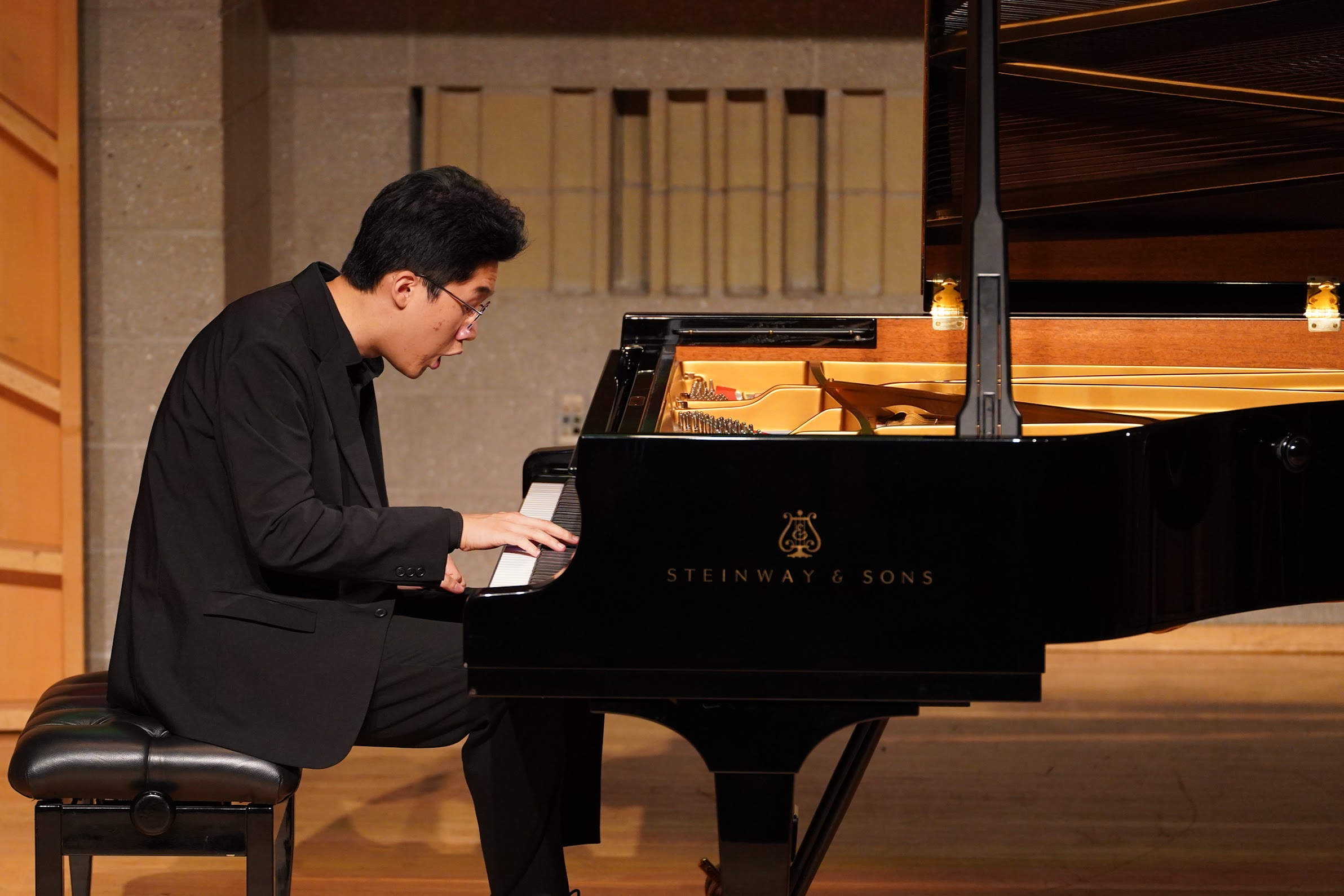
At the age of 21, Chen Xingchi from Taiwan has achieved honors in several international piano competitions. In order to continue enhancing his skills, he searched online for international piano competitions and stumbled upon the information for the NTD International Piano Competition. He discovered that the repertoire of the competition included pieces from the Baroque, Classical, and Romantic periods, which are his favorites, so he decided to participate.
The NTD International Piano Competition aims to promote the pure, virtuous, and beautiful traditional art of piano music, showcasing the brilliance of piano music from the Baroque, Classical, and Romantic periods. Chen Xingchi, expressing his fondness for the competition, made the decision to travel across the ocean to New York to participate, hoping to convey and share the beauty of classical music.
On September 2nd, on the stage of the preliminary round in Manhattan, New York, Chen Xingchi performed Bach’s “Fantasia and Fugue in A minor, BWV 904”, as well as Chopin’s “Étude Op. 10, No. 1”.
Chen Xingchi mentioned that he generally prefers classical music and is not particularly fond of playing modern pieces. To him, classical music serves as a form of long-term musical training.
He specifically highlighted the harmony and polyphony in Bach’s works, stating that the more he plays Bach’s pieces, the easier it becomes to understand and practice more difficult pieces, as there is a gradual grasp of a “grammar” within them. According to him, by understanding this musical language, he can swiftly comprehend other diverse works.
Chen Xingchi believes that pop music tends to become repetitive, requiring a constant change of songs, whereas classical pieces often become more enjoyable the more you play them.
“You will feel like, wow, these composers really put a lot of thought into writing these pieces,” Chen Xingchi said.
In his view, as the accumulation of playing and listening progresses, the understanding of the pieces deepens layer by layer.
He also places great importance on understanding the meaning behind the pieces. His teachers often remind him to grasp the composer’s emotions at the time and what the pieces aim to express. Taking Beethoven as an example, certain rhythms evoke a sensation of horse riding for him; once he comprehends this musical language, he can better appreciate the composer’s intent when performing.
“If you know these stories, playing will have more feeling to it.”
Regarding whether he enters a state of “selflessness” while performing, Chen Xingchi has his own thoughts on this.
“I don’t like that, I’m always following the music,” he said, sometimes even humming along with the music to maintain a sense of where the music is heading, rather than completely losing himself in it.
He has had experiences where delving too deeply into the music led to forgetting the notes, so he now prefers to stay alert and move along with the music. “I feel it’s better to go along with her rather than getting lost in it.”
This has also become his way of performing – not disappearing into the music but consistently maintaining an awareness of the melody, structure, and emotions during the performance.
There is a special connection between Chen Xingchi and the “designated pieces” in this competition.
Having previously studied Chinese traditional wind instruments, he felt an unusually familiar sensation while practicing a piece that incorporates elements of Chinese traditional music for the first time. “I used to learn Chinese traditional music and play a lot of Chinese music, so many things in it are similar to some music I used to play before, so I felt very familiar with it.”
The sense of familiarity he experienced stemmed from the pentatonic scale and the Chinese-styled musical elements within the piece. “When you look at the pentatonic scale and various aspects, it’s very Chinese, something I understand well.” He eagerly anticipates making it to the next round to have the opportunity to perform this piece, showcasing the fusion of Eastern and Western musical elements on the piano.
In his recent performance in the first round of the competition, Chen Xingchi was deeply impressed by the live piano and sound effects on stage. “As soon as I laid hands on it, I knew this piano was very pleasant to play,” he stated, acknowledging that when the instrument is in good condition, he can focus more on the music itself, allowing his original musical ideas to be presented more clearly.
He also hopes that his performances can allow more audiences to experience the beauty of classical music. “I hope everyone listens to more classical music.”