
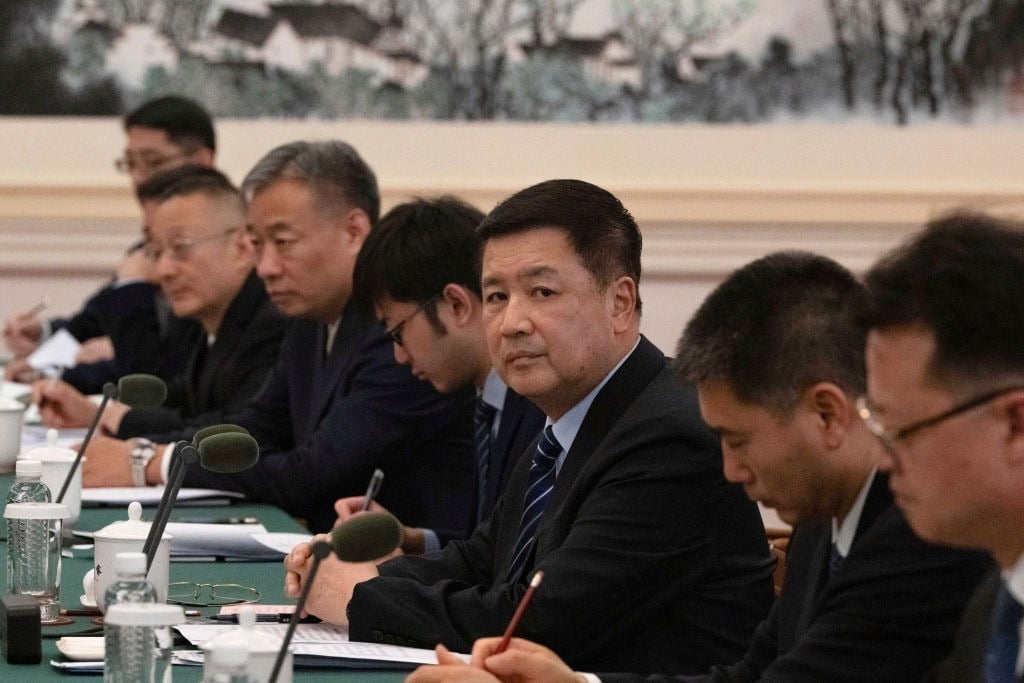
Recently, senior official Hua Liebing of the Chinese Communist Party’s Ministry of Public Security has been appointed to the vacant position of the head of the Discipline Inspection and Supervision Team stationed at the Central Hong Kong and Macau Affairs Office, which had been vacant for ten months. The previous head of the Hong Kong and Macau Affairs Office discipline inspection team, Geng Changyou, was transferred after serving for only eight months.
Hua Liebing is a close confidant of Wang Xiaohong, a high-ranking member of the Xi family’s Fujian faction, while Geng Changyou is an old subordinate of Huang Kunming, a high-ranking member of the Xi family’s Fujian faction. The current head of the Hong Kong and Macau Affairs Office, Xia Baolong, and the former head of the discipline inspection team at the Hong Kong and Macau Affairs Office, Shi Kehui, are both high-ranking members of the Xi family’s Zhejiang faction.
The frequent changes in leadership of the discipline inspection team at the Hong Kong and Macau Affairs Office indicate intense infighting among the Xi family’s Zhejiang, Fujian, and Shanghai factions.
Recently, the official website of the Central Committee of the Chinese Communist Party’s Hong Kong and Macau Affairs Office updated its “Leadership” section to show that Hua Liebing has been appointed as the head of the Discipline Inspection and Supervision Team stationed at the Central Hong Kong and Macau Affairs Office.
According to his public resume, Hua Liebing, born in January 1967 in Taicang, Jiangsu province, graduated with a degree in History from Shandong University. He has held various positions such as Deputy Director of a detention center in Henan Province, Deputy Director of the Legal Affairs Department of the Henan Provincial Public Security Department, and Secretary and Director of the Legal Affairs Office of the Beijing Municipal Public Security Bureau. In November 2016, he became the Secretary and Deputy Director of the Legal Affairs Department of the Beijing Municipal Public Security Bureau. In August 2018, he was appointed as the Secretary and Director of the Legal Affairs Department of the Beijing Municipal Public Security Bureau. In 2020, he became a member of the Beijing Municipal Public Security Bureau’s Party Committee and Deputy Director. In 2023, he was appointed as the Secretary of the Party Committee and Director of the 2nd Bureau (Economic Crime Investigation Bureau) of the Ministry of Public Security.
Wang Xiaohong, a confidant of Chinese Communist Party leader Xi Jinping from Fujian, served as the head of the Henan Provincial Public Security Department from August 2013 to March 2015, the head of the Beijing Municipal Public Security Bureau from March 2015 to April 2020, the Executive Vice Minister of the Ministry of Public Security from March 2018 to June 2022, and has been the Minister of Public Security since June 2022. Hua Liebing has followed Wang Xiaohong in his various positions in Henan, Beijing, and at the Ministry of Public Security, steadily rising through the ranks.
Additionally, Hua Liebing, a graduate of Shandong University, has had extensive interactions with Qi Yanjun, the current Executive Vice Minister of the Ministry of Public Security, who is also from Shandong. Qi Yanjun has served as an associate and deputy to Wang Xiaohong in various positions in Henan, Beijing, and the Ministry of Public Security.
Qi Yanjun, born in October 1964 in Laiwu, Shandong, has held positions such as Deputy Director of the Shaanxi Fire Brigade, Director of the Henan Fire Brigade, Director and Deputy Director of the Fire Supervision Department of the Ministry of Public Security, Chief of the Beijing Municipal Public Security Fire Department, Deputy Secretary of the Party Committee, Deputy Director, and Executive Deputy Director of the Beijing Municipal Public Security Bureau. In April 2020, he succeeded Wang Xiaohong as Deputy Mayor and Director of the Beijing Municipal Public Security Bureau. In May 2022, he became a member of the Party Committee and Deputy Minister of the Ministry of Public Security, and in October 2023, he was promoted to Deputy Secretary of the Party Committee of the Ministry of Public Security, serving as a Deputy Minister in charge of daily operations.
After Hua Liebing’s transfer, a commentator who often reveals the movements of senior Chinese Communist Party officials, Jiang Wangzheng, posted online that if Geng Changyou could not hold onto the position of head of the Discipline Inspection and Supervision Team stationed at the Hong Kong and Macau Affairs Office, then neither could Hua Liebing; and the core business overseen by Shi Kehui has not been relinquished. Jiang Wangzheng also revealed that the infighting between the Zhejiang and Fujian factions has intensified, leading to the exposure of the Fujian faction’s money laundering hub in Hong Kong; and if Hua Liebing dares to conceal any internal information, he would also fall from grace.
Over a year ago, in March 2025, the official website of the Chinese Communist Party’s Hong Kong and Macau Affairs Office announced that Geng Changyou had been appointed as the head of the Discipline Inspection and Supervision Team stationed at the Hong Kong and Macau Affairs Office. Just eight months later, in November 2025, he was transferred to serve as a member of the Standing Committee and Secretary of the Discipline Inspection Committee of the Hebei Provincial Committee.
Public records show that Geng Changyou’s career is not well-documented, but as of at least April 2022, he had already been serving as the Director of the Cadre Bureau of the Propaganda Department. He has been overseeing personnel matters for the two Propaganda Department heads, Huang Kunming (October 30, 2017 – October 26, 2022) and Li Shulei (since October 26, 2022).
Huang Kunming and Li Shulei are both key figures in the Xi family’s Fujian faction. Huang Kunming has served as Xi Jinping’s subordinate in Fujian and Zhejiang and is currently a member of the Political Bureau of the Chinese Communist Party and the Secretary of the Guangdong Provincial Committee. Li Shulei is a former colleague of Xi Jinping at the Central Party School.
From January 2014 to December 2015, Li Shulei served as a member of the Standing Committee of the Fujian Provincial Committee and Minister of the Propaganda Department. He was a subordinate of Huang Kunming, who was then the Deputy Minister and Executive Deputy Minister of the Propaganda Department. By at least May 2022, before the 20th National Congress of the Chinese Communist Party, Li Shulei had been serving as the Executive Deputy Minister of the Propaganda Department and became the Deputy Minister of the Propaganda Department, subsequently joining the Political Bureau at the 20th National Congress and assuming the position of Minister of the Propaganda Department.
During Huang Kunming and Li Shulei’s tenure as heads of the Propaganda Department, Geng Changyou served as the personnel manager, indicating that he was highly trusted by Huang and Li.
Geng Changyou served as the head of the inspection team for the 20th Central Committee’s second round of inspections in October 2023. From April to July 2024, he led the 5th inspection team of the Central Committee to inspect the General Administration of Customs. During and following the inspection, several high-ranking officials from the Customs Administration were investigated, including Sun Yuning, a Party Committee member and Deputy Director of the General Administration of Customs, who was detained in September 2024.
As high-ranking Customs officials fell one after another, on the evening of December 10, 2024, the official website of the General Administration of Customs published an obituary stating that Yu Jianhua, the Secretary of the Party Committee and Director of the General Administration of Customs, had “died of an illness after rescue efforts were ineffective” at the age of 63. Despite making public appearances on the day of his death, the official reports of his death were mysteriously retracted, raising doubts about the officially announced cause of death.
A day before the official obituary was released by the Chinese Communist Party, a commentator named Cai Shunkun revealed on the X platform that Yu Jianhua had committed suicide in his office on December 10, 2024. Only the day before, on December 9, personnel from the Discipline Inspection Commission of the Communist Party had spoken with Yu Jianhua, and it was unexpected that he would commit suicide immediately.
Cai Shunkun later stated on December 12, 2024, that during the period of Jiang Zemin and Hu Jintao’s leadership, Yu Jianhua did not have significant career advancements; his real rise occurred after Xi Jinping came to power. Yu Jianhua’s ability to rise to power was related to his connection with Ding Xuexiang, a member of the Political Bureau of the Communist Party from Jiangsu. The Customs Administration projects each year transport significant profits to individuals associated with Ding.
After Yu Jianhua’s unusual death, rumors of adverse news about Ding Xuexiang began to spread at the end of 2024. He was noticeably absent from the inauguration ceremony of the Chief Executive of Macau, leading to speculation about potential issues. Following the end of the Chinese New Year holiday in 2025, Ding Xuexiang’s absence at the opening ceremony of the Asian Winter Games and the Paris Tech Summit in February raised speculation among the public.
Ding Xuexiang rose in his career in Shanghai and served as Xi Jinping’s “chief manager in the Zhongnanhai’s inner circle.” He is a new high-ranking member of the Xi family’s Shanghai faction. At the 20th National Congress of the Communist Party, Ding Xuexiang was promoted to the Political Bureau and then appointed as the Executive Vice Premier of the State Council, simultaneously leading the Central Leading Group for Hong Kong and Macau Affairs.
At a critical moment, after Geng Changyou cleaned up the Customs Administration under Ding Xuexiang’s authority, in March 2025 he succeeded Shi Kehui and further assumed the position of head of the discipline inspection team at the Hong Kong and Macau Affairs Office under Ding Xuexiang’s jurisdiction. However, after eight months, Geng Changyou was transferred.
The background of leadership changes involving Geng Changyou, including his appointment and subsequent transfer, and the internal power struggles within the senior echelons of the Chinese Communist Party, particularly the connections with Ding Xuexiang, have raised speculations.
Four months ago, from mid-April to the end of June 2026, Shi Kehui led the 12th Central Committee’s inspection team to inspect the Party Committee of the Ministry of Public Security. Following the inspection of the Ministry of Public Security, there were successive personnel adjustments among senior officials in political and legal affairs in various provinces and cities. Shi Kehui is a former associate of Chinese Communist Party leader Xi Jinping and former Central Commission for Discipline Inspection Secretary Wang Qishan. He is also a former associate of Xia Baolong, the current head of the Hong Kong and Macau Affairs Office, from their time together in Zhejiang.
Shi Kehui, born in July 1961 in Pujiang County, Jinhua City, Zhejiang Province, held various positions in Zhejiang for an extended period. During Xi Jinping’s tenure as Secretary of the Zhejiang Provincial Committee from 2002 to 2007, Shi Kehui served as Deputy Director of the Information and Communication Department, Deputy Director of the Comprehensive Department II, and Director of the Information and Communication Department of the Provincial Committee Office. At the time, Xia Baolong served as Deputy Secretary of the Zhejiang Provincial Committee and was Xi Jinping’s “right-hand man.”
Xia Baolong was promoted to Governor of Zhejiang Province in January 2012, becoming Secretary of the Provincial Committee in December of the same year. At the time, Shi Kehui served as Deputy Director of the Provincial Committee Office and Deputy Secretary of the Provincial Committee (at the department level).
In 2014, Shi Kehui was appointed Deputy Secretary of the Central Commission for Discipline Inspection and Director of the Office, becoming the “chief steward” of Wang Qishan, the then Secretary of the Central Discipline Inspection Commission. In May 2017, before Wang Qishan stepped down as Secretary of the Central Commission for Discipline Inspection, Shi Kehui was appointed member of the Standing Committee, Secretary of the Discipline Inspection Committee, and Secretary of the Guangdong Provincial Committee. In January 2021, Shi Kehui was reassigned to head the Discipline Inspection and Supervision Team stationed at the State Council of the Hong Kong and Macau Affairs Office under the Central Commission for Discipline Inspection and the National Supervisory Commission.
According to publicly available information, the head of the Central Committee’s Hong Kong and Macau Working Group is Ding Xuexiang, the Executive Vice Group Leader is Xia Baolong, the Deputy Group Leaders include Wang Xiaohong, Chen Wenqing, Shi Taifeng, and Wang Yi, while the members include Huang Kunming, Zhou Ji, Zheng Xincong, Xu Qifang, and Meng Fanli. Xia Baolong is the head of the Hong Kong and Macau Affairs Office, and Xu Qifang is the Executive Vice Director.
Among them, Ding Xuexiang is a high-ranking member of the Xi family’s Shanghai faction; Xia Baolong is a high-ranking member of the Xi family’s Zhejiang faction; Wang Xiaohong, Chen Wenqing, Huang Kunming are high-ranking members of the Xi family’s Fujian faction; and Xu Qifang is a senior member of the Xi family’s Shaanxi faction.
Chen Wenqing is currently a member of the Political Bureau of the Chinese Communist Party and Secretary of the Politics and Law Committee. He previously served as a member of the Standing Committee of the Fujian Provincial Committee, Secretary of the Discipline Inspection Commission, and Deputy Secretary of the Provincial Committee. Huang Kunming, a former associate of Xi Jinping, serves as a member of the Political Bureau of the Chinese Communist Party and the Secretary of the Guangdong Provincial Committee, bordering Hong Kong.
Xu Qifang, originally from Hanbin, Ankang City, Shaanxi, and a fellow native of Xi Jinping, had a long career in Shaanxi, serving as Deputy Secretary and Mayor of Ankang City, Secretary of the Baoji Municipal Committee, and Deputy Governor of Shaanxi. When Xi Jinping’s close associate, Chen Xi, was head of the Organization Department of the Central Committee, Xu Qifang was appointed in January 2021 as member of the Standing Committee of the Hainan Provincial Committee and Secretary of the Organization Department, subsequently promoted to Deputy Secretary and Secretary of the Politics and Law Committee of the Hainan Provincial Committee; in October 2022, appointed as Deputy Minister of the Organization Department of the Central Committee, serving as Chen Xi’s deputy; in July 2025, promoted to Executive Vice Director of the Hong Kong and Macau Affairs Office (equivalent to a ministerial level).
Hong Kong, as an international financial center, has long been used by high-ranking Chinese Communist Party officials as a base for money laundering. Senior lecturer in Journalism at the Hong Kong Baptist University, Lu Bingquan, revealed in an interview with Deutsche Welle on June 10, 2018, that high-ranking Chinese Communist Party officials use Hong Kong as a transit station and springboard for money laundering, followed by transferring assets overseas. Almost all elite families in China operate in this way. Mainland Chinese media have revealed six primary abnormal ways in which funds flow from the mainland to Hong Kong for laundering purposes, including carrying cash for smuggling, underground money changers, international trade, investments, using shell companies and bank accounts, gambling, and significant credit card expenditures; all of which can be used for money laundering.
The Singapore money laundering case exposed in 2023 involved an amount of about 3 billion Singapore dollars (approximately 16 billion RMB), with funds originating from organized crimes such as telecom fraud and online gambling. The ten individuals involved in the case were all from Fujian, and the criminal group used Hong Kong as a financial jumping-off point. They funneled illicit funds from illegal online gambling and telecom fraud (known as “pig slaughtering”) from Southeast Asia (such as the Philippines and Cambodia) into Hong Kong bank accounts, then transferred the funds to financial institutions in Singapore, the US, and other places through forged trade documents and other means under the guise of “repaying loans” or investments.
The Jiangsu-Zhejiang-Shanghai region is the most active area for private enterprises and cross-border e-commerce in China, generating vast amounts of international trade funds settlement and foreign exchange demand. It is also a gathering place for Chinese Communist Party tycoons and “white gloves” for the elites; the massive flow of funds provides cover for illegal money laundering activities.
The Jiangsu-Zhejiang-Shanghai region has seen a series of cases involving cross-border money laundering or illicit outflow of funds through Hong Kong, with the most significant being the “Zhejiang Jinhua 410 billion RMB massive underground money changers case.” Other major cases include the “Shanghai Yisidun 2 billion RMB market manipulation futures money laundering case,” and the “Jiangsu Jiangyin 400 million RMB using overseas insurance for illegal money laundering case.”
Reports from US congressional committees and think tanks indicate that in recent years, Hong Kong has not only served the private assets of the elites but has also gradually evolved into a conduit for Beijing to assist sanctioned countries (such as Russia, Iran, and North Korea) in conducting illegal financial operations, evading Western sanctions, and attempting to “de-dollarize.”
Hua Liebing’s appointment as head of the discipline inspection team at the Hong Kong and Macau Affairs Office by Wang Xiaohong, a close confidant of the Minister of Public Security, highlights the Chinese authorities’ use of a “sharp blade” and escalation of financial supervision within the Hong Kong and Macau system, as part of the recent comprehensive efforts of the Chinese Communist Party to seize money.
Hong Kong has long been a battleground for power struggles among the top Chinese Communist Party leaders. The frequent abnormal changes in leadership of the discipline inspection team at the Hong Kong and Macau Affairs Office not only reveal the escalating internal strife among the Xi family’s Zhejiang, Fujian, Shanghai factions, as they vie for control of the dark money laundering network in Hong Kong, but are also closely related to the personnel positioning in the upcoming 21st National Congress of the Chinese Communist Party.
(Original article published on September 2, 2026, by Epoch Times)