
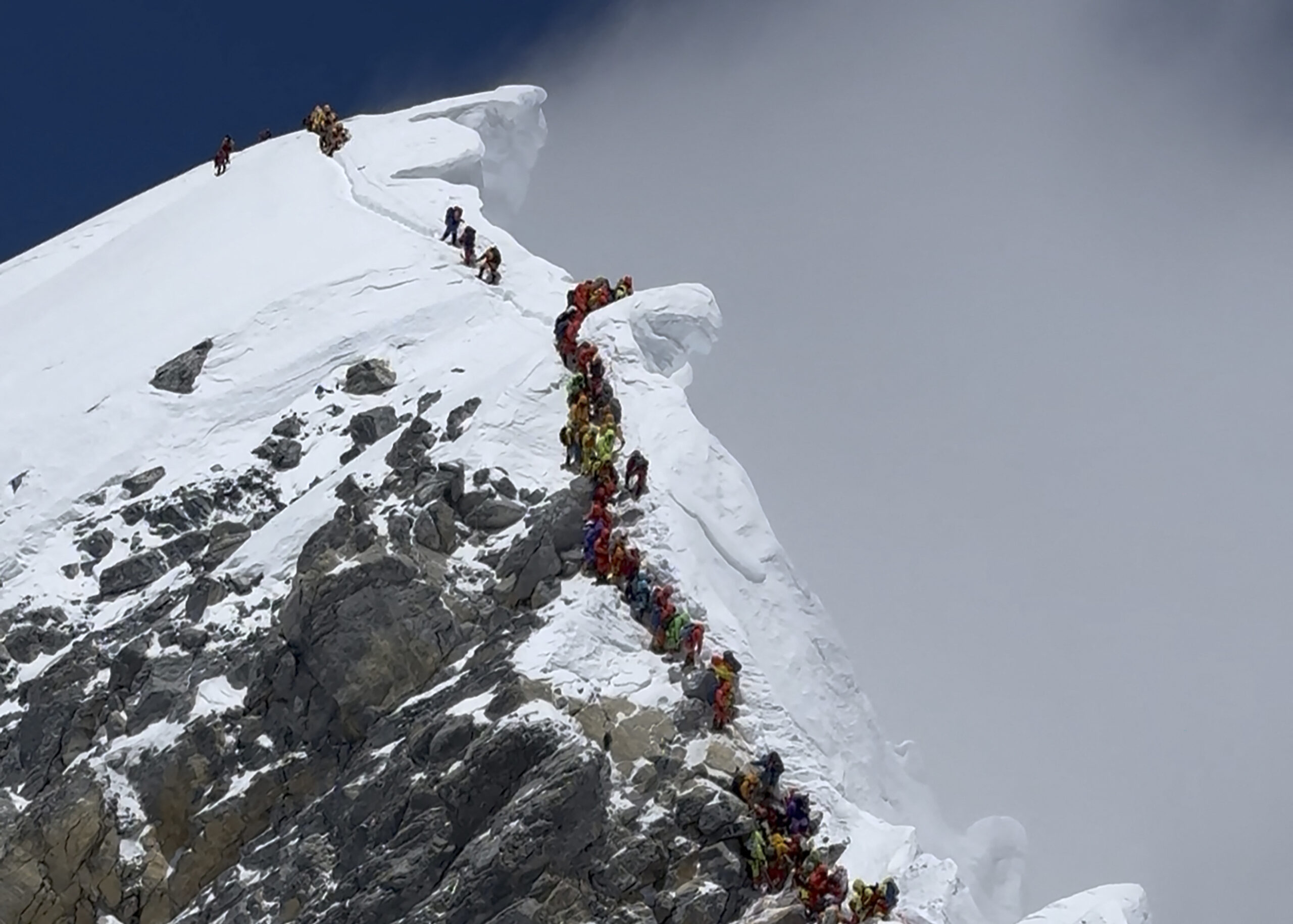
A catastrophic flood, reportedly triggered by a glacier collapse, has suddenly swept through the border region of the Himalayas spanning China and Nepal this week. The massive “debris flow,” consisting of floodwater, mud, and rocks, tore through southwestern Tibet and ripped through central Nepal along the Lhende River, stretching nearly 170 kilometers, resulting in hundreds dead and thousands missing in the tragedy.
This sudden disaster has once again brought global attention to the enormous disaster risks triggered by climate change in mountainous regions. Glaciers on high mountains worldwide are becoming “frozen time bombs” hanging over humanity’s head.
Regarding the sudden disaster on Wednesday (August 26) in the China-Nepal border region, a report from National Geographic pointed out that extreme climate conditions have made glaciers in high-altitude mountain regions extremely unstable.
Geologists and glaciologists have preliminarily assessed that large chunks of glacier ice hanging high in the sky suddenly broke off along with nearby cliff rock facades, resulting in an ice-rock mixture equivalent to the volume of 70 Great Pyramids of Giza plummeting down the valley in an instant. The enormous potential energy released from the thousands of feet of freefall is equivalent to millions of tons of TNT — like a striking “glacier nuclear explosion,” with the rapid descent causing friction and impact that even triggered seismic-like shock waves.
The U.S. Geological Survey confirmed that the impact observed by seismometers was equivalent to a magnitude 5.2 earthquake.
Kristen Cook, a geologist at the Université Grenoble Alpes, explained to National Geographic that the sudden collapse of the bedrock beneath the glacier dragged the entire glacier down the cliff face, with the rapidly falling ice rapidly melting and blocking the river channel, subsequently triggering a catastrophic glacial lake outburst flood.
This kind of rapid glacier collapse, akin to a “glacier nuclear explosion,” is not unique to the Himalayas. According to Euronews, Europe is one of the continents experiencing the fastest warming globally, and melting glaciers and permafrost are seriously destabilizing high mountain regions, threatening human settlements at elevations of 2,500 to 3,000 meters in countries like France, Italy, Austria, and Switzerland.
Olaf Eisen, a glaciologist at the Alfred Wegener Institute, warned in an interview with Euronews that climate change is causing water pockets to form at the base of glaciers, making the entire unmelted ice mass prone to instantaneous collapse during heat waves or heavy rainfall.
Similar tragedies have occurred in the Alpine region. In 2022, 11 climbers died in Italy’s Dolomites mountains due to the collapse of the Marmolada glacier; in May 2025, the village of Blatten in the Swiss Alps was buried under 20 million tons of rock, ice, and snow avalanche.
Le Parisien quoted Antoine Rabatel, a glaciologist from the Université Grenoble Alpes, warning that there are glacier risks in the French Alps that should not be underestimated. Currently, France has about 500 glaciers, with more than ten of them assessed to have collapse risks.
Le Figaro mentioned that as early as 1892, near the highest peak of the Alps, the Mont Blanc massif, a sudden glacial lake outburst at the Tête-Rousse Glacier led to a massive ice and rock avalanche, resulting in the death of 175 people.
Since then, French authorities have been closely monitoring glacier movements in the Alps.
Professor Eisen told Euronews that although the risks in the Alps are similarly high, the estimated volume of the snow avalanche in the Nepal collapse is 10 to 20 times that of the Blatten incident in Switzerland.
Scientists are still analyzing the exact causes of the catastrophic flood at the China-Nepal border. According to CNN, Daniel Shugar, a geologist at the University of Calgary, who is part of the scientific team, stated that the glacier collapse alone cannot generate such massive energy.
“Therefore, there must have been other factors at play.” They believe there may have simultaneously been a landslide.
Scientists say there is still much work to be done to accurately determine the sequence of events and the reasons for the deadly floods.
“Figuring out where this water actually came from is probably the most challenging part of this whole thing,” Shugar added.
The formation of three subsequent glacial lake outbursts near the disaster site has raised concerns about a new round of floods and temporarily halted rescue efforts in the China-Nepal region.