
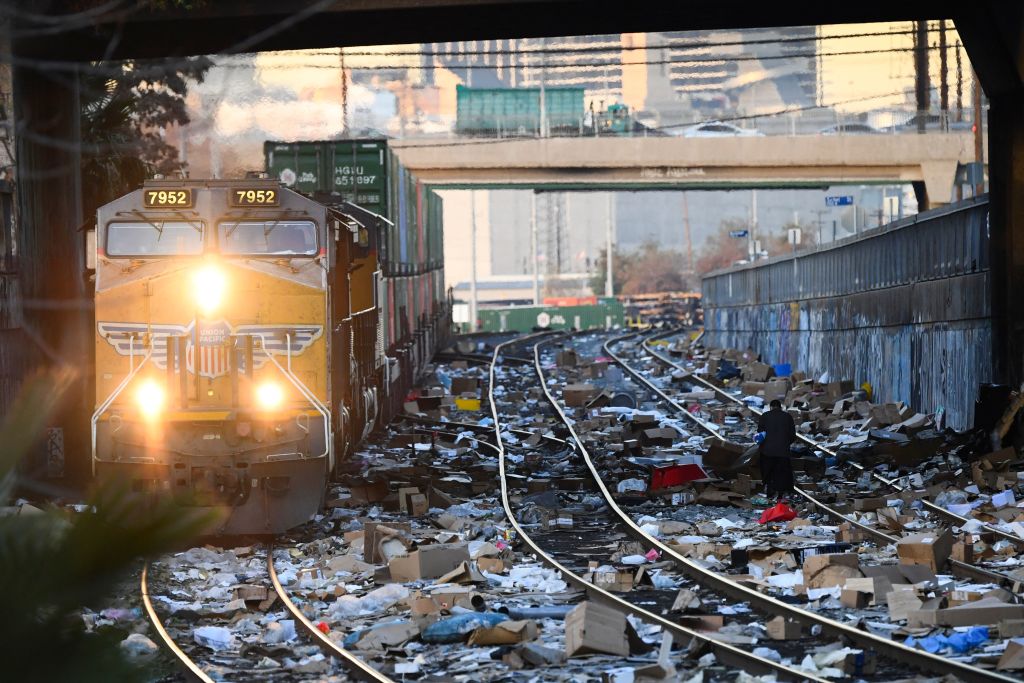
Train robberies, a classic scene in Western cowboy movies, are making a comeback on freight railways in the United States today. Since the COVID pandemic, the number of freight train thefts in the US has quadrupled compared to 2020, with a wide range of stolen items including TVs, cars, toys, tires, and annual theft losses reaching up to $200 million.
In November 2025, as a CSX freight train stopped outside a station in Memphis, Tennessee, three men emerged from a car under cover of darkness, climbed onto the freight car, broke open the container locks, and stole over $20,000 worth of goods destined for Belk department store, including high-end women’s clothing, laser building blocks, and two boxes of non-alcoholic wine. After loading a car full of stolen goods, the thieves even hid the remaining loot in a nearby forest, planning to come back for it later.
However, the entire theft process was captured by artificial intelligence (AI) surveillance. The Tennessee Bureau of Investigation (TBI), in collaboration with federal, state, and local law enforcement agencies, the National Guard, and the CSX police force, took action. They deployed aircraft to track the suspects’ vehicle and arrested one of them about 11 miles away while the other two were apprehended days later.
Similar incidents have also occurred in Chicago. In August 2024, a Union Pacific train parked in the West Side of Chicago, Illinois, was robbed by thieves who loaded TVs and other electronics into waiting vehicles. Even after the police arrived, the thieves brazenly loaded the stolen goods onto a car in front of the officers, then drove away. Two months later, local media reported that a dozen individuals once again robbed another train from the same company. The video showed several men directly removing packages from the carriages and loading them onto nearby parked trucks.
According to a Bloomberg report on Monday, during the pandemic, criminal groups that originally relied on drug trafficking turned to freight theft due to supply chain disruptions. Criminal activities are concentrated near major rail hubs in cities such as Memphis, Chicago, and Los Angeles.
Industry organizations representing multiple railway companies including CSX, BNSF, and Union Pacific stated that in 2025, there were 75,000 theft cases in the American freight rail system, four times more than in 2020, with stolen goods valued at over $200 million.
Sean Douris, head of the police department at CSX, mentioned that criminal syndicates can steal goods worth tens of thousands of dollars within minutes, causing damage to train equipment.
The most vulnerable moment for freight trains is when they slow down or stop before entering the yard. American freight trains can be up to about three miles long and are usually operated by just two crew members; criminals study the train’s stops and dispatch patterns, striking when the train is stationary for an extended period.
Thieves may attempt to steal large items like cars, but their security measures are usually too tight to breach and difficult to transport. Therefore, they tend to target small, high-value items that are easily resold. Investigators note that popular items for thieves include electronics, branded clothing, alcohol, and car tires. Stolen goods are distributed through online platforms, individual buyers, small businesses, independent tire dealers, or auto repair shops.
Perpetrators range from ordinary thieves to organized, transnational criminal networks. Train thefts around Memphis involve street gangs like the Gangster Disciples, Crips, and Almighty Vice Lords. In the American Southwest, theft cases are linked to transnational crime networks in Sinaloa, Mexico. In Chicago, both random thieves and organized gangs are involved in train theft.
In the face of the growing problem of freight theft, railway companies are increasing their investments in technology surveillance and security teams.
CSX stated that through schedule changes, reducing time spent in high-risk areas, strengthening monitoring and cooperation, they have reduced railway theft in the Memphis area by 80%. However, criminal syndicates are adapting their strategies, abandoning cell phone communications for walkie-talkies, shifting their operations to suburban areas, even jumping onto moving trains from bridges during slowdowns in speed-restricted sections. More organized groups have even directly tampered with tracks or cut brake lines, attempting to stop trains in remote areas for easier looting.
Enforcement and sentencing remain major challenges in railway theft cases. Investigators point out that unless suspects are caught with firearms or exhibit other violent behavior, simple theft of goods typically receives lenient penalties, and many suspects are granted bail.
In cities like Memphis, Los Angeles, and Chicago, the primary focus of local prosecutors’ offices is on violent crimes and homicides, causing theft cases to face long delays in prosecution.
In May 2026, the US House of Representatives passed the “Organized Retail Crime Enforcement Act” with bipartisan support, proposing measures such as seizure of stolen goods, expanding the application of money laundering laws, merging multiple theft amounts to increase charges, and setting up cross-agency coordination mechanisms within the Department of Homeland Security.
Co-sponsor of the bill and Republican Congressman from California, David Valadao, noted that railroads operated by BNSF in his district are frequently targeted by thieves, with torn open boxes scattered alongside the tracks.
“Thieves jump on the tracks, break open packages, and then toss the parcels by the wayside for their accomplices to pick up,” he mentioned in an interview, “When I discussed this with law enforcement, they said it’s sadly becoming a common sight.”
The three suspects in the November 2025 Memphis case are facing charges of felony burglary and theft. As the stolen goods exceeded $10,000 in value, at least one defendant may face up to 15 years in prison, while the other two are likely to receive lighter penalties. The local Shelby County prosecutor is preparing to present the case to a grand jury.