
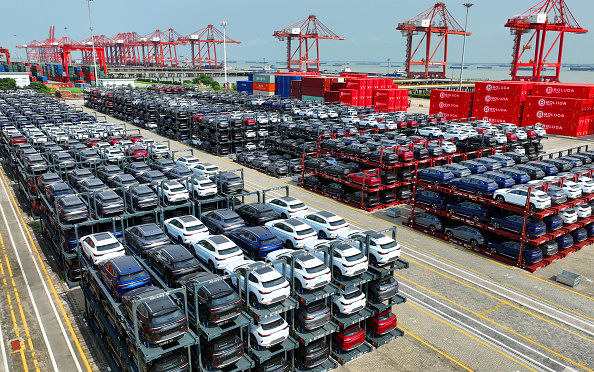
Norwegian National Guard during a military exercise found that Chinese-made smart cars recorded and stored surrounding images, sparking concerns about military information leaks. Poland, the United States and others have also taken preventive measures, increasing Western societies’ attention to the data security and national security risks posed by Chinese-made smart cars.
Experts warn that the data collection and remote connectivity features of Chinese-made smart cars could be used for intelligence gathering, leading to concerns in the West.
Norway’s Dagens Næringsliv reported on October 8 that during the “Capital Exercise” held by the Norwegian Home Guard from September 14 to 18, soldiers discovered that the military had recorded and stored activities through Chinese-made cars rented by Hertz Norway.
Participating lieutenant mentioned that the footage recorded soldiers boarding and disembarking, vehicle routes, personnel pick-ups, and locations, and even captured soldiers entering military facility access codes. At least two involved vehicles belonged to the Deepal brand under China’s Changan Automobile. Due to a lack of substitute vehicles, the units continued to use these vehicles even after discovering the recordings until the exercise ended.
An October 17 report from Agence France-Presse indicated that a spokesperson for the Norwegian Home Guard confirmed that soldiers did find sensors recording in the vehicle system. However, it is still uncertain whether the data has been transmitted to a third party, including China.
Norwegian Minister of Defense Tore Onshuus Sandvik stated in a written response to parliamentary inquiries on October 16 that the military had conducted an overall threat assessment, including digital threats, before the exercise. However, there was no specific risk assessment conducted for the use of Chinese rental cars. The soldiers reported the recordings immediately, and the related videos have been deleted.
Green Party member Lars Lønberg Henriksen proposed a written inquiry requesting the government to suspend the use of vehicles related to China until concerns about the possible leak of sensitive information are resolved and to seek European alternative suppliers.
This incident highlights the military information security risks posed by smart cars with photography, sensing, data storage, and networking capabilities, drawing attention to military vehicle procurement, data management, and rules regarding entry and exit from sensitive facilities.
American economist Davy J. Wong commented to Dajiyuan, “This is a global crisis. The core issue is not just about commercial competition or trade protectionism, but primarily about national security, data sovereignty, and deep fears of an intangible ‘Trojan horse’.”
“Electric cars can serve as a mobile surveillance tool around the clock. The modern Chinese-made smart electric cars silently connect to networks. They are not just transportation vehicles but super data collection tools that move around.”
He explained that “onboard radar, high-definition cameras, GPS positioning, environmental perception, frequent over-the-air updates, remote communication, and the uploading of conversations, sounds, videos of both inside and outside the car make it an all-encompassing large-scale intelligence collection tool,” extending from civilian leaks, personal information exposure, spying, surveillance, to the military level.
He further added that smart cars can “quietly record people’s pupils, voices, fingerprints, even passwords,” making it a very terrifying intelligence collection tool.
Researcher at the Taiwan Institute for National Defense and Security Studies Ming Shi also remarked that Chinese-made “smart cars essentially serve as large-scale equipment for collecting various information or transmitting information.”
“Modern smart cars are equipped with numerous cameras, global positioning systems, or radar. After these vehicles are imported into Europe or South Korea, they can fully scan the surrounding environment of military bases, government agencies, or critical infrastructure, and record precise coordinates.” This raises suspicions that relevant secrets may be transmitted to China.
Ming Shi pointed out that “they may not operate normally in peacetime, but in times of conflict or crisis, they could be remotely controlled to disable tens of thousands of vehicles or disrupt transportation networks, causing serious social unrest.”
In addition to the incident of Chinese-made cars recording access codes during a military exercise in Norway, similar security investigations, military facility restrictions, and official warnings about the data collection capabilities of smart cars have appeared in Europe, Australia, and other regions in 2026.
The Associated Press reported on February 18, 2026, that Poland’s military announced a ban on Chinese-made cars entering military facilities due to concerns about onboard sensors potentially collecting sensitive data such as images, sounds, and locations.
Germany’s ARD-owned Tagesschau reported on February 25, 2026, that the German Federal Office for the Protection of the Constitution and the Federal Office for Information Security jointly inspected vehicles from several Chinese car manufacturers to assess what data the vehicles collected and whether the information could be sent overseas.
The Guardian reported on October 1, 2026, that the Netherlands General Intelligence and Security Service warned that modern car microphones, cameras, GPS, Bluetooth, Wi-Fi, charging systems, and other connected functions could be used to obtain in-car conversations, passenger information, and travel information. Some vehicles’ microphones and cameras could theoretically be activated remotely.
An investigation by Australia’s ABC “Four Corners” on September 21, 2026, pointed out that the Leapmotor C10 model of China’s electric car brand Zero Run is equipped with six cameras, some of which are produced by Dahua, a Chinese company. Surveillance cameras manufactured by the company had previously been removed from some Australian federal government buildings due to security concerns.
These cases illustrate that various countries’ concerns about the security of smart cars have extended from investigating and evaluating data collection capabilities to restrictions on the use of military facilities and security checks in the supply chain.
According to Voice of America, the US Senate Commerce Committee passed the “Internet-Connected Vehicle Safety Act” on July 22, 2026, across party lines. It intends to prohibit Internet-connected vehicles, software, hardware, and critical components related to “foreign adversaries” such as China from entering the US market, to prevent sensitive data leaks, remote vehicle manipulation, and national security risks.
Furthermore, in September 4 French news, major US car manufacturers pressured Congress to permanently ban the sale, import, and production of Chinese Internet-connected vehicles and their software and hardware within the US. The Alliance for Automotive Innovation urged Congress to pass this ban by the end of the January 3, 2027 session.
Wong mentioned, “Facing the ban by the US Congress and domestic car companies and the security vigilance of countries worldwide, Chinese car companies will likely try to resolve the crisis through so-called functional modifications. However, due to the genetic makeup of the system, people are unlikely to trust them.”
“According to China’s National Intelligence Law and other related laws, all domestic companies and citizens must collaborate on national security and intelligence work. Western countries are concerned that the remote control backdoors and data servers of Chinese smart cars will ‘definitely be controlled by Beijing’s power will.'”
Recent incidents have revealed that data collection and remote connectivity features of smart cars have become a new focus for evaluating national security risks in Western countries. Experts believe that China’s smart internet-connected car industry’s development strategy, relevant legal system, and the sensing and communication capabilities of the vehicles themselves are important factors that raise concerns externally.
Ming Shi pointed out that the fundamental reasons lie in China’s business model, domestic laws, and national strategy among other factors.
He stated that China views smart internet-connected cars as a crucial industry for building a strong nation or achieving technological self-reliance, being part of its national big data, smart city, and navigation systems. However, smart car technology itself presents security risks.
Moreover, Ming Shi noted that the most critical aspect is the mandatory laws like the National Intelligence Law that restrict any organization and citizen to comply with national intelligence work. As part of the national intelligence network, the country can request car companies to provide the data they have collected.
Wong added, “China’s so-called new energy cars are deceiving Western environmentalists for climate negotiations; but the deeper reason is that it can become a powerful surveillance tool.” Furthermore, it “can serve as a remote control tool to control your car at critical moments.”
“Beijing views electric cars as a very significant and vital national strategic development and as the most concrete and detailed tool in information warfare.”
He emphasized that “its role, purpose, data collection intensity, coverage, and detail are unprecedented in history, far exceeding the capabilities of normal spy satellites and intelligence agents.”