
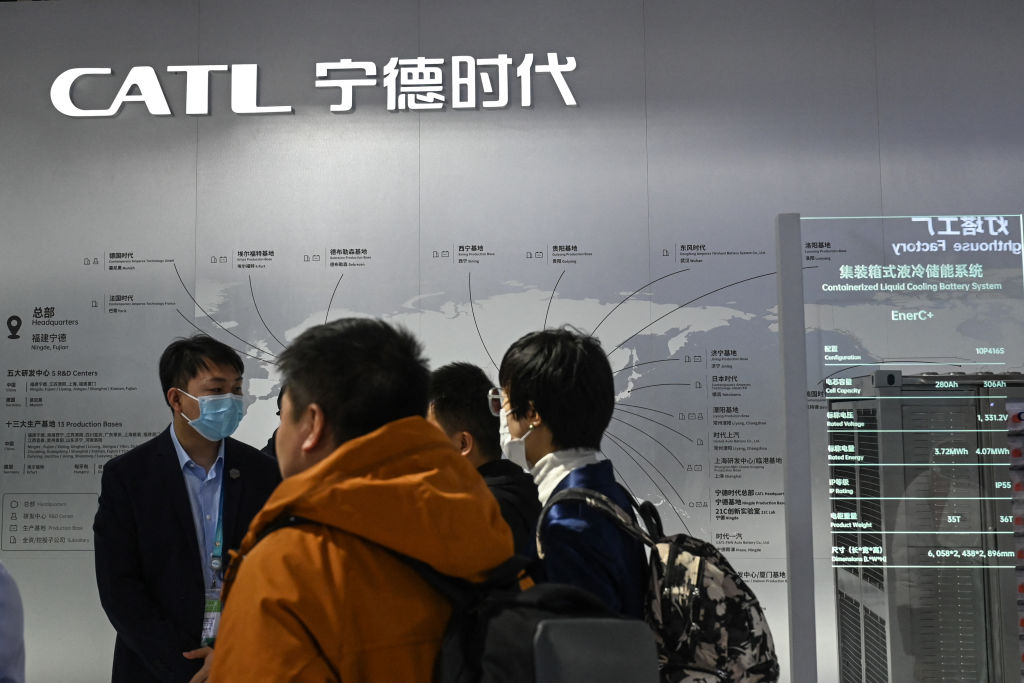
On October 20, mainland power battery company Contemporary Amperex Technology (CATL) saw its Hong Kong-listed shares fall by 6.58%, dropping nearly 9% during trading to hit a new low in over a year. On the same day, US investment bank J.P. Morgan downgraded its rating on the CATL’s Hong Kong-listed shares to “Neutral” and reduced its target price by approximately 31%.
At the close of trading, CATL’s Hong Kong shares hit a low of 402.6 Hong Kong dollars before settling at 411.8 Hong Kong dollars. Its A-shares also declined by 2.97% on the same day, closing at 259.08 Chinese yuan.
Other battery stocks listed in Hong Kong experienced declines as well. Contemporary Amperex Technology (CATL) China plunged by over 10% during trading and closed with a decrease of 9.21% at 14 Hong Kong dollars. Ganfeng Lithium and Ruipu Lanjun also saw synchronized downward movements in their stock prices.
According to a report by Securities Times on October 20, J.P. Morgan lowered CATL’s rating on its Hong Kong-listed shares from “Overweight” to “Neutral” with the target price per share dropping from 725 Hong Kong dollars to 500 Hong Kong dollars. However, the “Overweight” rating for its A-shares remained unchanged.
J.P. Morgan stated that battery consumption taxes, reductions in battery export tax rates, and increased trade barriers are putting pressure on the profitability of complete vehicle manufacturers. The bank believes that the deterioration of battery industry profits is occurring faster than expected, resulting in a redistribution of profits within the electric vehicle industry chain.
On the same day as the market decline, CATL released its third-quarter financial report, showing an operating income of 165.221 billion Chinese yuan, a year-on-year increase of 58.58%; net profit attributable to shareholders was 21.246 billion Chinese yuan, a 14.54% increase year-on-year but a decrease of approximately 5.8% compared to the second quarter.
The production schedules of battery manufacturers and energy storage projects were below market expectations. Citigroup’s research report cited a survey from ZE Consulting, a third-party organization, indicating that the expected production volume growth for the top five battery manufacturers in October is only 1%, falling short of the previous estimate of 7%. As a result, Citigroup lowered its production forecasts for CATL, Contemporary Amperex Technology (CATL) China, and EVE Energy.
Citigroup noted that October was supposed to be a peak production season, but the actual production lags behind expectations. Rushed production for increased output that was previously anticipated is unlikely, reflecting signs of weak battery demand.
On October 19, a research report from CITIC Securities stated that large-scale energy storage projects in mainland China were not landing as expected, leading to a revision of the annual forecast for new installations of large-scale energy storage to between 230 gigawatt-hours and 250 gigawatt-hours. The same report mentioned that in the first three quarters of the year, overall new installations of energy storage in mainland China reached 102.3 gigawatt-hours, a 6% year-on-year increase.
CITIC Securities attributed this to the narrowing price difference between peak and off-peak power consumption in the northwest region, resulting in reduced profit margins for energy storage stations charging at low prices and discharging at high prices. Factors such as rising operational costs, slow implementation of capacity-based pricing, and delays in grid connection approvals have also had an impact.
As battery stocks declined, the Hong Kong stock market continued its downward trend. According to the Daily Economic News, the Hang Seng Index closed at 23,867.74 points on that day, dropping by 1.32% and once again falling below 24,000 points. The Hang Seng Tech Index reached a new low in this round of adjustments, closing at 4045.91 points with a 1.52% decline.
The majority of large technology stocks also experienced declines, with Lenovo falling by nearly 10% and Alibaba dropping by over 3%. On that day, the net outflow of Southbound capital through the Shanghai-Hong Kong and Shenzhen-Hong Kong Stock Connect programs was 1.723 billion Hong Kong dollars.