
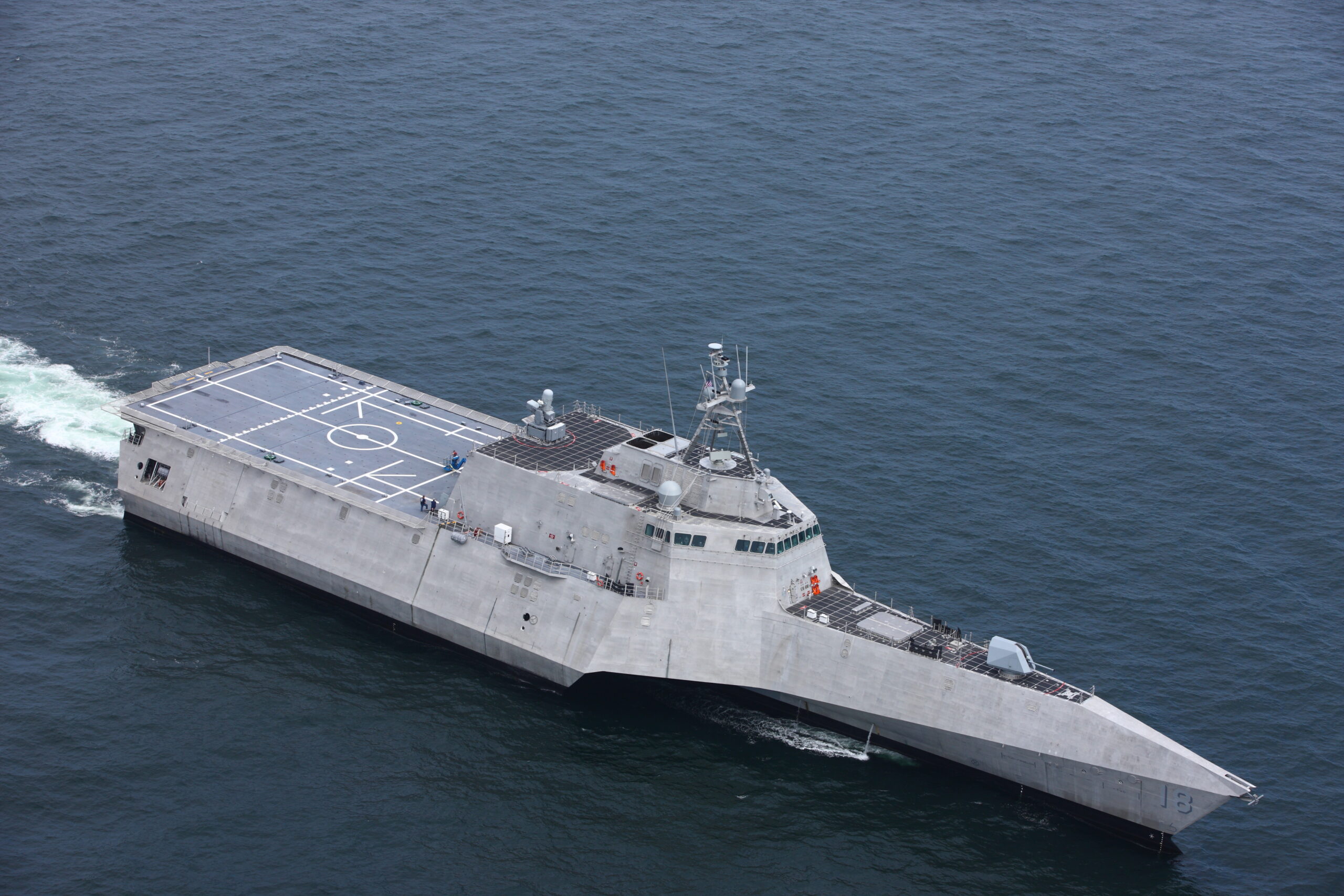
On Tuesday, October 20th, the U.S. Navy littoral combat ship USS Charleston passed through the disputed waters of the South China Sea near the Nansha Islands, triggering the dispatch of Chinese military forces to track and monitor it, prompting a response from the Philippines in support of the United States.
China accused the U.S. of violating sovereignty and disrupting regional stability, while the Philippine military publicly supported the U.S., refuting China’s claims of intrusion and emphasizing that no country has the right to restrict lawful passage in international waters.
The U.S. Navy typically refers to such missions as “Freedom of Navigation Operations,” aimed at demonstrating that crucial shipping lanes are not solely controlled by Beijing. It is reported that the last time the U.S. military conducted such a mission in the South China Sea was a year ago.
The Chinese military claimed that the USS Charleston entered the waters near Sabina Shoal in the Nansha Islands without Beijing’s approval, labeling it as an “illegal intrusion” early Tuesday morning.
The Southern Theater Command of the Chinese military issued a statement saying that they have “organized forces in accordance with the law to track and monitor the U.S. ship.”
China accused the U.S. of infringing on Chinese sovereign rights and demanded an immediate cessation of such activities.
Philippine Navy Rear Admiral Roy Vincent Trinidad, a spokesman, directly contradicted Beijing’s stance, stating that the U.S. warship “did not intrude into ‘Chinese territory’.”
The Philippines reiterated that “no country has the right to demand prior permission when passing through international waters legally.” Admiral Trinidad warned China to stop its “coercive and provocative behavior.”
China claims sovereignty over around 90% of the South China Sea, overlapping with claims by Brunei, Malaysia, the Philippines, Taiwan, and Vietnam. A permanent arbitration court in The Hague ruled in 2016 that Beijing’s sovereignty claims based on the so-called “nine-dash line” in the South China Sea had no legal basis, which China refused to accept, leading to ongoing conflicts with the Philippines.
According to Reuters, the Philippine Coast Guard accused a Chinese coast guard ship of ramming a Philippine vessel conducting refueling operations near Sabina Shoal last month, but China blamed the collision on the Philippines.
The Philippines and the United States have signed a Mutual Defense Treaty. Its core provisions stipulate that in the event of an armed attack in the Pacific region, both parties will take action to address common threats.
The treaty’s definition of an “armed attack” extends not only to attacks on each other’s territories but also includes attacks on their armed forces, government vessels, aircraft, and those on their controlled islands.