
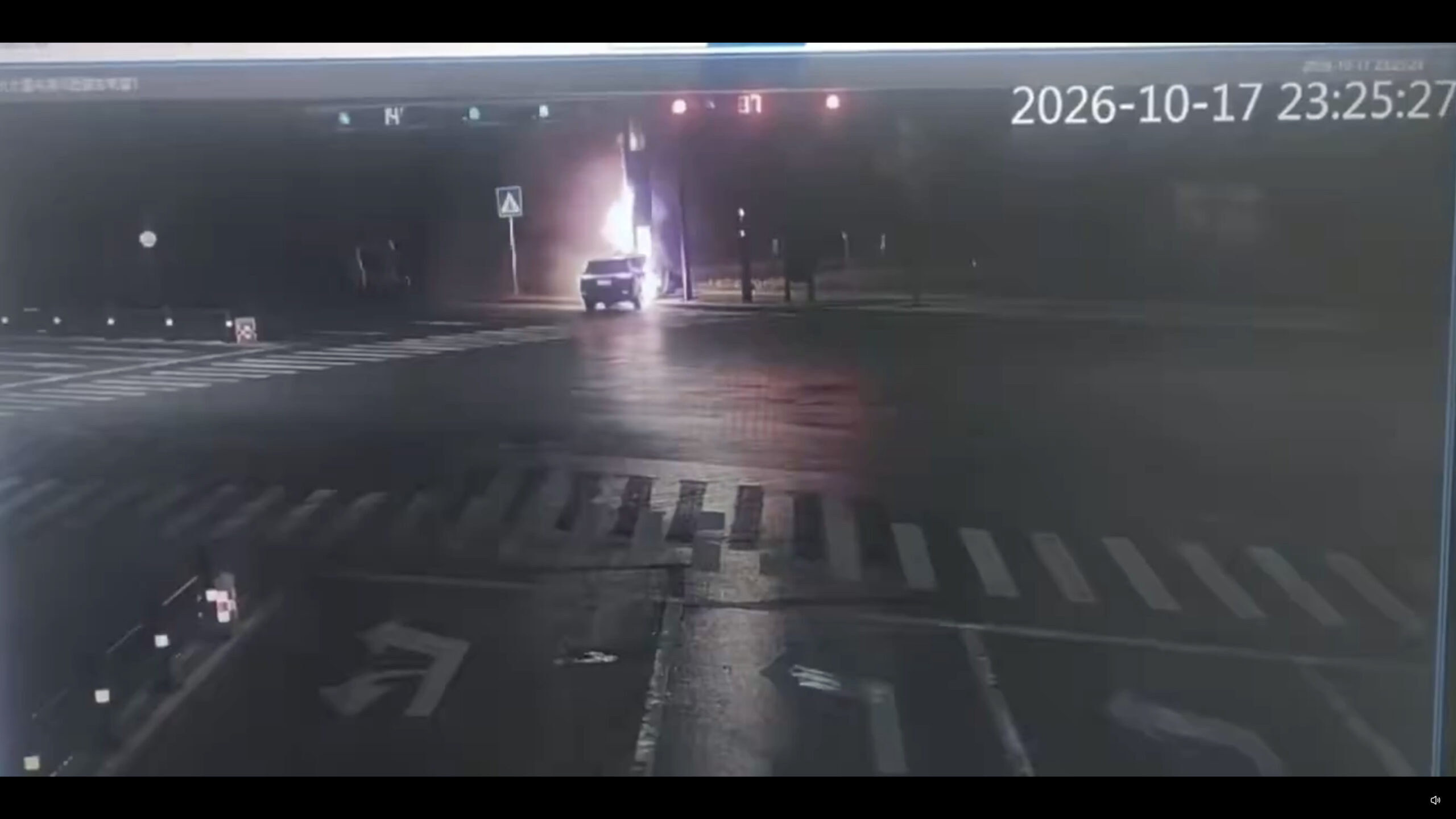
Recently, a Huawei Wanjie M9 vehicle collided with a traffic light pole in Shenmu City, Yulin, Shaanxi Province and caught on fire, resulting in the unfortunate death of the driver. Wanjie released an accident explanation on October 21, detailing the driving conditions and speed of the vehicle at the time of the accident, but did not mention the casualties, sparking controversy.
According to mainland media reports, late at night on October 17, a Wanjie M9 electric vehicle was involved in a traffic accident at an intersection in Shenmu City, Yulin, Shaanxi Province. It collided with a square traffic light pole, causing a rapid fire at the front of the vehicle, with flames intensifying at the scene.
After the accident video circulated online, public attention focused on the cause of the fire and the safety of the intelligent driving system.
On October 21, the Wanjie customer service released a statement regarding the vehicle accident in Shenmu City, Yulin, Shaanxi Province, stating that the vehicle’s emergency call (eCALL) system was triggered and connected immediately after the accident occurred.
Wanjie stated that upon preliminary verification, the vehicle was in manual driving mode at the time of the incident, traveling at a speed of 139.1 kilometers per hour when passing through the intersection, while the speed limit for that section of the road was 50 kilometers per hour. Due to the vehicle’s high speed collision with the traffic light pole, a fire broke out at the front of the vehicle.
Regarding the cause of the fire, Wanjie believed that the high-speed impact led to severe damage to the vehicle cabin, causing a short circuit in the wiring and oil leakage, resulting in combustion. Wanjie also denied network speculations about “battery explosion” and “intelligent driving collision,” stating that there were no abnormalities observed in the vehicle before the accident.
However, the 300-plus-word explanation detailed the vehicle’s driving status, speed, emergency call system, and initial cause of the fire, but did not mention whether the driver was injured or deceased.
According to the “Beijing News,” the Shenmu police confirmed that there was only one person in the vehicle, and the driver had already passed away.
The lack of mention of the driver’s casualties in Wanjie’s accident explanation has become a focal point of criticism among the public.
In a commentary article titled “Wanjie Fire Statement: Not a Word on Casualties?” by Phoenix Online columnist Zhang Feng, it was noted that Wanjie’s accident explanation rushed to emphasize the vehicle being in manual driving mode, while neglecting the public’s most concerning aspect, the condition of the occupants, making the expression of “deeply saddened” in the statement lack persuasiveness.
Some netizens also expressed that the omission of the driver’s fatality in the company’s statement lacked respect for human life.
Furthermore, netizens pointed out that before accidents occur, companies often promote the advantages of intelligent driving technology and product performance, but post-accident, emphasize that the vehicle was in manual driving mode.
Renowned Chinese writer Li Chengpeng commented on a platform X, stating that the Huawei Wanjie vehicle hit a roadside light pole and caught fire 2 seconds later, violating the country’s standard that prohibits fires within 5 minutes. Surveillance indicated that the vehicle did not reach Huawei’s claimed 139 kilometers per hour, with general analysis suggesting speeds of only 60-89 kilometers per hour, as the pole was merely stripped of its outer layer.
Concerns were also raised regarding the transparency of the accident data, with some netizens expressing worries that regular car owners and their families would find it challenging to independently understand the vehicle’s backend data. If the explanation of the accident relies mainly on data provided by the car manufacturer, the public might struggle to determine the adequacy of the conclusions reached.
The Wanjie M9 is a flagship full-size SUV jointly created by Huawei and Sylphe, released in 2023, with initial versions of Max and Ultra, priced around 500,000 yuan.
Not long ago, Jianghuai Automobile and Huawei’s collaboration to build the high-end new energy vehicle brand Zunjie encountered controversies over braking safety. The automobile platform “Understand Car Emperor” conducted emergency braking tests at 100 kilometers per hour on three Zunjie V800 vehicles, all of which experienced breakage in the brake pedal support.
As the incident continues to escalate, relevant test videos from Understand Car Emperor were reportedly taken down from multiple platforms, and the person in charge of the tests claimed to have received a barrage of text messages.