
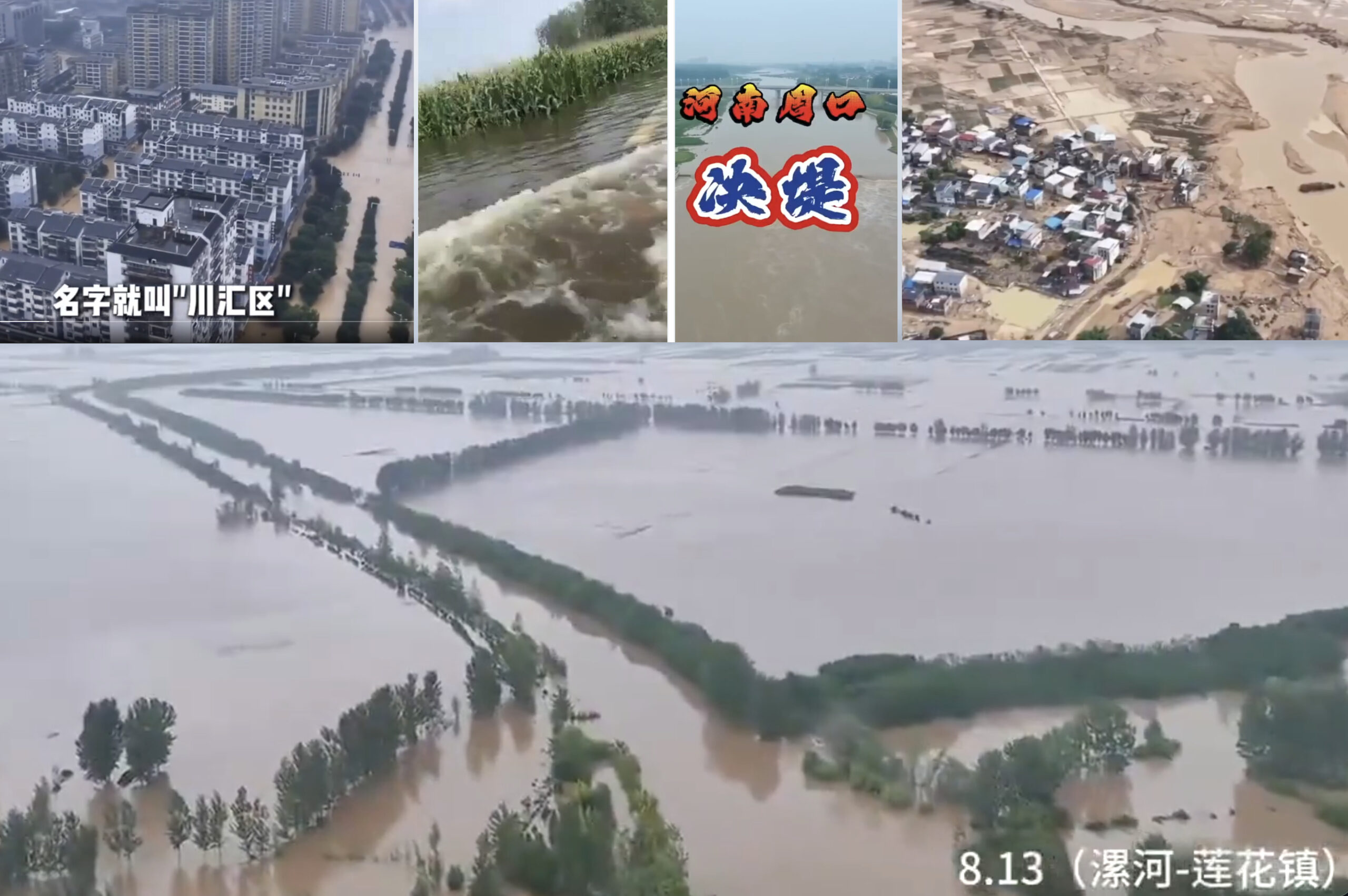
Severe damage from Typhoon “White Dolphin” has been reported in the provinces of Henan, specifically in Pingdingshan, Xuchang, and Zhoukou, where embankments have collapsed one after another leading to serious flooding despite having been sealed off. A local farmer shared his story of being trapped by floodwaters for four days, resulting in the urgent evacuation of nearly 200 live pigs and substantial losses in terms of food supplies and property damage at home. This farmer’s plight is not isolated, as post-flood challenges loom large for farmlands and livelihoods across multiple areas in Henan.
Amid the lingering influence of the remnants of this year’s 13th typhoon, “White Dolphin,” Henan province has been beset by prolonged and heavy rainfall since August 10, causing rivers to run at high levels. Incidents of embankment breach risks have occurred successively in Pingdingshan, Xuchang, and Zhoukou.
On August 12 around 7 p.m., a breach measuring approximately 47.5 meters wide occurred in the north bank civilian embankment of North Ruhe River in Jia County, Pingdingshan. On August 13, a breach of over ten meters appeared in Qingyao River in Yanling County, Xuchang; at around 11 p.m. on the same day, a breach of around 30 meters was detected in the Jalu River embankment in Chuanhui District, Zhoukou, subsequently widening to over 110 meters due to swift water flow. It wasn’t until August 17 that these breaches were sealed off.
Simultaneously, urban areas saw substantial flooding issues. Official reports indicated that on the 16th, 25 spots of accumulated water covering an area of 552,000 square meters were observed in the central urban district of Zhoukou, with 30 residential compounds and 11 areas suffering power outages. As of 7 p.m. on the 17th, the water level at Shaying River still exceeded the warning mark by 3.1 meters.
In the recent days, Henan has faced extensive flooding with breaches in several rivers, spillovers from upstream reservoirs, and large-scale inundation of farmlands.
Despite the sealing off of the breaches, the post-disaster pressure has not abated, with many affected families struggling to cope with the flood. The experience of a farmer in Fugou County, Zhoukou City, reflects the reality of ordinary farmers’ fate in this disaster.
Zhang Xiuying, a resident of Wang Cao Village in Hu Lou Township, Gucheng, Fugou County, Zhoukou City, shared her account of being besieged by floodwaters at her family pig farm and the subsequent losses during a phone interview with Epoch Times reporter on August 18.
Zhang explained that on the morning of August 11, she received a call from her mother informing her that their home was flooded. Upon her return, she found water accumulating in the yard, pig farm, and fields. Even though the rain had ceased by August 12, the water continued to rise slowly, severely affecting the pig farm.
The pigs were unable to rest, feed, or drink properly in the flooded water for about three days, according to Zhang. As raising the pig pens higher was no longer a solution, it became imperative to swiftly relocate the pigs. With the help of a transporter contacted through colleagues, they reached an agreement to transport the pigs at a reduced rate, approximately 14 yuan per head.
On August 15, the official relocation of the pigs commenced. The process encountered difficulties with herds being herded through the water, which was much more challenging than usual. As the water levels rose, relocating the third batch of pigs became even more arduous, with some areas submerged up to waist or higher levels.
The pig relocation operation involved family members, relatives, over ten colleagues, and five civilian rescue personnel. Despite significant injuries sustained by her father during the rescue, the family persisted in evacuating the pigs. By approximately 5:53 pm, three truckloads of pigs were successfully relocated. Out of the original 195 pigs, 194 were safely moved.
Apart from the pig farm, Zhang’s residence, storage facilities, equipment, and supplies were also inundated by floodwaters.
She mentioned that around 20,000 catties of wheat, 20,000 catties of corn, along with soybean meal, feed, and medicines were stored at home, incurring losses of thousands of yuan, notably from the medicines. The damages extended to household and farming equipment, such as refrigerators, electric tricycles, and other transportation and farming tools.
As of August 18, according to Zhang, some areas were still submerged, making it uncertain when the waters would fully recede.
Zhang highlighted the need to clean and disinfect post-disaster roads, pig pens, drainage systems, and expressed the complexities involved in relocating pigs. She illustrated that the village, being a plain agricultural region with extensive arable lands, some parts relatively low-lying, the inundation had rendered the crops irretrievable.
“Our village needs at least half a month for the water to recede; by then, all the crops would have perished. If the water does not recede within the house, you will barely get anything because it has already submerged long ago,” she explained. She raised concerns about the challenges in draining the water, particularly the issue of where to divert overflow since the water had no outlet except downwards.
Stressing that the region previously underwent relocations due to floods, she lamented that their current residential area still faced flood risks.
Zhang has been rearing pigs for more than 30 years, owning a farming facility for about 17 to 18 years. During periods of favorable market conditions with higher pig prices, the family relied on incremental income from pig farming and crop cultivation.
The flooding crisis has not only caused immediate losses in live pigs and equipment damage but has also raised concerns about subsequent disease risks. Zhang emphasized the precarious profitability of pig farming, which poses prolonged investments and hard labor. She noted that in case of an epidemic outbreak, their efforts would be in vain.
She also pointed out pre-existing issues with local water management facilities and gates that were ignored, aggravating the flood situation. “There are many damaged facilities left unrepaired,” she stated. “When the breaches occurred, the water levels rose so high that you couldn’t even find the leaks.”
Zhang’s plight is not an isolated case as post-flood challenges persist across farmlands and livelihoods in various regions of Henan.
As of August 18, many areas in Zhoukou City still grapple with standing water, leading to massive losses in crops across rural areas. Local residents voice grievances over water release from upstream in Zhengzhou diverting into Chuanhui District, inducing the breach on August 13.
Local villagers noted that extensive corn, peanuts, and other crops were severely affected and salvaging operations faced immense difficulties due to the vast areas submerged.
A local farmer, Mr. Zhang from Chuanhui District, Zhoukou, remarked, “With the downstream release, the village, where corn is cultivated predominantly and was only a month away from harvesting, has suffered irreversible losses. Over 100 acres completely inundated with water, nowhere to drain.”
Another farmer in Zhoukou, Mr. Liu, disclosed significant economic losses for farmers cultivating peppers and tobacco, with no subsidies or compensations forthcoming. He lamented the large-scale destruction of the peppers, covering several miles, anticipating a failed harvest. The breach in Jia County, Pingdingshan, led to considerable damages.
According to him, the pepper cultivation area spans from Xihua County in Zhoukou to Fugou County, Yanling County, and Linying County in Luohe, including the renowned “Tobacco Kingdom of Henan” in Xiangcheng County, Xuchang.
Henan is in crisis! 23.7 billion cubic meters of torrential rain!
48 hours and three breach incidents, inundating the city.
The ravaging aftermath of the flooding in Henan has illustrated the catastrophic impact on agricultural livelihoods and the imminent challenges facing the local populace.