
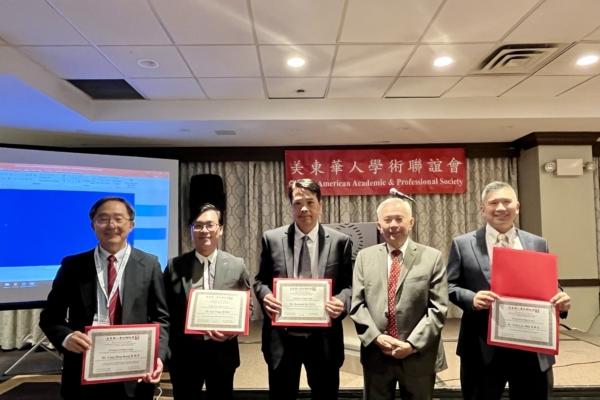
The Chinese American Academic and Professional Society (CAAPS) held its 51st annual conference at the Sheraton Hotel in Flushing, New York on August 16, with the theme “Advancing Academic Knowledge in the Age of Artificial Intelligence.” A total of 23 special lectures were conducted, with a focus on topics such as urban planning and transportation, including AI smart cruise ships, public housing, autonomous driving, and transportation in Chinese communities, exploring the impact of technology, housing, and transportation on urban development.
The special session was convened by former Chief Urban Planner of the New York City Department of City Planning, Xiangyuan Zheng, and featured senior transportation and cruise industry expert Yangming Geng, architect Bingwen He, New York-New Jersey Port Authority autonomous driving traffic expert Zhaojun Zeng, and Chinatown Manhattan physician Huasheng Li as speakers.
Physician Huasheng Li discussed transportation in Brooklyn and Chinatown Manhattan. He pointed out that many Chinese families have moved to Brooklyn due to housing costs, but education, culture, and family connections are still closely tied to Chinatown Manhattan, and inconvenient transportation affects residents’ ability to return to Chinatown. He called on the Metropolitan Transportation Authority (MTA) to study the addition of affordable bus services to improve transportation connections between Brooklyn’s Eighth Avenue, Sunset Park, West 86th Street, and Chinatown Manhattan.
Using the decline in enrollment at Chinatown schools as an example, Dr. Li asked, “What will Chinatown become if there are no children left?” He emphasized that Chinese residents have long paid various taxes and advocating for public transportation is not asking for charity but for rightful public services. He urged Chinese people to actively vote, participate in censuses, and engage in community affairs, proactively expressing their demands to elected officials.
Architect Bingwen He compared the public housing models of Hong Kong and New York. He noted that housing not only meets residential needs but also affects population distribution, traffic flow, and the layout of schools, businesses, and community facilities, stating that “housing is not just about providing a place to live, but an important element of urban planning.”
He explained that Hong Kong has long integrated public housing with new towns, public transportation, schools, hospitals, and commercial facilities to drive urban development, while New York’s public housing focuses more on addressing the housing needs of low-income residents, with later phases mainly involving the maintenance and renovation of existing residences. He believed that a shortage of public housing would force some middle and low-income residents to move away from the city center, increasing commuting pressure. Therefore, housing policies should be integrated into overall urban development, focusing on “designing cities” rather than just buildings.
Transportation expert Zhaojun Zeng introduced the application of autonomous driving technology in airport shuttle systems, describing the technology’s progress from concept to gradual popularization as a transition from “crazy” to normal. He explained that the team has been continuously testing vehicles’ pedestrian recognition, obstacle avoidance, emergency braking, and multi-vehicle coordination safety capabilities in recent years; the airport environment is relatively controllable, and autonomous driving shuttles could provide more flexible transportation options between airport terminals.
“People will be excited the first time they ride it, but feel nothing special the second time.” Zeng said that when passengers no longer consciously perceive that they are riding in an autonomous vehicle, it indicates that the technology has truly matured.
With about 45 years of experience in the transportation field and nearly 40 years in the cruise industry, Yangming Geng presented “Future Global AI Smart Cruising Platform,” proposing the use of AI to establish a global smart cruise integration platform. He stated that in the future, cruises could utilize AI to integrate functions such as ship operations, passenger services, medical health, safety, maintenance, supply chain, and onshore sightseeing, providing safer, smarter, and personalized services.
Geng suggested that smart cruises should consider “intelligence, integration, well-being, sustainability, and value-sharing,” and the benefits created by AI should also benefit passengers, partners, and society, ultimately moving towards a smart living platform where “life is travel, and travel is life.”
Through 23 specialized lectures during the conference, ranging from artificial intelligence technology to urban housing, transportation, and community development, it showcased the opportunities and challenges faced by various professional fields in the era of AI. The urban planning and transportation session further highlighted that future city competitiveness relies not only on technology itself but also on whether housing, transportation, and public resources can truly meet the needs of residents.