
In the Chinese Communist Party’s stability maintenance system, the “Domestic Security Protection” (referred to as “Guobao”) has always been the most mysterious and powerful covert law enforcement force. Despite the official propaganda always packaging its work as “governing the country in accordance with the law” and “maintaining national security,” a recently leaked internal training document from a grassroots Chinese Communist Party public security agency has exposed the dark secrets of this national security machinery.
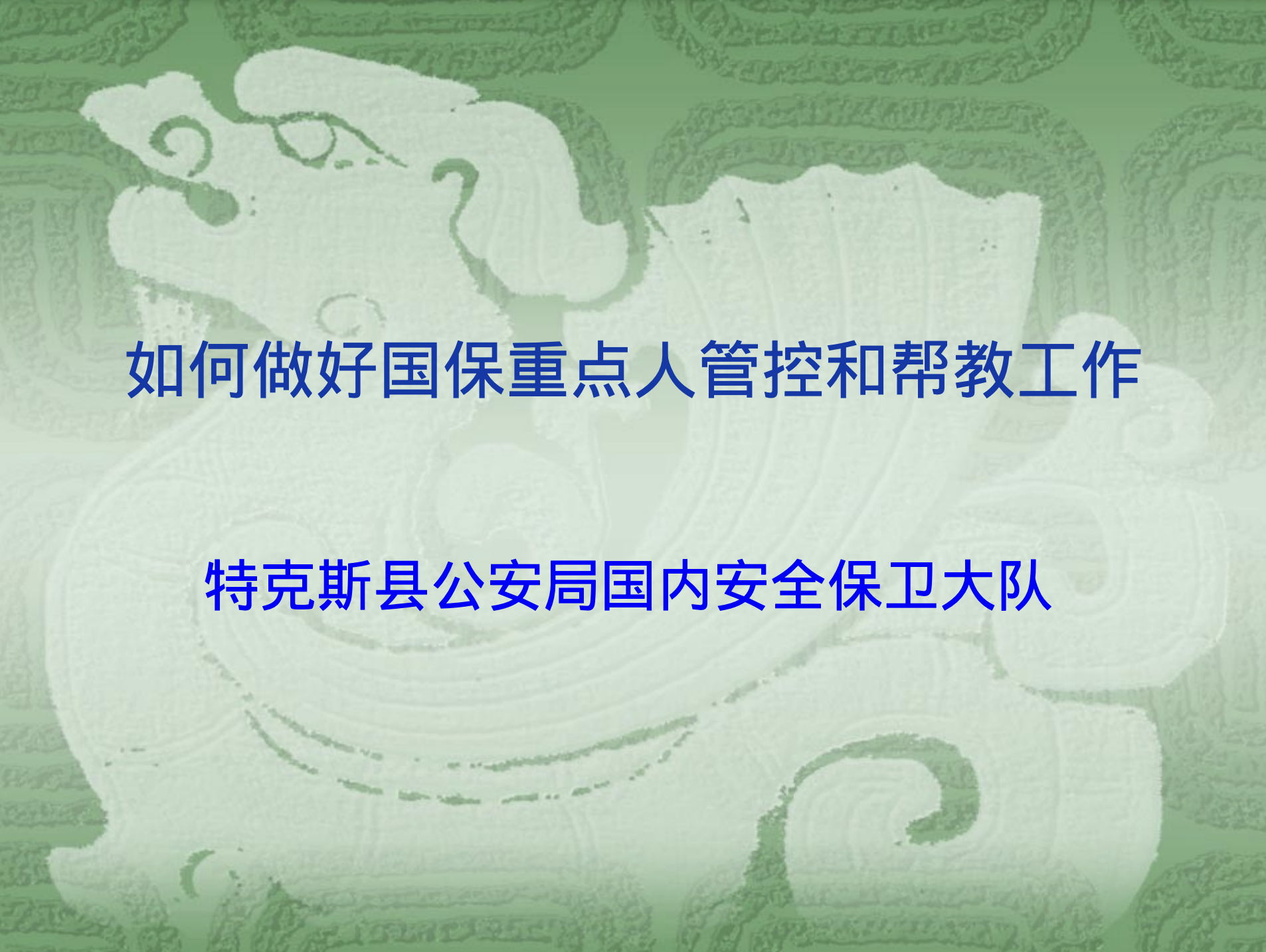
Epoch Times recently obtained an internal document issued by the Guobao Brigade of the Tekes County Public Security Bureau in Xinjiang, titled “How to Do a Good Job in Controlling and Helping Education for Key Guobao Targets,” prepared in 2013.
In this document of tens of thousands of words, the authorities not only detailed 17 categories of so-called “suppression targets,” but also systematically summarized the “18 control strategies and methods” used by grassroots Guobao in practical work. From coercing citizens into compliance using “dirty secrets,” employing administrative measures for “economic suffocation,” to covertly “manufacturing internal unrest” and “depoliticizing political issues,” etc., this set of “sinister tricks” reveals the underlying operational logic of the Chinese Communist Party’s stability maintenance system for outsiders to understand.
The document directly points out the essence of Guobao work in the opening section, which is to “defend the political power of the people’s democratic dictatorship and the socialist system.”
Unlike ordinary criminal or public security police, the document explicitly positions the Guobao as an important force in “covert struggle,” emphasizing its main features of “secrecy,” “sharpness,” and “extremism and cruelty in means.” The document also admits that Guobao work is a “invisible front line” that must fully utilize the advantages of “intelligence personnel, secret forces, and technical means” in practical operations.
Notable is that, although the document claims that the Constitution, Criminal Law, National Security Law, and other laws are the formal basis for Guobao work, when describing specific control methods, the law is often blurred or disregarded. For example, the document requires Guobao police to fully utilize the “political advantages of the state, the open management advantages of public security organs, various social resources, as well as strategic methods, technological methods,” to achieve “combat, restriction, prevention, education, agitation, and disintegration” combined, essentially authorizing law enforcement personnel to use various means beyond the law, even illegal, to achieve political control goals.
The most shocking aspect of this internal “training material” is its systematic summary and theoreticalization of illegal control methods that have long been questioned by the outside world but lacked official direct evidence. The document listed the “18 control strategies and methods” for “key Guobao targets,” demonstrating the extreme level of mafia-style operation of this national machinery.
1. “Overall Joint Law”: Mobilize Party, government, military, police forces, and all of society to besiege.
The document emphasizes that control work must be implemented under the leadership of the Party committees and governments with three joint operations: internal police coordination combining Guobao (secret forces), technical reconnaissance (phone tapping, mail interception), and internet monitoring departments tightly, “like the joint military operations of land, sea, and air on the battlefield”; inter-regional public security coordination; cross-government department coordination, such as all levels of Party committees, governments, people’s congresses, propaganda, education, communities, and units where key individuals are located to jointly implement control, forming a network to besiege the “key individuals” throughout society.
2. “Space Compression Law”: Cut off living resources and external contacts.
To weaken the activity energy of key individuals, the document advocates direct and indirect space compression. Indirect means are vividly summarized by the authorities as “cut off oxygen, tie hands, bind feet, cover eyes, and plug ears.”
“Cut off oxygen”: Use administrative means to compress the key person’s wages, bonuses, and benefits, and work with banks to restrict remittances from overseas entities or individuals, economically cutting off the key person’s source of livelihood.
“Tie hands”: Coordinate industrial and commercial, tax, and other departments to restrict and suppress the key person’s business operations.
“Bind feet”: Seize vehicles such as cars and motorcycles used by key individuals in their activities, making their movements inconvenient.
“Cover eyes”: Seize computers used by key individuals in their activities, making it difficult for them to access the Internet.
“Plug ears”: Seize mobile phones used by key individuals in their activities, making communication inconvenient for them.
3. “Administrative Constraints Law”: Arrange unit control and enclose them.
The document states that key individuals with fixed units are easier to manage than those without fixed units. Therefore, the document aims to make every effort to keep key individuals with fixed units in their original units. For those without units, with the coordination of Party committees, governments, and relevant departments, key individuals can be assigned to work units.
The document indicates that this arrangement has two advantages: one is that key individuals’ energy can be restricted to work through workload and work responsibilities; the other is that the unit can restrict key individuals through administrative means such as annual assessments, restrictions on unauthorized absences, and even mobilizing colleagues for supervision, saving Guobao’s resources.
4. “Close Surveillance Law”: Internet monitoring + grid officers create a comprehensive surveillance system.
During sensitive periods, an established “Stabilization and Control Special Team” led by comprehensive governance committees or petition departments is set up to use special investigations, technical reconnaissance, and internet monitoring measures. Technical reconnaissance equipment is installed at the key individual’s residence entrance and community security guards and workplace personnel are mobilized for 24-hour strict supervision, creating a comprehensive surveillance system.
5. “Diversion Strategy”: Forcibly relocate under the pretext of official business or tourism.
When a key individual plans to initiate activities during a specific period, the document suggests that Guobao police can adopt a “diversion” strategy to relocate the key individual to prevent their activities. For example, for key teachers, they are organized to participate in activities by the education system, for National People’s Congress representatives, they are organized by the local People’s Congress to go on “inspections,” and for key individuals without units, they are organized by the community to go on “tourism,” diverting the key individual away from the site.
6. “Utilize Leverage”: Collecting dirty secrets for coercion.
The document frankly states that “leverage is a person’s soft spot, even a tough guy can be easily subdued,” requiring police to thoroughly investigate whether key individuals have engaged in illegal or immoral “dirty deeds” such as illicit sexual relations, gambling, corruption, and bribery. After investigating and obtaining evidence, they are to “temporarily not disclose it publicly,” instead using these situations as “leverage” to warn key individuals, “to stop their activities, or make them write a written guarantee, or coerce them to obey my commands and serve me.”
7. “Cause Discord and Disintegration”: Spread rumors and internal turmoil.
In the face of rights protection or petitioning groups, the document requires Guobao police to act as rumor mongers, utilizing internal conflicts within key individuals’ groups to “create internal turmoil,” causing suspicion and mistrust among comrades to achieve the goal of disintegration. For example, spreading rumors among a petitioning group’s main core that “they don’t participate in petitioning, letting others serve as cannon fodder to benefit themselves”; spreading rumors in the rights funding sector that “the core embezzles collective fundraising funds”; instigating “there are traitors within” when activities are obstructed. These rumors can be spread through special situation personnel, friends, unit leaders, colleagues, or police by conveying “secret messages,” undermining the cohesion of key individual groups.
8. “Forced Expulsion Law”: Implement expulsion using grassroots forces.
For out-of-town key individuals who coordinate or interfere in local affairs, the document advocates the use of “public, faceless, hard methods.” For example, using reasons like “local affairs should be administered by local people, outsiders shall not interfere,” these key persons intervening in elections are kicked out of the venue; using “no press credentials,” to expel key individuals who come to investigate private teacher treatment, immigration funds, and other local affairs; and direct coordination with the key person’s unit to dismiss them and forcibly expel them from the jurisdiction by police.
9. “Familial Influence”: Pressure family members for dual effects.
The document requires Guobao police to work through the key individual’s parents, wife, children, and other family members, using family ties for influence or pressure. Not only must they influence key individuals through this means, but they must also prevent surrounding family members from being influenced, achieving the dual objectives.
10. “Conversation and Repressive Education”: High-pressure admonishment to destroy psychological defenses.
Government personnel with intimidating effects such as Guobao police, procuratorates, or court personnel must have face-to-face talks with key individuals. The document specifically points out that this strategy utilizes non-violent means, admonition, co-action, and intimidation, “aiming to destroy their psychological defenses,” making them voluntarily give up their desires for activities.
11. “Network Investigation and Control Law”: Organize writers to counter online activities.
For key individuals’ online activities, the document requires taking internet monitoring measures to track their movements, eliminate the impact of their negative propaganda, obtain potential evidence of illegal activities, and it emphasizes coordinating with local internet monitoring and propaganda departments to organize writers to counter key individuals’ online articles to address their views, eliminate their influence, or publicly announce their “violations” online to render them without a “market.”
12. “Technical Interference Law”: Covert remote control warfare.
In specific situations, Guobao can use technical means to interfere with the key individual’s communication tools, preventing them from communicating normally with the outside world or controlling network bandwidth flow to make internet access difficult. The document explicitly states, “This is called remote control warfare.”
13. “Close Combat Method”: Multilayered blockade and direct interception.
If a key individual does not heed advice and insists on engaging in petitioning, meetings, coordination, or meeting with foreign journalists, Guobao police need to forcibly prevent or directly intercept them. The document calls this method “close combat” warfare: including community personnel intercepting at home doors; security personnel intercepting at vital intersections; traffic police intercepting vehicles and other transportation used by key individuals; railway police intercepting from trains, etc.
14. “Border Control Prevention”: Three major tactics of border controls.
The document detailed three border control tactics: limiting exit for those preparing to participate in conferences abroad, termed as “dulling their vigor”; restricting entry for those abroad participating in hostile organizations, terming it “restricting their entry”; for key individuals who are difficult to deal with in the country but attempt to leave, moving them overseas first, then processing their restricted entry, preventing them from returning.
15. “Summons Prevention Law”: Leaders without followers tactic.
When key individuals gather, the local police station should take them away for review stating “received public reports”; or on the eve of a large-scale petition, selectively summon core organizers or contacts to create a situation where “there are no leaders in the army and no heads in a multitude,” causing an inability to proceed with activities.
16. “Educational Training Method”: Soft against hard indoctrination seminar-style brainwashing.
Using the method of organizing “legal education and training classes” (commonly known as brainwashing classes) to indoctrinate key individuals. The document emphasizes that this method uses a soft approach against a hard approach, inviting different experts to educate different subjects, such as leaning towards those dissatisfied with the system by having Party history experts preach that “only the Communist Party can lead and govern the country,” etc.
Specifically, having political science professors lecturing on the achievements of the CCP and the importance of maintaining political stability; having party and government leaders speak on international and domestic situations, saying that “the West fears China’s strength,” democracy is “deceptive propaganda.”
17. “Forced Discipline Method”: Hard against hard, closed forced indoctrination
For key individuals not influenced by “general education,” the document requires, based on collecting and fixing evidence, to take compulsory measures such as criminal detention, residential surveillance, to “restrict personal freedom,” conducting educational management in a “forced” manner.
18. “Violent Strikes”: “Kill one to warn a hundred” achieves a deterrent effect.
For key individuals unwilling to compromise, “strikes handling” must be implemented, using a “violent storm approach” to stop their activities, achieve “kill one to warn a hundred, and intimidate most key individuals.” For key individuals they have evidence against, Guobao will investigate their criminal responsibility, resulting in a loss of personal freedom.
In addition to the suppression methods, this document provides a full disclosure of the “17 categories of key Guobao targets” determined by the Chinese Ministry of Public Security. (Ministry of Public Security [2002] No. 20 “Opinions on Further Strengthening and Improving the National Security Protection Work of Public Security Organs”)
In addition to the so-called overseas hostile forces, ethnic separatist forces, religious extremism, and “cults” defined by the CCP, the list vastly extends to ordinary citizens’ daily lives and online expressions.
For example, the 14th category is people who speak out on the internet; the 15th category is individuals calling for public attention to social conflicts and hot issues; the 16th category is individuals deeply dissatisfied with society, seeking to improve it; and the 17th category uses “other personnel” to cover the individuals to be targeted. These individuals are identified as “endangering national security and social-political stability.”
This list indicates that the CCP’s reach for stability maintenance has far exceeded traditional national security boundaries, encompassing all dissatisfied voices towards the government in civil society.
To achieve control over these 17 categories of “key individuals,” the document constructs “one to four levels” of strict control levels and implements a “national strategy” of “co-control” and “trans-control” mechanisms. For example, when key individuals leave their registered hometowns to work, seek medical treatment, or travel elsewhere, both the origin and host public security personnel must complete handover surveillance procedures within 5 days. The threshold for “withdrawal control” (lifting control measures) is astonishingly high – defined officials of levels one and two key subjects must undergo a 5-year observation period without incident before requesting a “withdrawal control” application, and any signs of instability will immediately trigger a “re-control.” This means that once an individual is placed under Guobao surveillance, they face a lifetime of monitoring and control fate.
This leaked document from grassroots public security in Xinjiang, like a mirror, reflects the true face of the Chinese Communist Party’s stability maintenance machinery. While the CCP claims to “govern the country in accordance with the law” and “build a rule of law society,” the operation of its Guobao system is a mafia-style control process that combines blackmail, rumors, economic blockade, personal restrictions, and judicial persecution.
Political commentator Li Linyi pointed out that the leaking of this document is far more valuable than a typical leak. For persecuted human rights activists, religious groups, and dissenters, it is ironclad evidence of the CCP’s authoritarian wrongdoing. For ordinary people, it exposes the regime’s worst kept secret – deep-rooted fear. What is even more chilling is that 2013 was a relatively loose period of control by the CCP, yet the methods used at that time were already so despicable. Today, more than a decade later, the CCP’s surveillance network has tightened on all fronts, and their methods will only become more stringent and more malicious, with likely more hidden tricks unseen by the outside world. The fact that a regime must rely on collecting citizens’ privacy as leverage, spreading rumors internally, even cutting off livelihoods to maintain control, shows that its proclaimed “institutional confidence” no longer exists.