
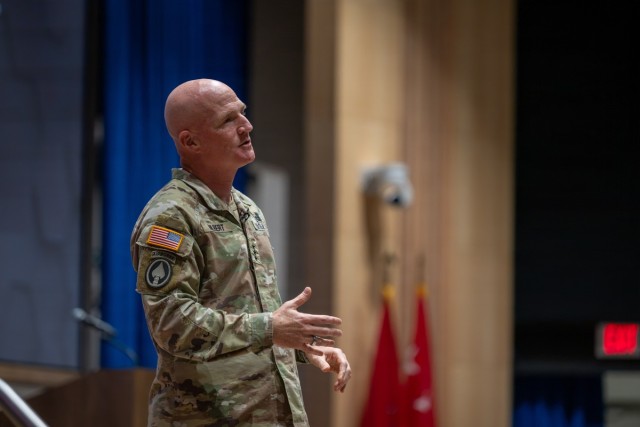
The US military is emphasizing the ability of its troops stationed in South Korea to execute missions outside of the Korean Peninsula. Joe Hilbert, the commander of the US Eighth Army, recently stated that the US troops in South Korea must be prepared to deploy outside the peninsula as ordered while continuing to uphold America’s defense commitment to South Korea.
Hilbert, in an email interview with the South China Morning Post, emphasized that one of the primary missions of the Eighth Army is to fulfill the defense commitments outlined in the US-South Korea Mutual Defense Treaty. He highlighted that the forces stationed in South Korea should not be restricted from carrying out other missions, stating that focusing solely on security threats on the Korean Peninsula would be “irresponsible.”
Positioning the Eighth Army as part of America’s global military capabilities, Hilbert stressed the need for the troops to maintain readiness to deploy to relevant regions when ordered by US national command authorities. He also mentioned the participation of the Eighth Army in multinational military exercises in the Asia-Pacific region as an example of its activities extending beyond the Korean Peninsula.
This statement touches on the considerations of the mission scope of US forces stationed in South Korea. Traditionally, the core mission of the US troops in South Korea has been to deter North Korea and support Korea’s defense. As the US continues to adjust its military deployments in the Indo-Pacific region, discussions in Washington include enhancing the strategic flexibility of troops in South Korea to respond to security situations outside the peninsula when necessary.
The Eighth Army’s 2026 Campaign Strategy document mainly discusses how the US military should address security challenges in the Korean Peninsula and the broader Indo-Pacific region. The document highlights that Chinese military actions against Taiwan could trigger larger-scale conflicts in the Indo-Pacific region, potentially impacting the Korean Peninsula situation and regional conflicts.
According to US military information, the Eighth Army is responsible for supporting the United Nations Command, US-Korea Combined Command, and missions related to deterring North Korea’s military actions. The unit also conducts readiness training and relevant operational support tasks. Hilbert assumed command of the Eighth Army on October 23, 2025, having previously served as the commanding officer of the US Army’s 11th Airborne Division.
With around 28,500 troops deployed in South Korea, the US forces play a crucial role in the US-Korea security alliance. The US-South Korea Mutual Defense Treaty, signed in 1953 following the Korean War, underscores the ongoing military cooperation between the two nations to address security threats on the Korean Peninsula.
The capability of US forces in South Korea to execute missions outside the peninsula has been a significant topic of discussion in the US-Korea alliance adjustments. During his visit to Korea on November 4, 2025, US Secretary of War Pete Hegseth stated that deterring North Korea remains the core of the US-Korea alliance, but US forces need the flexibility to address security situations in other regions. He mentioned that the US troops in South Korea may need to address security issues beyond the Korean Peninsula in the future.
At the time, Reuters reported that the US was considering enhancing the strategic flexibility of its forces in South Korea to address a wider range of regional security threats, including activities in the Taiwan Strait and around China’s periphery. The report also highlighted the cautious stance of the South Korean government regarding changes in the mission scope of US troops in South Korea.
Randall Schriver, former Assistant Secretary of Defense for Indo-Pacific Security Affairs, expressed at a forum hosted by the Korea Institute for Defense Analyses in June this year that expanding the “strategic flexibility” of US troops in South Korea would enhance deterrence and contribute to a more stable security environment in the Indo-Pacific region.
However, expanding the mission scope of the US troops in South Korea also involves coordination between the US and South Korea regarding defense responsibilities and troop movements. South Korea is concerned about whether such adjustments would affect peninsula defense and the potential for being drawn into conflicts in other regions.
Hilbert’s recent emphasis on the troops’ capabilities to carry out missions outside the peninsula without disclosing specific redeployment plans or confirming the US decision to deploy US forces in South Korea to other operational areas.