
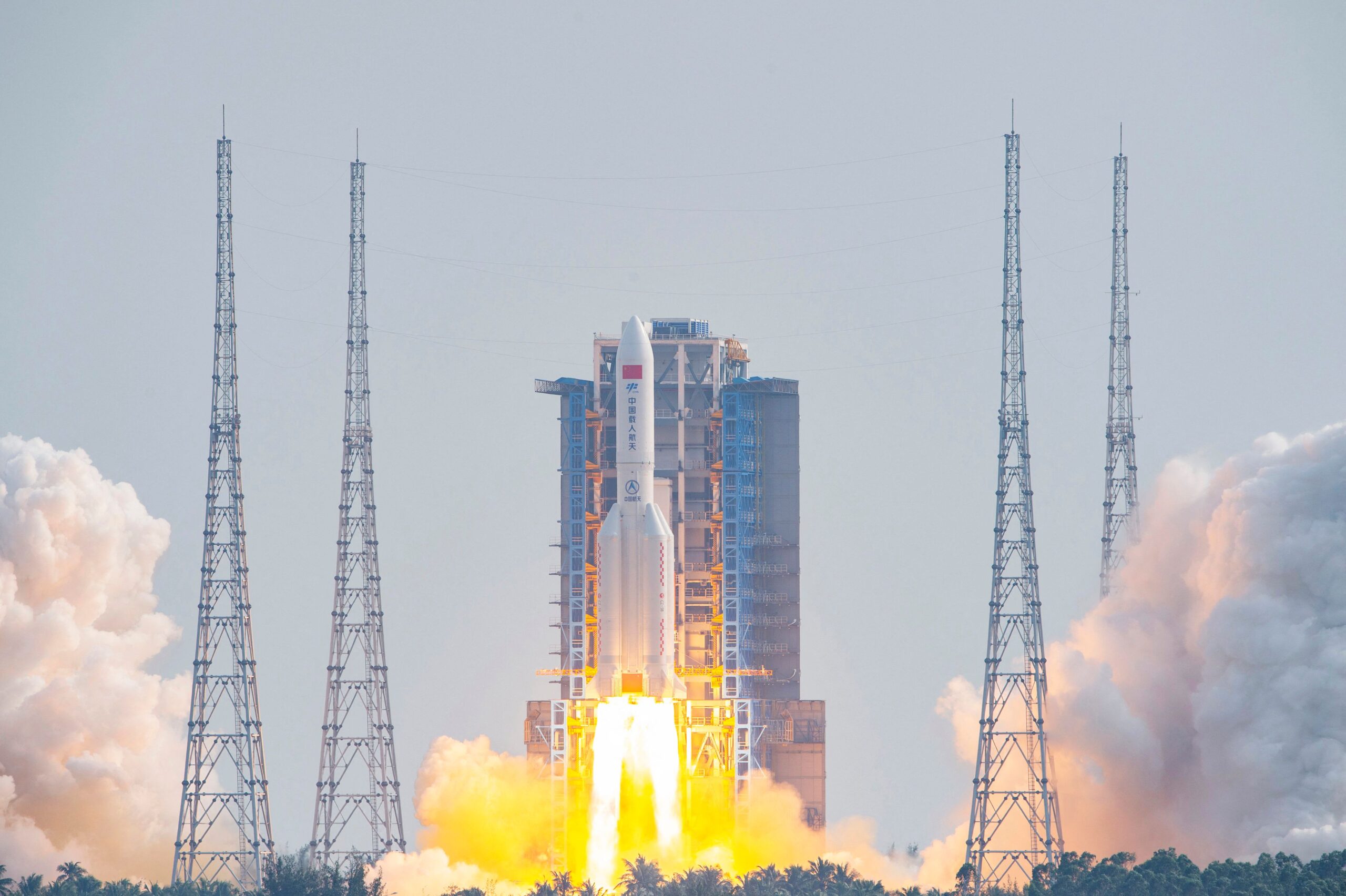
In Scott Township, Stevens County, Minnesota, a farmer made an unexpected discovery while harvesting corn – a metal object with a diameter of about 11 feet (approximately 3.35 meters) peacefully lying in the soil. The object, found on October 14, 2026, is speculated to be debris from the upper stage of a recent launch of a Chinese “Zhuque-2E” rocket.
This finding has raised a sharp question: Did the disposal operation aimed at reducing orbital debris lead to rocket debris that should have fallen into a remote maritime area instead landing on rural American land?
Although this link has not been officially confirmed, the discovery has prompted discussions about the unintended consequences of space debris management procedures. The authorities confirmed that the object, approximately 11 feet in diameter and with a serial number, poses no direct danger to the public.
According to a statement from the Stevens County Sheriff’s Office, the object that fell in the field is likely spacecraft debris. The condition of the corn underneath the object indicated that it had been in the field for weeks before being discovered by the farmer during harvest.
Investigators have removed and secured the object, while state and federal agencies are verifying its origin and ownership. No injuries have been reported so far.
The size of the object aligns with the known diameter of the upper stage of the “Zhuque-2E Y7” rocket, but its specific attribution has not been officially confirmed.
On September 15, 2026, LandSpace launched a “Zhuque-2E Y7” rocket from the Dongfeng Commercial Aerospace Innovation Test Area in northwestern China, carrying 10 “Qianfan” communication satellite constellations. The launch site is in the same region as the Jiuquan Satellite Launch Center operated by the Chinese military.
After delivering the satellites into orbit, the Chinese rocket reignited its engine and followed a trajectory that led to its debris falling in the central United States.
The rocket’s flight on September 15 lasted 75 to 80 minutes before prematurely reentering the atmosphere without completing a full orbit around the Earth. Eyewitnesses reported seeing debris with fiery tails flying north over Kansas, eventually reaching Minnesota. People in Wisconsin also witnessed the nighttime spectacle on the western horizon.
Based on the specific time, location, and direction of the debris sightings, experts have linked the unidentified object in the Minnesota cornfield to the “Zhuque-2E” rocket launch. The approximate 11-foot diameter of the object matches that of the rocket’s upper stage.
However, this connection remains a technically plausible hypothesis rather than a confirmed fact.
When dense rocket components reenter the Earth’s atmosphere, they may not completely burn up. Errors in calculation or execution during the disposal process could lead to the transfer of risks from orbit directly to the Earth’s surface.
Responsible disposal methods typically designate remote areas (often in the ocean) to ensure debris does not pose harm to people or property upon reentry. It remains unclear whether the failure was due to the braking burn not being executed or the debris spreading beyond the anticipated range in this instance.
Minnesota law enforcement officials assured that the debris does not pose a danger to the public. However, if the object had reentered the atmosphere over more densely populated areas, the situation might have been different. While no severe injuries have been reported from falling space debris in the past, instances of property damage have occurred.
Under international law, countries launching objects into space bear responsibility for any ground damage caused by their debris.
Chinese rockets have previously encountered issues in this regard, such as uncontrolled reentries into the atmosphere or on-orbit breakup events. In contrast, U.S. rockets conducting missions in low Earth orbit typically reserve enough propellant for controlled disposal.
The “Qianfan” constellation project requires a continuous launch frequency, resulting in a growing number of discarded upper stages that need careful disposal at the end of each mission. With the increased satellite count, launch frequency, and upper stage quantities, the already complex chain of tracking and disposal has become more challenging.
During a flight in June, an upper stage of a “Zhuque” rocket disintegrated after completing its mission, leaving dozens of fragments in a congested low Earth orbit area. This region hosts the International Space Station and numerous satellites from SpaceX’s “Starlink” broadband network. Fortunately, due to the rocket’s altitude at the time, the majority of the debris is expected to reenter the atmosphere and burn up within a few months.
LandSpace, the company that owns the “Zhuque” series rockets, has not publicly acknowledged debris falling in Minnesota.
【This article has been referenced from technology news and commentary websites Ars Technica and Yahoo News】