
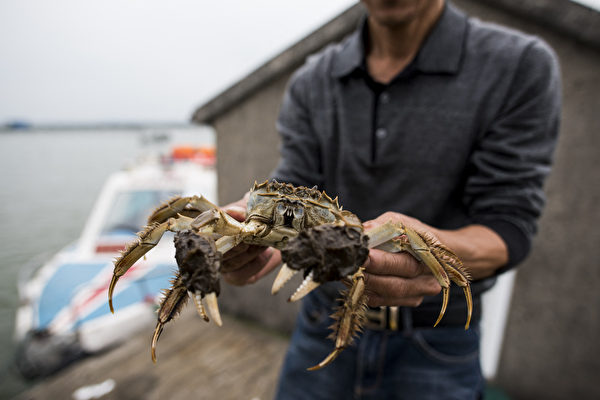
China’s hairy crabs have entered the peak season for listing, but the price of some small-sized male crabs has dropped to less than 10 yuan each. In recent years, the production of hairy crabs has continued to increase. After the peak demand for festival gifts subsided, the pressure of falling prices has spread along the industry chain. Crab breeders are facing difficulties in recovering costs, while distributors are bearing price differentials and losses risks. Even the business of selling crab cards, which are vouchers for purchasing crabs, is also being impacted.
According to a report by Interface News, in the Shanghai market, small male crabs weighing two taels are selling for 8 yuan each, and the price can drop to 6 yuan if more than ten are bought at once. At another booth, male crabs weighing four taels and female crabs weighing 2.8 taels are being sold for 18 yuan each. Female crabs weighing three taels with the origin label of Yangcheng Lake are being sold at nearly 50 yuan in supermarkets. At the Beijing Xinfadi wholesale market, female crabs weighing three taels are averaging 66.5 yuan per catty, which is approximately 19.95 yuan each.
This means that there is a significant price difference for hairy crabs of different sizes, origins, and sales channels. Premium crabs are sold at higher prices, while during times of increased supply, the prices of medium and small-sized products are lower.
The market situation for hairy crabs is highly dependent on the production volume.
It has been reported that over the past five to six years, the net annual production of crabs nationwide has increased by two to three thousand tons each year, reaching 939,000 tons in 2025. This year, favorable weather and environmental conditions may result in a total production of up to 1 million tons.
Additionally, due to the early date of the Mid-Autumn Festival this year, which fell before the peak season for hairy crabs, prices were driven up by the demand for gifts and banquet invitations before the festival. However, after the Mid-Autumn Festival and the National Day holiday, more crabs entered the market, leading to a decrease in demand for gifting and a subsequent price drop.
Data from the Zhangyang Fine Aquatic Products Trading Market in Xinghua, Taizhou, Jiangsu Province, shows that the purchase price of female crabs weighing two taels per catty dropped from 39 yuan on September 29 to 29 yuan on October 7, a decrease of approximately 25.6%. The wholesale price at the Beijing Xinfadi market also dropped by more than 10 yuan per catty after the National Day holiday.
The cost of breeding crabs is not low. According to data from Hongcan.com, the costs of pond rental, feed, water and electricity, and daily management for crab breeding range from 7,000 to 12,000 yuan per mu. For high-standard ponds in Yangcheng Lake, the annual cost per acre is close to 12,000 yuan. By calculation, the comprehensive cost of a four-tael male crab is about 42.5 yuan.
These cost figures may not be applicable to all production areas, sizes, and breeding models. The higher price of premium crabs does not mean that all breeders can shift to high-priced products. It is more critical to increase the proportion of large-sized crabs that meet market demand rather than simply increasing the weight of the crabs harvested. Furthermore, higher investment in breeding also requires corresponding sales channels to absorb it; otherwise, there might still be price pressures during peak listing periods.
Price pressures will also affect the purchase and wholesale sectors. When the market is on a downward trend, the longer the time between receiving and selling, the greater the price differential risks that distributors face. Additionally, losses in live crab temporary storage and transportation will erode profits.
With the increase in the production of hairy crabs, traditional crab card businesses are facing competition in spot sales this year. Some crab sellers have reported on social media that the growth rate of crab card sales this year is not significant. On second-hand trading platforms, some crab cards with prices in the hundreds of yuan are being heavily discounted.
The “crab card business” is a light-asset commercial model involving “futures sales + financial turnover + gift economy”. Businesses do not need to breed in advance or stockpile a large number of live hairy crabs. Instead, they obtain substantial cash flow and profits by selling vouchers in advance.
There are over 4,000 records related to crab cards and vouchers on the Black Cat complaint platform, involving issues such as being unable to redeem, shortages in weight, and unresponsive merchants. The willingness of consumers to pre-purchase vouchers may be affected.
As a result, some businesses have shifted to spot sales, accepting orders through live broadcasts, e-commerce platforms, and existing customers before shipping directly to consumers. This method can reduce dependence on preselling vouchers, but businesses still need to bear the costs of inventory, transportation, and losses of live products.