
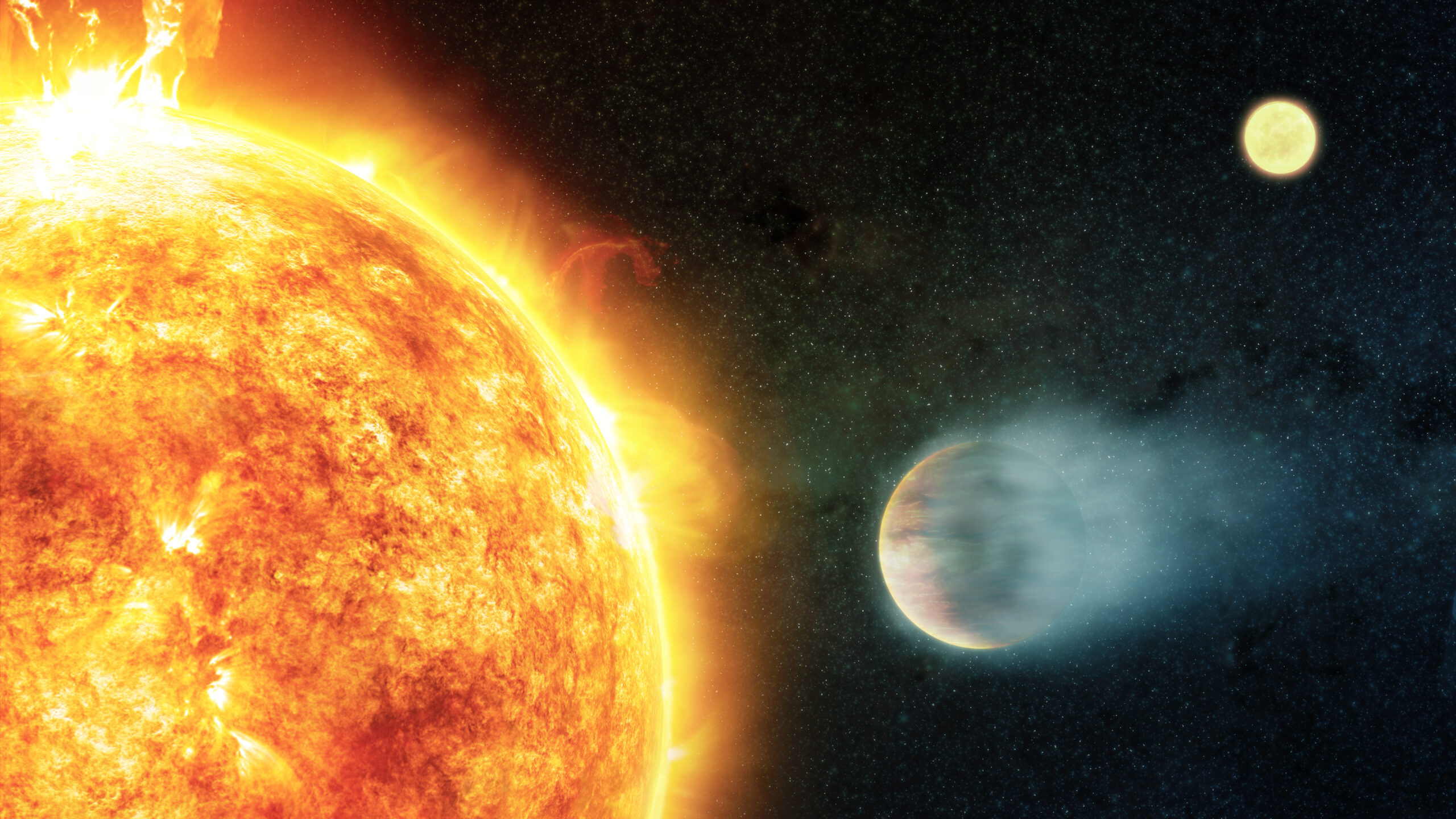
Researcher revealed a method to collect “fingerprints” on the sun similar to forensic investigators at a crime scene, uncovering strong evidence that the sun had once “murdered” – engulfed its own planets in the past.
When astronomers scanned other star systems in the galaxy using space telescopes, they discovered a common phenomenon: many stars were surrounded by “Super-Earths” with masses several times that of Earth. However, why is it that our solar system lacks these common giant rocky planets inside?
A recent study published in the “Monthly Notices of the Royal Astronomical Society” provided a fascinating answer to this long-standing mystery in the astronomical community. Mutlu Yildiz, an astrophysicist from Ege University, and his team pointed out that during the sun’s infancy in the Pre-Main Sequence, it may have engulfed a “Super-Earth” with a mass 5 to 10 times that of Earth, leaving behind lasting chemical imprints deep within itself.
Described as a “forensic investigation” in astrophysics, the team’s work sought to bridge the discrepancies between the standard solar model and actual observational data in the astronomy field. One of the most prominent disparities being the “Lithium Problem” – the low lithium content on the sun’s surface, far below theoretical predictions and other similar stars and primitive meteorites.
Professor Yildiz, a co-author of the paper, explained, “Young stars are born within massive protoplanetary disks where gas and dust are abundant and accreted onto the star.” He continued, “Since planets undergo material differentiation during their formation, their chemical composition differs significantly from the primitive gas in the protoplanetary disk. This prompted us to consider: if a young sun devoured a fully formed planet in its early evolution, would it leave enduring chemical signatures inside the sun?”
To validate this hypothesis, the research team utilized the Modules for Experiments in Stellar Astrophysics (MESA) open-source stellar evolution software, a core tool in modern stellar physics, to conduct precise numerical simulations of scenarios involving the sun’s accretion history with different masses and compositions.
Subsequently, the team compared the simulated internal structure of the sun with precise observational data from helioseismology, which detects sound wave oscillations on the sun’s surface. This method allows for a detailed examination of the solar interior’s sound speed distribution, density structure, and the depth of the convective zone like a medical CT scan.
The simulation results showed:
1. Explanation for the disappearance of lithium elements: When a “Super-Earth” with a mass of about 5 to 10 times that of Earth was engulfed by the sun, the dissolved high metallicity material altered the average molecular weight and opacity of the sun’s outer convective zone.
2. Mechanism for deepening of convection zone: This led to the early sun’s convective zone extending deeper, carrying surface material into the deep layers of the star where temperatures exceed 2.5×10⁶ K, leading to efficient destruction of lithium elements through nuclear reactions at high temperatures, perfectly explaining the sun’s low lithium content.
3. Matching helioseismology sound speed profile: Models incorporating material from the “Super-Earth” yielded a convective zone boundary position and sound speed profile that more closely aligned with current helioseismology observations than the traditional standard solar model.
If this hypothesis continues to be substantiated, it suggests that the early solar system likely harbored a “Super-Earth” inside Mercury’s orbit (Mercury being the closest planet to the sun in the solar system), but it migrated inward due to gas drag in the protoplanetary disk or gravitational perturbations between planets, eventually falling into the nascent sun. The molten planetary material at high temperatures still precipitates near the tachocline at the bottom of the sun’s convective zone.
Although obtaining definitive evidence will require higher precision helioseismology observations and spectroscopic analysis of neutrinos, this research undeniably opens up a new path for astronomers – by probing the sound waves and chemical features inside stars, we can not only understand their current state but also “reconstruct” their history from billions of years ago. ◇