
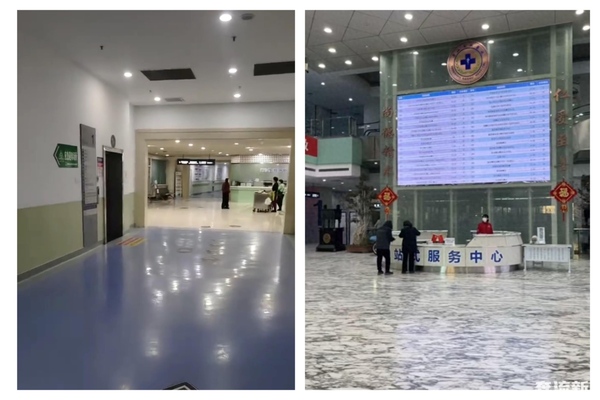
Recently, the topic of “Staff Layoffs in Top Hospitals” has sparked widespread attention. On August 31st, related keywords trended on social media platforms, leading to discussions on whether the “iron rice bowl” in the medical industry is beginning to loosen.
Many netizens and healthcare professionals have reported on social media platforms that some hospitals have recently undergone adjustments in administrative, logistical, and non-clinical positions, with healthcare workers also experiencing a decrease in performance-based income. Some practitioners mentioned that certain hospitals have streamlined personnel through methods such as not renewing contracts upon expiration and staff reassignments.
There have been rumors circulating online stating that by the end of 2026, administrative and logistical staff in tertiary public hospitals should account for only 15% compared to the previous national average of 22.7%.
The decline in doctors’ income is another phenomenon drawing attention. A blog post by “Mr. Wang’s Afternoon Tea” on August 31st highlighted the challenges hospitals face, attributing them to delayed hospital payments through medical insurance, making hospital operations even more difficult.
The second reason cited is that many hospitals have expanded significantly in recent years, establishing branch campuses and constructing new facilities, which have increased the hospitals’ debt pressures. Many hospitals have blindly expanded, acquiring land for branch campuses, leading to an increasingly bloated staff structure and an inability to repay infrastructure costs.
The article mentioned that county-level and city-level secondary hospitals are facing dire situations, with many hospitals unable to pay salaries, facing widespread bankruptcy and closures. Even with temporary financial support, there are significant long-term issues.
On August 31st, previous articles from “Trio Life Weekly” were widely shared once again. The magazine had previously interviewed an orthopedic surgeon from a second-tier city tertiary hospital, who stated that after practicing for over a decade and holding a deputy chief title, their average monthly income had dropped from around 15,000 yuan to just over 10,000 yuan.
The financial pressures faced by hospitals are supported by public data, and the situation varies significantly among different regions and types of hospitals.
A document released by the Finance Bureau of Ankang City, Shaanxi Province in 2025 mentioned the financial challenges confronting most public hospitals in Ankang City, especially city-level public hospitals, including slowing or declining revenue growth, increased cost pressures, deficits, cash flow shortages, and debt risks. The document cited Ankang Central Hospital, with total debts reaching 850 million yuan as of 2024, with current liabilities of 700 million yuan, an asset-liability ratio of 46%, indicating substantial short-term debt and cash flow risks.
In late March to early April this year, the mass layoffs at Jiangxi Leping Tianhu Hospital also garnered attention. Official reports stated that the hospital, founded in 2015, is a second-tier Class A comprehensive private hospital with 315 employees. Since March 2025, the hospital had experienced a continuous decline in business volume, facing operational difficulties and salary arrears for employees. Subsequently, some individuals were investigated for suspected violations of medical insurance fund supervision regulations.
It is important to note that Leping Tianhu Hospital is a second-tier Class A private hospital, not a top tertiary public hospital.
However, from a policy and official data perspective, the operational model of Chinese public hospitals is indeed undergoing changes.
The “2023 National Performance Monitoring and Analysis Report on Tertiary Public Hospitals” published by the National Health Commission and seven other departments revealed that 2,168 tertiary public hospitals participated in performance monitoring in 2023. That year, the proportion of medical service income in tertiary public hospitals, excluding revenue from drugs, consumables, and diagnostic tests, increased by 0.94 percentage points to 29.59% compared to 2022; the proportion of high-value medical consumables revenue under key monitoring decreased to 24.86%, a decline of 3.22 percentage points from 2022. Additionally, personnel expenses in tertiary public hospitals accounted for 39.18% of the total, up by 0.13 percentage points from 2022.
These data indicate that the revenue structure of tertiary public hospitals is adjusting, with the proportion of medical service income continuing to rise, while revenue from ancillary drugs and high-value medical consumables under key monitoring is decreasing.
Simultaneously, the state continues to promote centralized procurement of drugs and medical consumables, as well as reforms in healthcare payment methods, leading to increased demands for cost control and refined management in hospitals. The 2023 performance monitoring report also highlighted issues in some tertiary public hospitals, including a blind pursuit of scale expansion, neglect of cost control and operational management, and inefficient resource utilization.
The trending topic of “Staff Layoffs in Top Hospitals” reflects a deeper operational model adjustment happening in Chinese public hospitals: income from drugs, consumables, and tests is more regulated, healthcare payments are transitioning from per item to per diagnosis, requiring hospitals to focus more on cost, efficiency, and the value of medical services.
In terms of personnel, some hospitals may seek to reduce costs by adjusting administrative, logistical, and ancillary positions, while doctors’ performance-based income may be affected by hospital revenue structure and payment reforms.