
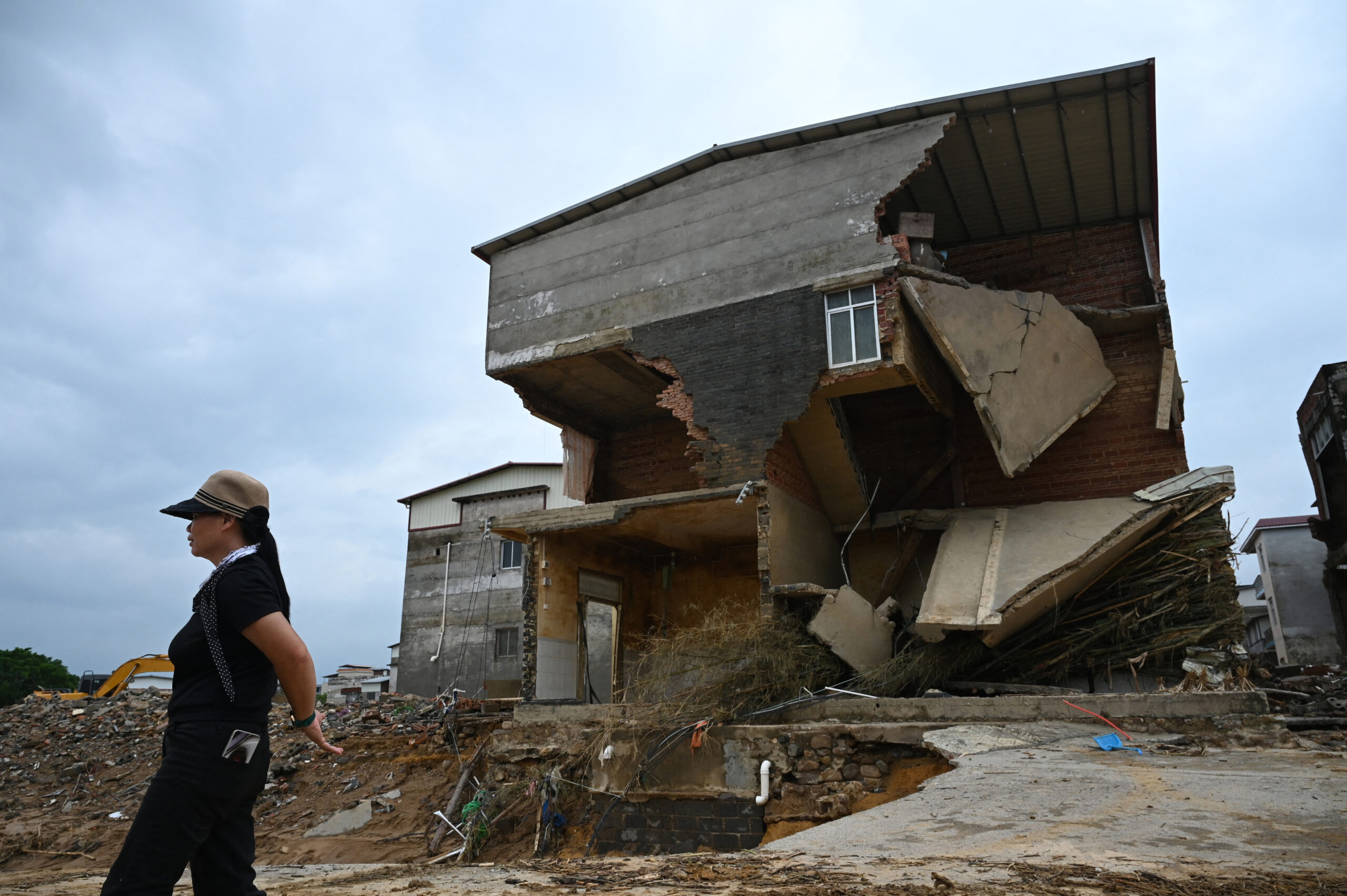
Guangxi authorities recently updated the death toll from the flood disaster, raising it from 39 to 159, which is four times the previous figure. The significant increase in the number of casualties within just 43 days has become a focus of attention. Meanwhile, multiple sources have revealed that the actual death toll far exceeds the official numbers, with ongoing questions about the transparency of the disaster and the responsibility of reservoir projects.
According to CCTV reports, Nanjing and Guigang in Guangxi recently held post-disaster recovery and reconstruction work meetings following Typhoon “Meisake.” As per official reports, as of midnight on August 21, the disaster had affected over 1.65 million people in 16 counties (cities, districts) in these two cities, resulting in the unfortunate deaths of 159 individuals and 10 missing persons.
In early July, Guangxi experienced historically rare and prolonged heavy rainfall, which triggered severe disasters. On July 9th, Nanjing issued a report stating that as of that morning, Guangxi had reported a total of 39 deaths and 9 missing persons. Subsequently, there were no further updates on the number of related deaths.
However, various sources indicate that the actual death toll far surpasses the latest official figures.
On August 23, a resident of Guangxi, Mr. Chen, disclosed to Epoch Times that the officially announced data was seriously falsified, and the actual death toll could be in the four digits. He also mentioned that “those who understand will naturally understand.”
Recently, an insider claiming to be a worker within the system in Nanjing, Guangxi, informed Epoch Times that the numbers he learned from various towns in Hengzhou City were much higher than the public figures. “When summarizing the reported death tolls from various towns in Hengzhou, just one town reported over 2,000 deaths, with an estimated total of at least tens of thousands in the entire Hengzhou City.”
He mentioned that the related meetings are “off the record, with no recording,” so information is compiled based solely on memory.
He stated that some families, during the flood, had elderly individuals tightly holding onto children and ultimately perishing together.
“The deceased are mostly elderly and children who were left behind, coupled with the fact that schools had just adjourned for summer break, and children were at home with their grandparents. Additionally, many homes in the area were no more than three stories tall, resulting in a large number of casualties.”
Furthermore, he recounted a case involving a local supermarket: “Due to the approaching flood, a supermarket had lowered its shutter gates, causing all individuals inside to perish. After the flood receded, over 100 bodies were found inside.”
“Most people in the villages, except for those who had gone out for work, perished. Combined with untimely rescue efforts, many people died like this, not even accounting for an official report.”
Regarding the authenticity of the aforementioned numbers and cases, reporters currently lack publicly available information for independent verification.
The informant mentioned that internal meetings also required investigations into the itineraries of the families of the deceased and “stabilizing counseling.” Simultaneously, close attention was demanded towards the ideological dynamics of local cadres and workers, especially those whose relatives perished in the disaster.
The informant also revealed the internal stabilization measures taken after the disaster. He stated that one of the meeting’s requirements was, “No journalists or volunteers are allowed to enter the core disaster area, and their compliance is to be enforced.”
Similarly, on July 23, the official mouthpiece Xinhua News Agency reported that the Cyberspace Administration of China and the Ministry of Emergency Management jointly issued a notice to carry out a concentrated clean-up and rectification of so-called “illegal and harmful” information related to flood disasters during the flood season, including the centralized cleaning of relevant pictures, videos, and information. The rectification content involved historical reviews, revisiting old events, core data on casualties, housing damage quantities, economic loss scales, and rescue details.
Guangxi’s Ningming flood real scenes: water has already reached the second floor and no one is managing it, within less than an hour, the water depth exceeds 3 meters, and the people were unprepared and are now left to fend for themselves! They can’t move their belongings, and now there’s no water or electricity, with many households comprising elderly and children!
Guangxi’s Chongzuo City, Ningming County after the flood passed through, this city is submerged in a sea of water.
Renowned human rights lawyer Chen Weimin (pseudonym) residing in mainland China, in an interview with Epoch Times, mentioned that the delayed significant increase in the officially reported death toll indicates that the previously released information was difficult to fully respond to outside doubts.
“After dragging it out for so long and then updating the casualty data, it’s obvious they couldn’t hide it anymore,” he said. In the absence of a transparent verification mechanism for disaster information, even if the authorities later adjust the figures, it would be challenging to immediately restore public trust.
Lawyer Chen believes that the factors contributing to such changes may not be singular and could include domestic and international public pressure, as well as “not ruling out some struggles within the government.”
Regarding the long-standing pattern of information dissemination by the Chinese Communist Party (CCP), he said: “Numbers come from officials, and officials provide numbers.” This has been the way the CCP operates for years, exaggerating anything beneficial to itself limitlessly while downplaying or concealing unfavorable aspects.
He noted that Typhoon “Meisake” was just a catalyst for the floods in Guangxi. If the infrastructure itself had long-term risks, natural disasters only serve to highlight existing vulnerabilities.
Lawyer Chen expressed, “Because this government is not elected by the people, it cannot possibly prioritize the safety and interests of the public as the highest goal.”
China affairs expert Wang He believes that the timing and manner of the CCP’s official data adjustment are worth examining.
He told Epoch Times that following the Guangxi flood, overseas public opinion and disclosures from so-called “insiders” have been increasing, putting pressure on the authorities, which led to the State Council dispatching an investigation and assessment team.
“Wang He stated, “The data concealed and tampered with by the Guangxi authorities undoubtedly faced severe criticism internally within the CCP.” Under this pressure, a significant adjustment was made to the initially published data. He added, “The actual death toll is likely far beyond 159 people.”
He indicated that the disclosed 159 figure is still part of the data shared externally after being screened and controlled by the authorities. Internal information might have been reported through other channels, but when made public, social stability factors would be considered.
He believed that the subsequent investigation might involve holding local officials in Guangxi accountable and did not rule out the possibility of a group of officials facing consequences.
The situation in Guangxi is too tragic! Donating privately is seen as subversion, media collectively remains silent! Private disaster relief teams are criticized, left unattended for 17 days, reconstruction plans unfinished, hundreds of thousands homeless, and regular departments unable to pay wages.
From 8 a.m. on August 21 to the 23rd, Guangxi’s Chongzuo, Fangchenggang, and several other places were hit by heavy rain, even torrential rain, with localized rainfall in Chongzuo reaching 483.7 millimeters. Currently, 13 rivers at 19 stations in Guangxi have exceeded warning levels, and authorities have issued a red flood warning, subjecting local residents to flooding once again.
Chinese hydrology expert Wang Weiluo, currently residing in Germany, recently discussed in an interview with Epoch Times that the Guangxi flood should not be solely understood as a result of extreme rainfall but also by analyzing factors such as reservoir dams, river channel modifications, and regional water system changes together.
He stated that a crucial issue reflected in the Guangxi flood is the intricate relationship between man-made water projects and natural floods.
Guangxi is one of the provinces with the highest number of reservoirs in China, with over 4,500 large and small reservoirs and dam projects, ranking second nationally.
From the quantity of reservoirs in Guangxi to the completion of large projects like the Pinglu Canal and Datengxia Reservoir in June, and with multiple floods in various areas of Guangxi, Wang Weiluo believed that the convergence of these factors might further change the processes of flood accumulation, retention, and discharge.
“The series of dam failures in Guangxi causing severe floods are a direct result of the CCP’s malicious destruction of nature and alteration of terrain and river channels,” he stated.
Due to the impact of Typhoon “Meisake,” at least four reservoirs in Nanning and at least five in Guigang faced perilous situations, leading to over a million people being affected.
The breached Liulan Reservoir in Hengzhou City, located in Liulan Village, is the largest medium-sized reservoir in the city, originally constructed in 1958. In 2009, the reservoir underwent an emergency reinforcement project. In 2023 and 2025, it underwent two more modernization overhaul projects, termed as a “model project.”
Wang Weiluo argued that the dam collapse disaster at the Liulan Reservoir in Hengzhou City on July 6, 2026, is, from whichever perspective analyzed, a man-made disaster. Issues such as engineering design, reservoir reinforcement against collapse, weather forecasting, water level scheduling during the flood season, early warning of reservoir dam collapse risks, preparedness for accidents that could lead to dam failure, post-collapse relief efforts, and the risks posed by large-scale projects on the environment, are all straightforwardly man-made.