
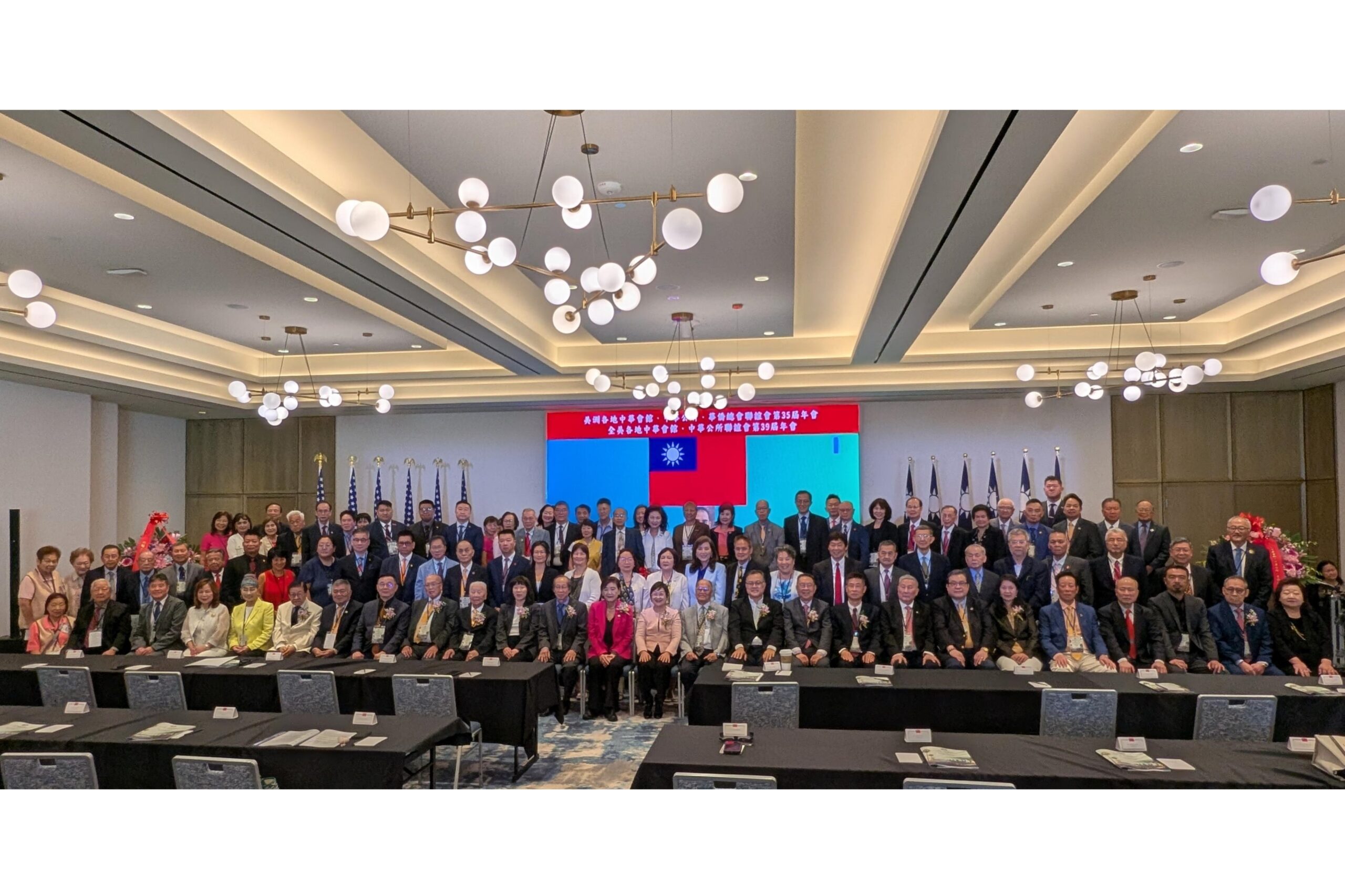
The 35th annual meeting of the Chinese Associations, Chinese Chambers, and Overseas Chinese Associations from across the Americas was held in Los Angeles from August 22nd to 24th. Representatives from the United States, Canada, Brazil, Paraguay, and Taiwan gathered in Southern California to exchange ideas on the development of traditional overseas Chinese communities. The focus was on issues such as freedom, democracy, the influence of the Chinese community, and passing on traditions to the second and third generations.
On the evening of August 22nd (Saturday), a banquet was hosted by the Ministry of Foreign Affairs for representatives from Chinese Associations across the United States. The Chairperson of the Overseas Community Affairs Council of the Republic of China, Hsu Chia-ching, expressed gratitude for the long-standing support of overseas Chinese associations for Taiwan. She emphasized the values of freedom, democracy, and human rights cherished by Taiwan and overseas Chinese communities. She stressed the importance of nurturing the younger generations to continue the legacy of traditional overseas Chinese communities.
Ma Po-yuan, Director of the Taipei Economic and Cultural Office in Los Angeles, highlighted the unwavering support of traditional overseas Chinese communities for the Republic of China and Taiwan’s path to freedom and democracy. He pointed out that these communities are a strong support for overseas missions. Ma Po-yuan also emphasized the common values of “freedom and democracy” that unite the support for Taiwan among overseas Chinese descendants, regardless of their direct connection to Taiwan.
At the opening ceremony on August 23rd, US Congresswoman Judy Chu mentioned the historical lack of representation and voice for the Chinese community in Congress, leading to discriminatory policies such as the 1882 Chinese Exclusion Act. She applauded the increased representation of the Chinese community in Congress, enabling them to advocate for community rights at the negotiation table.
California State Assemblyman Mike Fong highlighted the state’s ongoing efforts to combat hate and discrimination against Asian and Chinese communities, allocating an additional $30 million this year for anti-hate crime and community safety initiatives. Fong stressed the importance of government collaboration with community organizations to ensure a place for Chinese Americans in US society.
Chang Tzuhao, Executive Director of the Pan-American Chinese Club Association, emphasized the need for traditional associations to embrace technological advancements to attract and engage younger generations. He advocated for the promotion of Chinese language, family education, and cultural activities to foster participation among the youth and ensure the continuity of traditions.
Nie Zeying, Chairperson of the Chinese Association in Los Angeles, underscored the importance of passing on the cultural heritage, history, and beliefs of the older generation to the new generation. The current annual meeting saw the participation of representatives from 20 cities across the United States, engaging in discussions on the future development and cultural inheritance of traditional overseas Chinese communities.
Chen Ling-hsin, Deputy Director of the Overseas Community Affairs Council, recognized the pivotal role played by Chinese Associations, Chinese Chambers, and Overseas Chinese Associations in the development of the American Chinese community. She described these organizations not merely as clubs but as a “home” where early migrants found support and care amid language, cultural, and life challenges.
In the history of Chinese society development in the Americas, Chinese Associations, Chinese Chambers, and Overseas Chinese Associations have played significant roles. Through the large annual meeting, associations from various regions can unite consensus, connect social networks and resources to become a crucial force supporting Taiwan.
Wu Chao-feng, Political Adviser to the Executive Yuan, emphasized the importance of collaboration and resource sharing among diverse overseas Chinese communities, including traditional organizations and Taiwanese immigrants. The annual meeting serves as a platform for associations to build consensus, connect social networks, and resources, collectively forming a significant force supporting Taiwan.
Wu Jingqun, Former Chairperson of the Chinese Association in Los Angeles and Executive Director of the Chinatown Service Center, highlighted the importance of interactions and exchanges among representatives from Chinese Associations worldwide to support the development of overseas Chinese communities. He noted that overseas communities can provide assistance through their networks and societal connections when needed, underscoring the significance of cross-border communication between the community and governments.
The annual meeting concluded after a series of events, including the Ministry of Foreign Affairs banquet, the opening ceremony, roundtable discussions on overseas Chinese affairs, and a cultural visit to the Huntington Library. From political advocacy, generational inheritance to volunteer mobilization, the 35th Pan-American Chinese Association annual meeting showcased the vibrancy of traditional overseas Chinese communities in continuing to unite, expand their social influence, and adapt to the new era.