
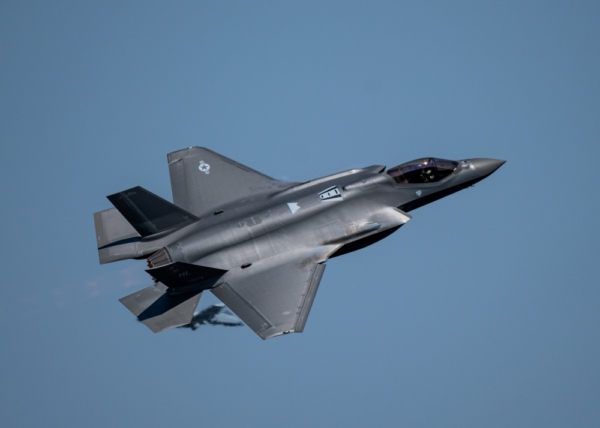
Lockheed Martin’s fifth-generation fighter jet, the F-35 Lightning II, leads the world in terms of export volume as the most advanced stealth combat aircraft. At least 17 air forces around the globe have equipped this state-of-the-art stealth fighter, forming the largest international network of stealth combat aircraft collaboration.
According to the 2026 aircraft statistics released by TheWorldData, the global delivery of F-35 has surpassed 1,300 aircraft, spanning across more than 17 countries. This scale sets it apart from all other stealth combat aircraft projects.
In contrast to the F-35, other countries operating stealth fighter jets such as China, Russia, and their allies are using different models – manufactured by different countries, following different sales rules, and serving under different alliance systems.
Since its inception in 2001, the F-35 Lightning II project has evolved into the largest defense project in U.S. history. The F-35 is mainly produced at the “Bomber Plant” of the U.S. Air Force in Fort Worth, Texas; additionally, there are two final assembly lines located in partner countries at Cameri in Italy and Nagoya in Japan. The rapid proliferation of the F-35 has fundamentally changed the landscape of 21st-century air power.
Since deliveries began in the mid-2010s, the F-35 variant has transitioned from an exclusive U.S. project to become a key pillar of air power for NATO and allied forces across three continents.
The F-35 has an extensive deployment range, from Arctic bases in Norway to coastlines in Australia, and even to bases in South Korea on high alert just a few hundred miles from North Korea, forming the largest international network of stealth combat aircraft collaboration in history.
This list continues to expand.
Currently, the largest global F-35 fleets are owned by the United States, Japan, the United Kingdom, Australia, Italy, Norway, Israel, and South Korea; while a second wave of countries including Poland, Finland, Germany, Switzerland, Canada, Romania, Czech Republic, Greece, and Singapore have recently joined the ranks of countries equipping this fighter jet.
Many countries opt for this stealth fighter due to similar considerations made by Denmark, Belgium, the Netherlands, and Norway when they decided to replace Lockheed Martin’s F-16 fighter jets with the F-35, driven by the interoperability needs within NATO. Regardless of the specific model being the conventional takeoff and landing F-35A, the short takeoff/vertical landing F-35B, or the carrier-capable F-35C, all customers will have access to the same global support network, software backbone system, and a supply chain controlled by the United States.
This exclusivity of the “F-35 club” in operational terms is primarily due to political factors rather than technological restrictions that exclude China, Russia, and their partners. Purchasing the F-35 entails joining an alliance system centered around the United States; countries severely conflicting with U.S. interests or facing U.S. sanctions, regardless of their budget, will not be able to secure procurement contracts.
These American ally countries collectively plan to deploy around 3,000 F-35 aircraft across three different models. Despite the United States holding nearly two-thirds of the global F-35 fleet, partner countries are progressively expanding their fleets of stealth combat aircraft to strengthen their joint defense systems.
Out of all the large-scale projects in the United States, the F-35 stands out as the most massive one. For the U.S. Air Force, Navy, and Marine Corps, replacing the distinct and battle-proven mainstay aircraft of the Cold War era, the F-16C/D, F/A-18C/D, and AV-8B, with the F-35 is an immensely challenging task. This project underwent decades of development, ultimately producing a fighter jet family featuring a shared airframe but with customized systems and performance tailored to the requirements of each branch.
Since the introduction of the F-35, the Marine Corps has acquired 353 F-35B aircraft with short takeoff and vertical landing capability.
Meanwhile, the Navy has ordered 340 F-35C aircraft capable of carrier-based operations. However, the Air Force remains the largest user of this aircraft type, agreeing to purchase up to 1,763 conventional takeoff and landing F-35A aircraft.
Japan’s decision to introduce the F-35 is driven by both urgent geopolitical needs and technological ambitions. The escalating threat posed by the CCP is evident in its development of new stealth fighter jets and their increasing frequency of intrusions into Japan’s airspace.
The F-35’s dual role as an intelligence node and interceptor makes it highly valuable in countering the increasingly assertive actions of the Chinese air and naval forces.
To date, Japan has ordered 42 F-35B and 105 F-35A series fighter jets, becoming the second-largest user of this aircraft type after the United States. Currently, new F-35 squadrons have been deployed at Japan’s Misawa and Hyakuri bases. The joint air combat exercise code-named “Bushido Guardian 25” (BG25) conducted last year at the Misawa base and surrounding airspace by the United States, Japan, and Australia marked the first joint exercise involving Japan’s F-35 squadrons.
In early August this year, the Japanese Self-Defense Forces received the first batch of 3 F-35B fighter jets at the Nyutabaru base on Kyushu Island. According to USNI News, these F-35B fighter jets will be deployed operationally on the “Izumo”-class helicopter destroyer JS Izumo (DDH-183) and JS Kaga (DDH-184), also known as “Lightning Carriers” or “Light Aircraft Carriers.”
Not all U.S. stealth fighters are on the export list. Lockheed Martin’s F-22 Raptor aircraft, in service since 2005, has garnered strong interest from countries like Japan, Australia, and Israel over the years, yet it remains the only fifth-generation fighter jet that the United States has not sold, leased, or authorized for production by any foreign air force.
As early as 1998 before the F-22 entered service, the U.S. Congress explicitly banned its export due to concerns that its sensors and stealth technology could leak to competitors through allied supply chains.
This decision means that the approximately 180 Raptors manufactured are solely used by the U.S. Air Force.
The design intentions of these two fighter jets are not meant to be mutually exclusive: the Raptor is specifically designed for air superiority to maintain supersonic cruising speeds exceeding 1.5 Mach without activating afterburners, while the F-35 was initially positioned as a networked, multi-role strike platform.