
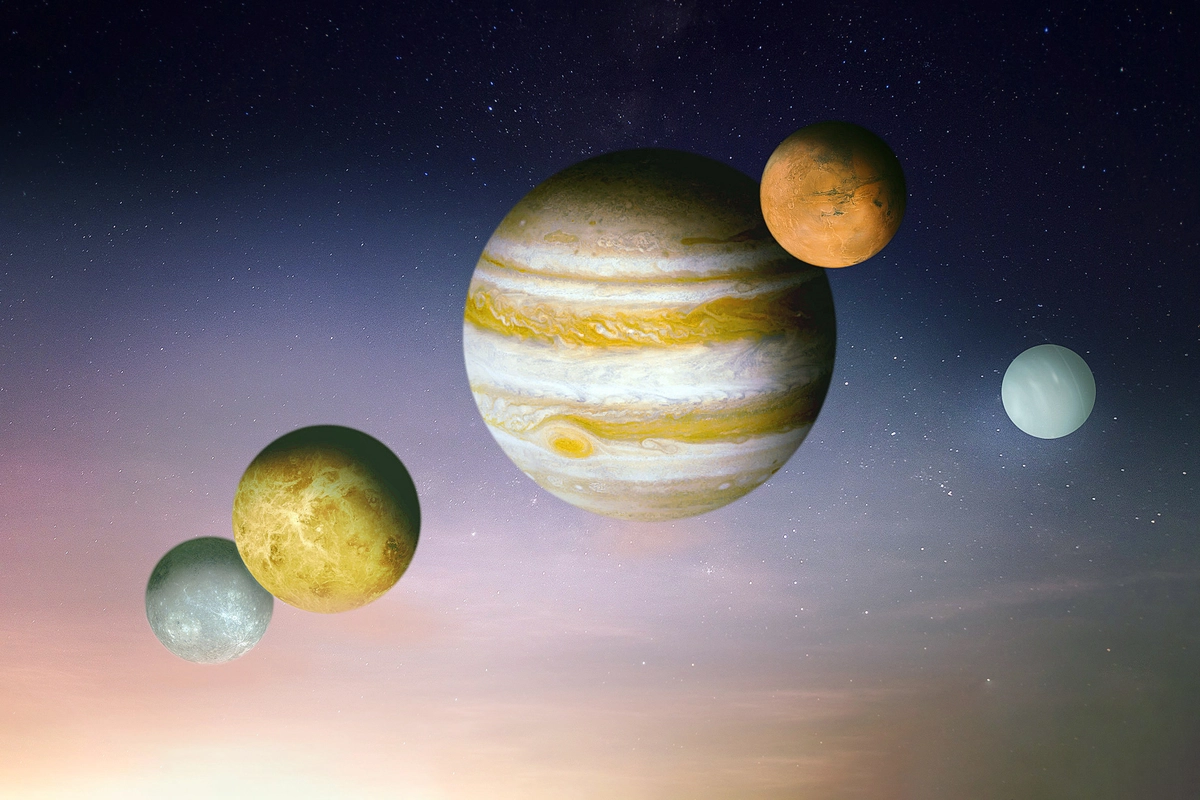
Next month, smart phones will pop up notifications reminding astronomy enthusiasts to use mobile applications to track the movements of planets and pay attention to the “Planet Alignment” in the night sky.
From November 12th to 28th, five planets will consecutively appear in the night sky, forming the so-called “Planet Alignment” where planets align together. These five celestial bodies will line up along a track spanning nearly 2 billion miles. For observers on Earth, they will conveniently fall within the same field of view. Weather permitting, most open areas on Earth will be able to witness this celestial spectacle.
Uranus, Mars, Jupiter, Venus, and Mercury will align in a row on the “superhighway” in space, although their formation may not be perfectly straight. Astronomers caution those expecting a perfectly straight line that planets won’t align perfectly in mathematical terms. While their orbital planes are roughly parallel, they are not perfectly aligned, explaining why planets appear to undulate as they move along the arc of the ecliptic. Therefore, the Planet Alignment will not form a mathematically perfect straight line.
Throughout history, scientists have found that people are not particularly concerned about whether the Planet Alignment strictly adheres to mathematical definitions. As long as they are roughly in a line, individuals from various cultural backgrounds consider it as an important omen. People have even made predictions of major events like floods or the downfall of empires based on these alignments. Hence, the definition of a Planet Alignment is quite broad: when three or more planets gather on the same side of the sun, or when two or more planets appear in a relatively narrow area in the night sky, it is considered a Planet Alignment.
According to the above definition, on November 14th, Uranus, the first in the line-up of five planets, will rise. Typically dim, Uranus is an ice giant and the seventh planet from the sun. On that day, its brightness will peak for the year. Positioned near the opposition point, where the planet and the sun are almost directly opposite in the sky, akin to a full moon, Uranus will rise at sunset and reach its highest point around midnight. However, as the first planet to appear in this Planet Alignment, it will not be particularly prominent as usual, requiring observers to use binoculars to spot the faint blue glow – Uranus.
Hours later, the other members of the Planet Alignment are slow to make their appearance. It is only around 3 a.m. when Mars and Jupiter finally rise from the haze near the horizon. Mars, resembling a rusty red coin, can be seen alongside Jupiter emitting a bright and steady white light. These two planets will be closely adjacent near Leo. Mars will be to the west of Jupiter, with only a finger’s width between them. This close proximity is known as “planetary conjunction” and will be a highlight of the night sky.
Observers will have to wait until just before dawn to witness the grand finale of the Planet Alignment. Thus, this celestial event is better suited for early risers. Shortly past 4 a.m., the bright “Morning Star” Venus will rise in the darkness. Subsequently, Mercury will appear towards the east around 5:15 a.m. Both planets will be visible near Virgo. These two inner planets of the solar system will debut as the eastern sky starts to lighten. However, with the onset of dawn, their light may slowly be overpowered by the increasing daylight.
The window of time when all five planets can be simultaneously seen in the sky is very brief, as Uranus will rapidly set at sunrise in many locations. The first to rise, Uranus, will already have dipped below the horizon in many areas.
For those busy with early morning work, it may be challenging to observe this celestial event. Nevertheless, the Planet Alignment is a tranquil nocturnal feast. Historically, it has primarily attracted amateur stargazers and scientists from NASA. Nowadays, as astronomical observation applications become more prevalent, witnessing the Planet Alignment is no longer limited to a few. Using apps like Stellarium Mobile or Star Walk 2, one can simply point their phone towards the sky to display the names and positions of planets, providing added convenience.
Next month, for a few days, a sprawling “stellar necklace” spanning millions of miles will overshadow earthly disturbances. Anxious news, fraudulent ads, and mindless scrolling on social media will fade amidst the eternal dance of the cosmos. Nothing compares to the Planet Alignment in the night sky in reminding us that despite the increasing complexity of the world, human worries still seem so insignificant in the face of the universe.