
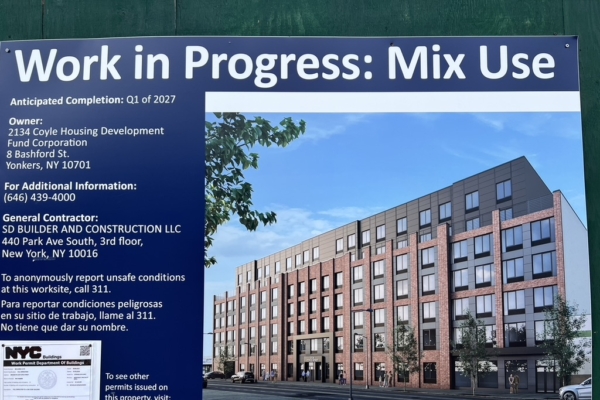
In an ongoing dispute involving the homeless shelter on Coyle Street, 2140 Bay Parkway in Brooklyn, there have been new developments. Despite the New York City Board of Standards and Appeals (BSA) voting to dismiss residents’ first two appeals (2025-54-A and 2026-09-A) on October 19, community representative Eddie announced that residents have proceeded with a third appeal (2026-32-A), alleging irregularities in the property registration and zoning consolidation procedures by the developer, and demanding the revocation of the Department of Buildings (DOB) previously issued foundation and new construction permits.
The first two cases underwent a five-hour hearing and review of supplementary materials. Eddie stated that in the vote on Monday (the 19th), the committee did not address key legal issues raised by residents in the second case, including doubts regarding the qualifications of the former owner and the land rights documents. The BSA is expected to release a written decision and full rationale in the future.
Faced with setbacks from the previous cases, the community quickly shifted focus, targeting the foundation permit issued by the Building Department on August 13. They officially filed the third appeal on August 19, swiftly accepted by the BSA on August 27, and are currently awaiting scheduling for a public hearing.
According to Eddie, the core issue of the third appeal lies in the legality of “property ownership and restriction statements” in multi-lot development.
In simple terms, the provisions of Article 12-10 of the New York Zoning Resolution act as a “borrowing” and restriction contract for land development rights: the project involves multiple lots owned by different individuals (in this case, Lot 11 and Lot 10). If a developer wants to build higher or larger on one lot, they often need to “borrow” the density or development rights from the adjacent lot. This means that the future development potential of the adjacent lot would be constrained by this arrangement.
As per the regulations of Article 12-10, when multiple lots are to be combined in this manner, all current owners must sign a legally binding “restriction statement” and complete the formal property registration at the City Register (ACRIS) for the Building Department to lawfully issue construction permits.
Eddie explained that the key breakthrough the community is focusing on this time is the serious disconnect in the property registration process following multimillion-dollar transactions involving the lots.
According to official property records, the site saw two significant transactions at the end of 2024: on December 5, 2024, Lot 10 was transferred for $3 million to Coyle Realty LLC (even without specifying the buyer’s representative, raising doubts about the authenticity of the contract).
On December 17, 2024, Lot 11 was sold for up to $22.4 million to 2134 HDFC (the property-holding entity) of the homeless shelter project. However, despite the new owners taking over, the corresponding zoning property changes were not implemented at the City Register (ACRIS) as required by law. Residents pointed out that the developer, when applying for permits, allegedly used outdated documents from the former owners to disguise the fact that the current owners had not completed registration.
According to the appeal documents provided by Eddie for the third case, this “shortcut” operation carries two significant risks: property rights disputes and project halts. Should one of the lots change hands again and the new owner refuse to acknowledge the originally “borrowed” development rights, ensuing property lawsuits would lead to indefinite project delays and substantial litigation costs.
The other risk involves taxpayers’ money being wasted: as the project is sponsored by the Department of Homeless Services (DHS) in New York City, a significant amount of public funds are being utilized. Residents emphasize that the public has the right to ensure projects fully comply with regulations, avoiding taxpayer funds being squandered due to administrative oversights and property defects.
Therefore, residents advocate for the Building Department not to issue permits until property and zoning documents are lawfully completed by the “true current owners.” The aim of the third appeal is to force the BSA to address these violations, revoke relevant foundation permits, and order a work stoppage to safeguard taxpayers’ money.
Additionally, Eddie revealed that besides the current third case, residents are closely monitoring the approval status of other permits, not ruling out filing fourth and fifth appeals in the future, continuing to fight to the end through legal means.