
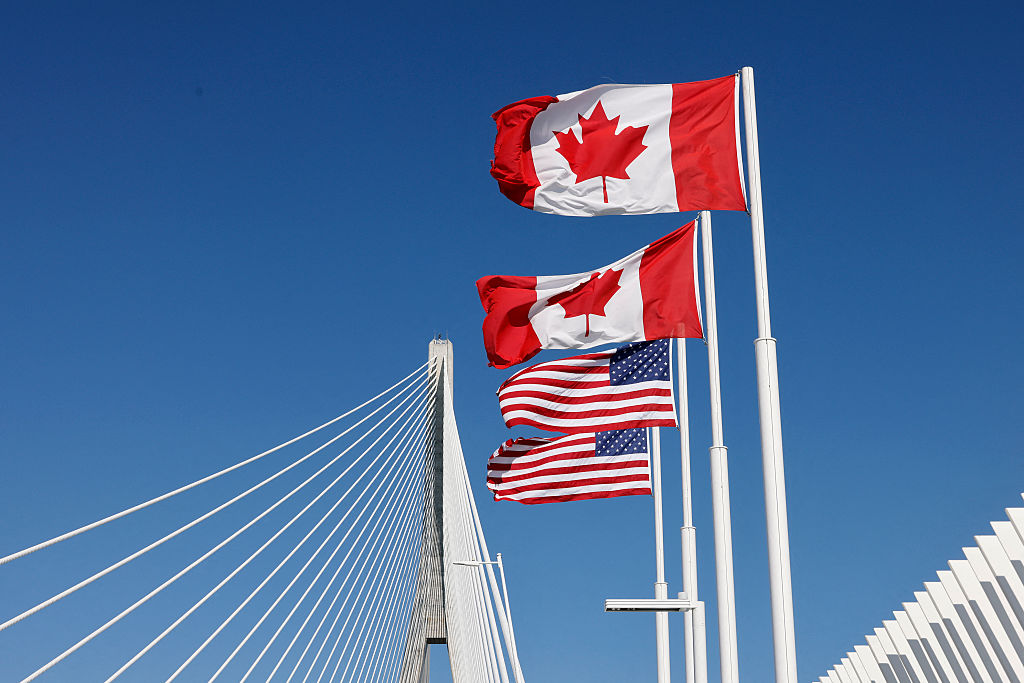
In a recent joint commentary published on the Canadian website Todayville, senior director of China policy at the America First Policy Institute, Piero A. Tozzi, and Canadian publishing figure Dean Baxendale issued a warning regarding the ongoing tariff tensions between Canada and the United States. They cautioned that continuing such internal disputes could ultimately benefit the Chinese Communist Party (CCP).
Titled “From ‘Elbows Up’ to ‘Shoulder-to-Shoulder’: Strengthening North American Security to Address the Common Chinese Threat,” their article proposed an alternative approach to the current situation. Instead of escalating tariff pressures, they suggested that Canada and the US should shift their focus towards jointly addressing the threat posed by the CCP.
Earlier this year, Canadian Prime Minister Mark Carney visited Beijing and reached a new trade agreement with China. Under the terms of the agreement, Canada agreed to allow the import of up to 49,000 Chinese electric vehicles per year with a reduced tariff of 6.1%, replacing the previous 100% tariff. In return, China made concessions in trade of agricultural products such as canola seeds.
Furthermore, Canada proposed to increase exports to China by 50% by 2030 and expand bilateral investments. This agreement has drawn increased attention from US policymakers amidst tensions in Canadian-American relations, as there are concerns about Chinese companies potentially using Canada as a gateway to enter the US market.
A report titled “Northern Trojan Horse” from the America First Policy Institute warned about the risks associated with Chinese companies leveraging Canada’s trade advantages to access the US market. Researchers expressed apprehension that through investments, manufacturing facilities, or cross-border transfers in Canada, Chinese firms could find new pathways into the American market.
The report highlighted the case of the Beaver Brook antimony mine in Newfoundland and Labrador, which is solely owned by the Chinese company Five Mines since 2009 and is a key resource for military equipment manufacturing. The report estimated that if the mine were to operate at full capacity, it could potentially account for approximately 5% of the global antimony supply.
Prior to this, the Canadian government had implemented restrictions on Chinese investments in critical mineral sectors. In 2022, citing national security concerns, the federal government had compelled three Chinese firms to withdraw their investments in Canadian critical mineral companies.
Additionally, with the US-Canada border stretching approximately 8,890 kilometers and certain areas featuring complex terrains that pose enforcement challenges, the report expressed worries about Chinese criminal networks exploiting North American ports and logistics systems to traffic precursor chemicals for fentanyl or illegally transfer advanced chips restricted by the US in third countries.
Tozzi and Baxendale emphasized the need for enhanced cooperation between Canada and the US in areas such as port security, intelligence sharing, foreign investment reviews, and combating cross-border crime to prevent adversaries from capitalizing on policy differences between the two nations.
The “Northern Trojan Horse” report proposed a series of tough measures for consideration: Canada should reinstate the 100% tariff on Chinese electric vehicles and coordinate with the US on investment reviews, rules of origin, and other trade restrictions against China. Should Canada resist cooperation, the US could contemplate revoking certain tariff benefits under the USMCA or imposing punitive tariffs on Canadian goods.
However, Tozzi and Baxendale cautioned in their commentary that the continued threat of tariffs from the US towards Canada could undermine cooperation between the two countries, potentially leading Canada to further seek opportunities in the Chinese market.
They urged Washington to view Canada as a partner in jointly combating the CCP and prioritize coordination on specific issues such as critical minerals, port security, foreign investment reviews, sensitive technology controls, and combating smuggling, rather than allowing tariff disputes to erode bilateral relations.
They issued a stark warning that if the US and Canada persist in an “Elbows Up” approach of mutual rivalry, it could inadvertently provide the CCP with greater maneuvering space.