
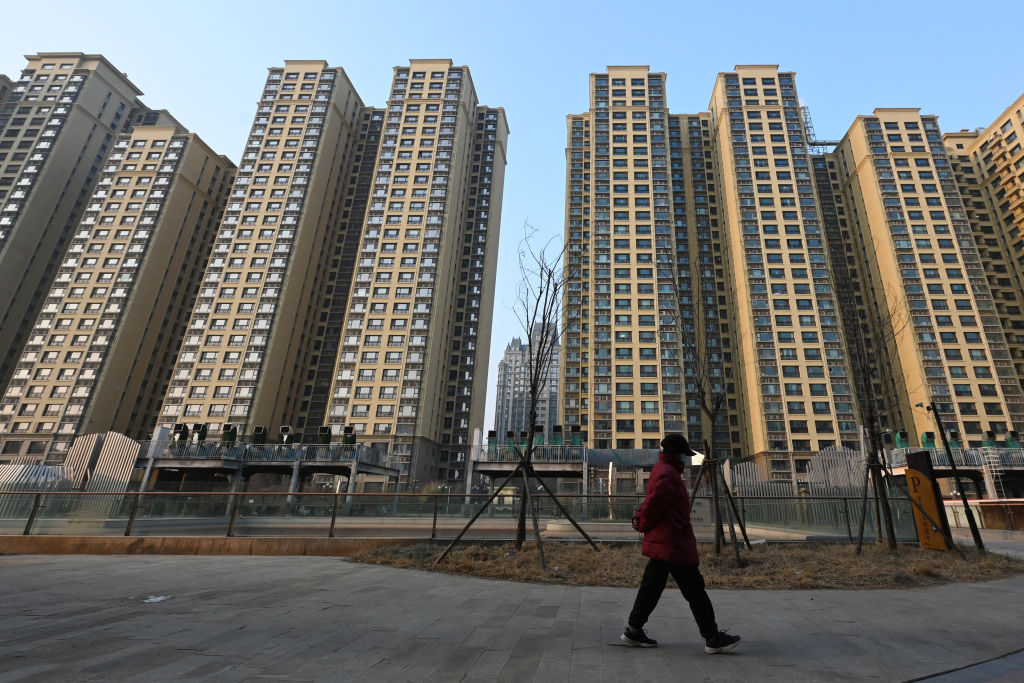
China’s real estate crisis continues to escalate, according to the latest data from the Chinese Communist Party. The mainland saw a 20.6% year-on-year decrease in real estate development investment in the first nine months, while the decline in new home sales widened.
On October 19, data released by the National Bureau of Statistics of the Chinese Communist Party showed that from January to September, the country’s real estate development investment totaled 5.3364 trillion yuan, a 20.6% decrease year-on-year. Of this, residential investment amounted to 4.1125 trillion yuan, down 20.5%. During this period, the construction area of real estate development enterprises was 5.65221 billion square meters, down 12.8% year-on-year. Specifically, the residential construction area was 3.92558 billion square meters, a decrease of 13.2%. The newly started construction area was 3.4031 billion square meters, down 24.9%, with residential new construction area declining by 25.4% to 2.4774 billion square meters.
The data further shows that the completed construction area was 2.3271 billion square meters, down 25.1%. Within this, residential completed area decreased by 26.6% to 1.6301 billion square meters. The sales area of newly built commercial buildings in the first nine months was 5.6483 billion square meters, a 13.2% drop year-on-year, with residential sales area decreasing by 13.8%. The sales revenue from new commercial buildings reached 5.3799 trillion yuan, down 13.9%, with residential sales revenue decreasing by 13.7%.
Data released on the same day for September showed that in China’s 70 major cities, including Beijing, Shanghai, Guangzhou, and Shenzhen, the prices of new homes in first-tier cities increased by 0.1%, the same as the previous month, while prices in second and third-tier cities continued to decline. Overall, the housing prices in first, second, and third-tier cities remained lower compared to the same period last year.
Research institutions widely believe that the prolonged downturn in the real estate market has become one of the biggest challenges facing the Chinese economy, severely affecting consumer confidence and local government revenue. The significant decline in real estate-related investments in the first three quarters of this year, over 20%, indicates that the real estate industry has yet to emerge from its difficulties. Approximately 70% of Chinese families’ wealth is concentrated in the real estate sector.
In contrast to past trends where house prices uniformly rose or fell, Zhang Dawei, an analyst at Zhongyuan Real Estate, told mainland media that “structural differentiation will become the market norm.”
The BBC reported on October 19, citing a report by Sheana Yue, stating that China’s real estate sector is still undergoing deep adjustments with a 20.6% year-on-year decrease in real estate development investment in the first nine months, a larger decline compared to the first half of the year at 18%, and a nearly 25% drop in new construction starts. Such a significant drop in new construction implies that building activities will continue to shrink in the coming months, affecting upstream and downstream industries such as cement, steel, and home appliances.
The weakness in the real estate market has become a significant factor affecting the Chinese economy. Sheana Yue, a senior economist at the Oxford Economics Research Institute, evaluated the Chinese economy in a research report, stating that “sluggish household consumption and the long-term sluggish real estate market will continue to suppress the domestic economy, limiting the driving force of these growth factors on the overall economy.”
According to recent analyses by the International Monetary Fund (IMF) and several foreign media outlets, due to the weak real estate market, sluggish wage growth, and persistently high youth unemployment rates, China must heavily rely on foreign trade to offset the lackluster domestic demand.