
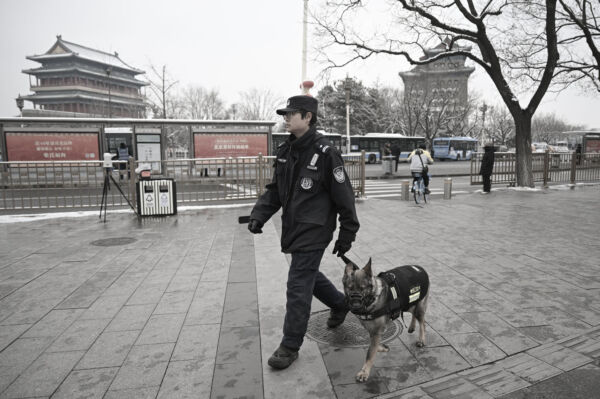
The 20th Fifth Plenary Session of the Chinese Communist Party (CCP) will be held next week as reported by Beijing veteran media person Gao Yu, to mark the 107th birth anniversary of former CCP leader Zhao Ziyang on October 17. Beijing is intensifying its stability maintenance measures. Prior to this, she had been monitored by officials for several days, believed to be related to the fourth anniversary of the Sì Tōngqiáo incident.
Gao Yu posted on X on October 16: “Just realized today, the 4 days from the 11th to the 14th were under surveillance, for two reasons, 1. the fourth anniversary of the Sì Tōngqiáo incident; 2. the ‘Forum on Reform with Immediate Action’ (12th to 13th) held at the Beijing National Convention Center. It’s quite interesting, the forum discussing ‘immediate action’, Beijing just dealt with all petitioners, along with the Sì Tōngqiáo incident, Beijing has handled everything it can. Today my friend received a call from the police, not allowed to go out on the 17th and 18th, asked: ‘Why?’ The police replied: ‘Don’t know.’ I haven’t received an official notice from the police yet, but heard that from the 17th to the 19th, there will be continued standing guard throughout Beijing, the 17th being Zhao Ziyang’s 107th birthday and the 18th being the anniversary of his burial, with heavy police presence at Changping Tianshou Garden.”
She wrote: “Starting tomorrow, I will of course be ready to shoot short videos at any time. Unless they make it so that I can’t see the people lurking at the windows and in the yard. Reflecting on the joint burial of Ziyang and his wife on October 18, 2019, the National Security and police made me stand guard, that was really a fascinating story. To be continued.”
Former CCP General Secretary Zhao Ziyang, who was forced to step down due to sympathizing with the Tiananmen Square protests, was born on October 17, 1919, and passed away on January 17, 2005. Following the Tiananmen Square incident, Zhao Ziyang and the topic of Tiananmen have been taboo in mainland China.
On October 13, Gao Yu posted a photo saying: “As soon as the long holiday ended, the watchers were sent, last year rented a 7-seater Buick, this year people just sit outdoors, no shelter from wind and rain. They arrived before dawn, someone brought food. Shift change in the afternoon.”
On the 14th, she wrote: “Today we played on our phones together. It seems they also feel that the work they do is very easy, only having to deal with inspections from the sub-bureau and police station.”
On the 15th, she found the yard clean and without any shadows, the guards had been withdrawn. However, National Security personnel came. She asked why they were monitoring her, and the other party innocently replied: “Don’t know!”
Gao Yu wrote: “Acting dumb is even more boring than pretending to sleep. Please comment, the four days of harassment have been blacked out and not mentioned at all? Someone made the decision, no one takes responsibility, always talking about ‘party building’, what’s the point!”
October 13 marked the 4th anniversary of the Beijing Sì Tōngqiáo incident. Four years ago on this day, Chinese citizen Peng Lifa (online alias Peng Zaizhou) publicly protested against CCP leader Xi Jinping at the Sì Tōngqiáo Bridge in Beijing. Since this incident, authorities have recruited a large number of “bridge watchers” to monitor the pedestrian overpasses in downtown Beijing. Recently, there have been “bridge watchers” on several overpasses in Beijing.
Following the Sì Tōngqiáo incident in Beijing, authorities started recruiting a large number of “bridge watchers” on overpasses in the city for surveillance. On October 12, “bridge watchers” on the overpasses of the East Third Ring Road in Beijing.
It is worth noting that the CCP Fifth Plenary Session will be held at the end of this month. Epoch Times previously learned that since mid-October, stability maintenance for petitioners has been initiated nationwide by local governments in China, many petitioners in Beijing or elsewhere have had their movements hindered. To avoid monitoring, some petitioners have left their local areas ahead of time.
Overseas media outlet “Bao Dian Weekly” recently disclosed a confidential notice from the central government indicating that for this Fifth Plenary Session, authorities have deployed so-called 18 stability and security measures, including strict prevention of people spreading reactionary slogans through flash mob activities, electronic screens, as well as risks like unauthorized drones flying, and designate groups such as delivery drivers, ride-hailing drivers, retired military personnel, and real estate investors as key targets for prevention.
Independent commentator Cai Shenkun recently wrote in “Bao Dian Weekly” that the exposure of the so-called “18 stability secret orders” before the Fifth Plenary Session reflects a huge contrast between the outward strength and internal anxiety of the Xi Jinping regime. While Xi seems to wield great power alone, judging from the scope of prevention and the level of vigilance reflected in these secret orders, Xi’s worries about political security, regime security, and social stability are far more serious than previously imagined.