
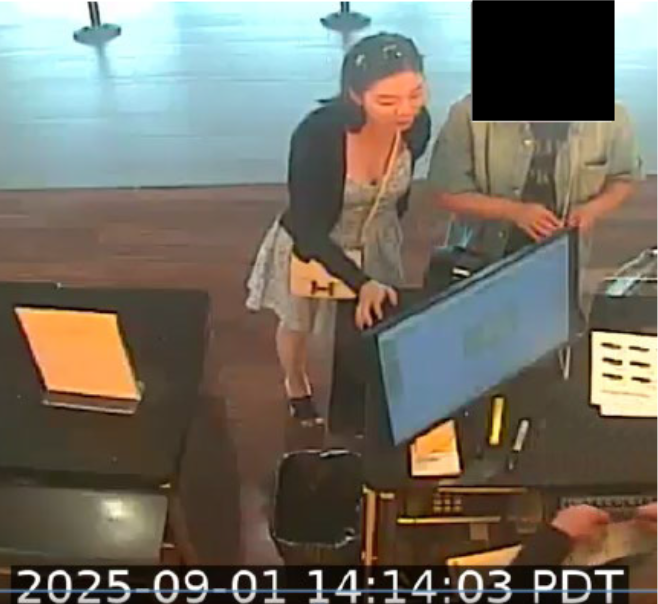
Former U.S. counterintelligence officials revealed that the arrest of Chinese spy Zhang Wanying in Southern California exposed how the Chinese Ministry of State Security conducts secret surveillance on political opponents. Zhang is accused of aiding the Chinese Communist Party in monitoring the family of Taiwan’s president within the United States.
On Wednesday, former China intelligence expert Nick Eftimiades from the CIA, Defense Intelligence Agency, and State Department told The Washington Times that “Zhang Wanying’s arrest also exposed the aggressive espionage activities of the Chinese Ministry of State Security.”
“Beijing has been conducting espionage activities in a ‘whole society’ manner and using overseas Chinese around the world,” he added.
Zhang Wanying was arrested by the FBI on the 4th while she was preparing to board a flight to Shanghai. She is charged with acting as an unregistered Chinese agent and is currently awaiting trial in prison.
Eftimiades stated that the surveillance operation conducted by Zhang Wanying and her accomplice on the son of former Taiwanese President Lai Ching-te in Washington State, as detailed in the indictment, revealed key elements of the Chinese Ministry of State Security’s spy activities.
The indictment detailed how Zhang Wanying and a second suspect, reportedly named Miao Fatai, traveled to Seattle in September 2025 to surveil President Lai Ching-te’s son.
According to Eftimiades, the Zhang Wanying case highlights the operating features of the Chinese Ministry of State Security, including how intelligence officers assign tasks, roles of two operatives, short-term car rentals, non-linear travel routes to Washington State, secure voice communications, and attempts to send operational images via Apple AirDrop rather than less secure text messages.
Eftimiades currently serves as the CEO of Shinobi Enterprises, a private counterintelligence training company.
He explained that outside the target residence, Zhang Wanying intentionally adjusted her seat to a reclined position to evade detection, while Miao Fatai was responsible for collecting photos, videos, and license plate information, which were then transmitted by Zhang to a Chinese intelligence officer.
Eftimiades detailed that the court documents listed two Chinese intelligence officers, one as a “civilian observer” or recruiter and the other as an active project officer providing guidance for the operation.
The shift from WeChat to AirDrop as seen in the court papers may indicate China’s adoption of a new means of covert communication.
FBI counterintelligence officer Kevin Holt stated in a court filing opposing Zhang Wanying’s bail that a review of her text messages revealed she had over $190,000 on a Chinese bank account and was involved in “illegally transferring funds from China to the United States without permission.”
Chinese authorities restrict citizens from transferring more than $50,000 annually overseas, with Chinese elites also using real estate transactions to circumvent this limit.
Additionally, Zhang Wanying is an investor in a nightclub in Shanghai.
According to court documents, Zhang Wanying graduated top of her class from the School of International Relations, which has close connections to the Chinese intelligence apparatus.
Court documents released on Tuesday stated that Miao Fatai is currently in China and has a romantic relationship with Zhang Wanying.
“The purpose of the Zhang Wanying case is to obtain information that can provide potential leverage for (Beijing) against Taiwanese political figures and their families,” Eftimiades said.
He indicated that China’s potential actions could involve threats to individuals, transnational repression, future human intelligence targets, and may even encompass “emergency plans during periods of political or military tension across the Taiwan Strait.”
For over a decade, China has been conducting “transnational repression” in the U.S., primarily targeting dissenters.
The Zhang Wanying case marks the FBI’s first public revelation of Chinese actions against family members of senior Taiwanese officials.
In 2022, the Justice Department released indictments against seven Chinese citizens, exposing how Chinese agents in the U.S. engage in Beijing-approved surveillance, harassment, intimidation, and forced repatriation.
An American intelligence official stated that China’s “Operation Fox Hunt” has shifted from targeting criminals to control over former Chinese citizens abroad, and may escalate further to control what Chinese Americans born in the U.S. can discuss and publish about China-related content.
“The Chinese Communist Party will never let go. It is like the world’s largest mafia, holding sovereignty, nuclear weapons, and a seat on the UN Security Council,” the official told The Washington Times.