
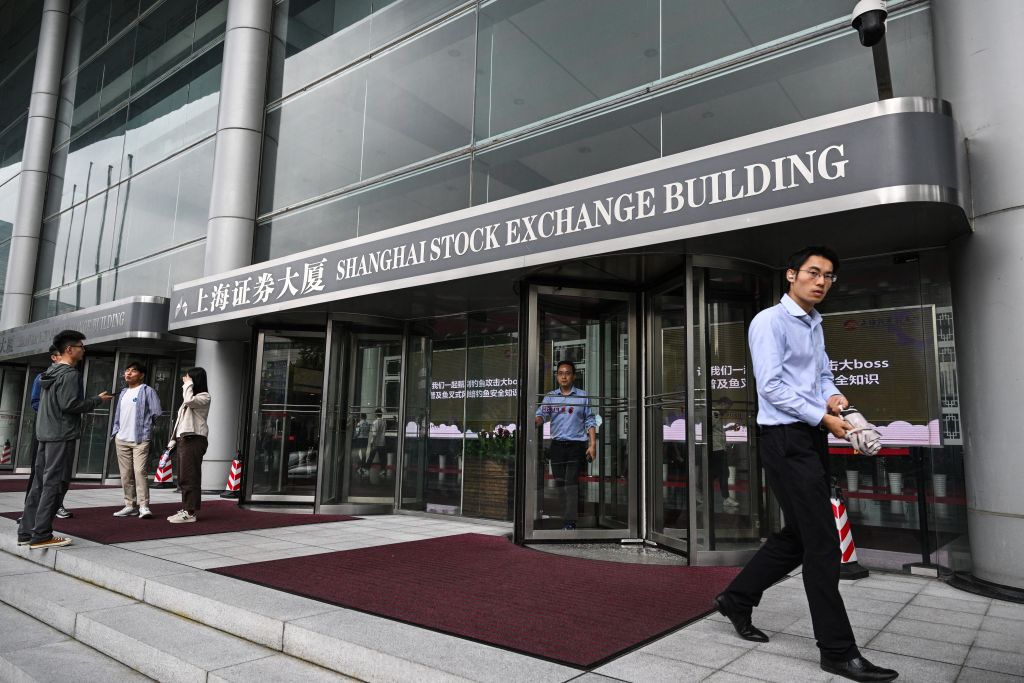
In recent days, the Chinese stock market has been continuously weakening. On October 15th, the three major A-share indexes all fell, with the Shanghai Composite Index falling below 3700 points at one point during the day, reaching a low of 3674.82 points. The Shenzhen Component Index fell over 2%, while the ChiNext Index fell nearly 3%. More than 5100 stocks in the market experienced a widespread decline. Concurrently, discussions around topics such as “when the stock prices of a thousand stocks are below the level of 2689 points” have been trending, with some financial bloggers lamenting that the market has returned to a situation reminiscent of two years ago.
On October 15th, the three major A-share indexes opened lower and maintained a weak and volatile performance throughout the day. By the close of trading, the Shanghai Composite Index reported 3707.48 points, down 1.59%; the Shenzhen Component Index reported 11816.79 points, down 2.43%; and the ChiNext Index reported 2783.17 points, down 2.92%.
During the trading session, the Shanghai Composite Index fell below 3700 points. At midday, the Shanghai Composite Index was reported at 3692.65 points, down 1.98%; the ChiNext Index saw its decline expand to over 3% at one point. In the afternoon, securities firms and major banks intervened to support the market, leading to a slight recovery in various indexes towards the end of the trading day, with the Shanghai Composite Index barely holding above the 3700-point mark.
The total trading volume of the Shanghai and Shenzhen markets for the day was approximately 1.63 trillion yuan, an increase of about 218.6 billion yuan compared to the previous trading day, indicating increased market activity.
The market showed a general downward trend. Wind statistics showed that out of the total listed companies in the two markets and the Beijing Stock Exchange, 425 companies saw gains, while 5105 companies experienced declines, with 38 remaining unchanged.
In terms of sectors, shipping-related stocks collectively declined, with stocks such as China Merchants Energy Shipping, China COSCO Shipping, and China Merchants Energy Shipping hitting the limit down. The coal sector also saw a significant retreat, with Hao Hua Energy, Yancoal Energy Resources, and Shaanxi Black Cat Coal among the top decliners. Technology stocks continued to face pressure, with declines seen in communication equipment, semiconductors, and certain computing hardware stocks dragging down the ChiNext Index.
The liquor sector was active, with the major financial sector leading in terms of gains. Banking stocks engaged in late-stage support actions, with the Big Five banks like Industrial and Commercial Bank of China (ICBC) seeing late-stage upward movements. Banks such as Bank of Communications, Agricultural Bank of China, China Minsheng Bank, and Industrial Bank performed well in terms of stock price increases.
East Sea Securities pointed out that the daily KDJ and MACD indicators showed a continued death cross, with the daily moving averages aligning in a bearish manner and trending downwards. The index falling below the previous low point of March 2026 indicates a continuation of weak technical conditions without signs of recovery.
On October 15th, A-share movements once again trended on social media, with tags like “the prices of a thousand stocks below the 2689-point level” gaining attention in the market.
Financial blogger “Tianjin Stock Hero” commented in a blog post, “As of today, there are a total of 1000 stocks whose prices are below the level corresponding to 2689 points on September 18, 2024. In the market this year, a 30% loss is considered normal, 20% is not too bad, 10% is seen as outstanding, and those who are not losing money are considered experts, with those still making profits being at the top level. Which category do you fall into?”
Financial blogger “Black Bear Knight” stated in a post, “Although the A-share index doesn’t seem too bad, the fact that over a thousand stocks are trading below the level of 2689 points indicates a typical scenario of index distortion and a bear market for individual stocks. The biggest pain point for trapped investors is that ‘while the index may recover, their accounts don’t break even,’ making it extremely difficult to get out of losing positions.”
The reference to “2689 points” dates back to September 18, 2024, when the Shanghai Composite Index touched 2689.70 points during trading. At that time, A-shares were on a continuous downward trend, and market sentiment was bleak. On September 24, 2024, the Chinese government introduced a series of measures to stabilize the stock market and the property market, leading to a significant rebound in A-shares, with a rapid surge in prices before the National Day holiday. However, after the National Day holiday, A-shares failed to sustain their previous strength, leading to a market situation with frequent fluctuations.
Currently, a large number of stock prices have fallen back to levels near the 2689-point mark when the Shanghai Composite Index was around that level in September 2024. This indicates that many stocks have essentially given up their previous gains over the past two years of market volatility, and some have even fallen to even lower levels.
Financial blogger “Duan Don” mockingly commented, “One online user astutely remarked: ‘If you want to hand over your assets to the state, there’s a specialized institution called the Shanghai Securities Exchange! And if you wish to hand over even more, there’s another one called the Shenzhen Securities Exchange!'”