
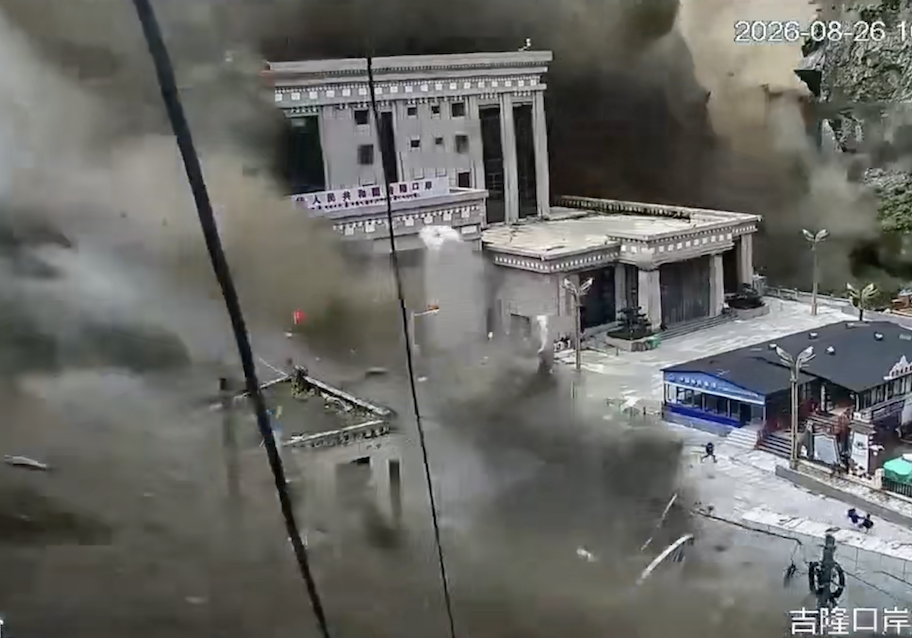
After the devastating casualties caused by a mudslide along the China-Nepal border, there has been external scrutiny on the warning mechanisms, yet the Chinese Communist Party (CCP) has labeled these criticisms as “eating human blood mantou.” Founder of the Taiwan Artificial Intelligence Laboratory, Du Yijin, emphasized that post-disaster accountability is a sign of respect for life, not for exploiting disasters, but to clarify risks and responsibilities to prevent future casualties.
In comparison to the aerial photos before the disaster at the Gyirong Port, Du Yijin pointed out that the joint inspection building at Gyirong Port was directly constructed at the confluence of the river channel and estuary, severely encroaching on the natural flood discharge space. He stated, “Respecting flash floods in construction is not about the fantasy of ‘man conquering nature’ with cement, but acknowledging that rivers need space in extreme weather conditions.”
Following the significant casualties from the mudslide along the Tibet-Nepal border, the CCP intensified internet stability measures by deleting posts, videos, and banning accounts. After Premier Li Keqiang’s visit to Tibet, the stability efforts escalated further. The internet police in Hunan and Tibet successively reported and penalized netizens for allegedly fabricating “rumors,” although the police were exposed for fabricating “rumor cases.”
Du Yijin pointed out that recently, Chinese media criticized Taiwanese media and online commentators with sensational headlines like “destruction of humanity, loss of morals,” accusing them of “eating human blood mantou” simply because some individuals started discussing public infrastructure safety, warning systems, and site selection after significant casualties.
In response, Du Yijin questioned, “When did examining the causes after a disaster become ‘loss of morals’?” He mentioned that no one denies that the triggering factors of this disaster were glacier collapse, rock avalanches, and subsequent flash floods. However, “natural disasters causing floods” and “whether human decisions escalate casualties” are fundamentally different matters.
Du Yijin challenged, “Typhoons are natural disasters, so should we refrain from scrutinizing embankments? Earthquakes are natural disasters, so should we not review building seismic resistance? Landslides are natural disasters, so should we ignore the location and evacuation of settlements? Glacier collapses are natural disasters, so should we not question where ports are built, how much space is left in river channels, how flood protection standards are set, and whether warnings are timely?” He emphasized that if this logic holds, the world would not need disaster reviews.
Interestingly, after the CCP’s military media accused Taiwan of “fabricating false news,” a Reuters investigation on August 30 directly interviewed Nepalese officials, reporting that months before the disaster, Nepal had requested increased collaboration with China on glacier monitoring, flood data, and warning information.
He stated that Nepal expressed dissatisfaction with obtaining real-time data from China. Post-disaster, Nepal is working towards establishing a more formal mechanism for sharing real-time glacier and water level information with China. This clearly indicates that disaster scrutiny is necessary for preparing for the next event, “the deceased do not die in vain but teach everyone the importance of future safety.”
“Discussing disaster warnings today is to evacuate 10 minutes earlier next time; understanding information transparency today is for downstream residents to know early next time; contemplating site selection for projects today is so public buildings do not put people in high-risk areas waiting; reviewing flood protection standards today is to avoid sacrificing hundreds of lives and extensive investments for a lesson during extreme floods.” Du Yijin said.
Du Yijin also criticized the CCP’s party media headlines of “destruction of humanity, loss of morals,” saying, does discussing “whether ports oppress river channels, occupy flood passages” imply moral decay? When someone raises “information transparency, the possibility of better warnings,” is that human annihilation? When someone scrutinizes “site selection and flood protection standards for major public projects, how did they pass in the first place” is that “eating human blood mantou”?
He pointed out that it is quite the opposite. Post-disaster review is the most basic form of respect for every deceased life because behind each death toll is a person, a family. Respecting them truly means not closing the case declaring “this is a natural disaster” after offering condolences, but reexamining every aspect—where could improvements be made? Which life could have been saved? How to prevent similar deaths next time?
“This is why in Taiwan, with every disaster, there are various discussions. The existence of engineering safety systems, disaster investigation systems, warning systems, was all borne out of humanity learning from repeated deaths,” Du Yijin said, “If so many people died, but in the end, the conclusion is ‘no scrutiny allowed’, then they truly sacrificed in vain.”
Du Yijin emphasized that scrutiny is not to shame the deceased, not to exploit disasters, and certainly not to deny natural disasters. Scrutiny is to save one less person when the next disaster strikes; saving one person means one family remains intact, that is true respect for life.
Du Yijin said, in democratic countries, the accountability habit formed long ago is truly terrifying “moral decay” is not someone seeking responsibility; it is when faced with the cost of hundreds of lives, there are still people eager to conform to authoritarian regimes, labeling dissent as anti-China, threatening freedom of speech for cross-border democratic accountability.