
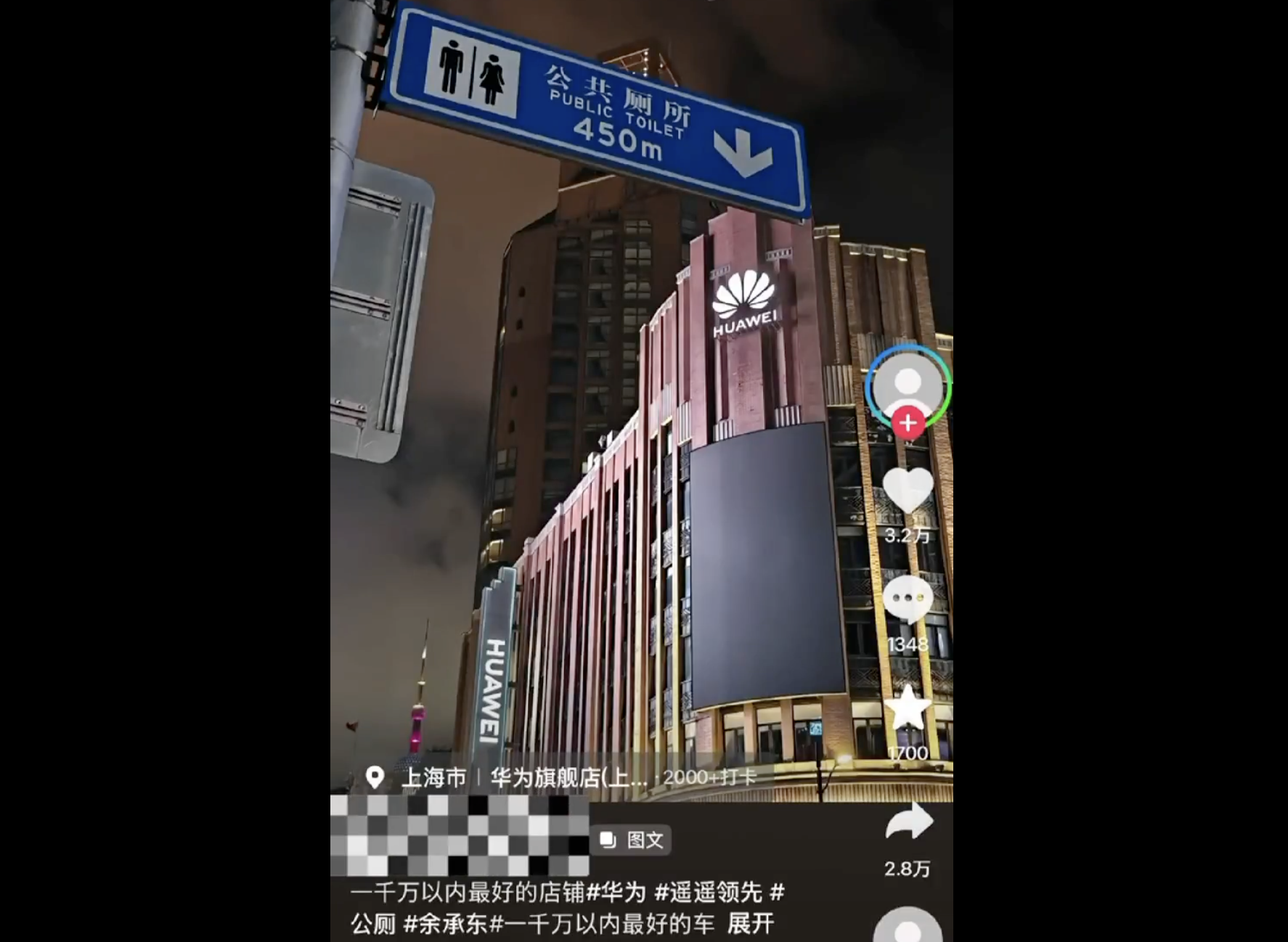
Recently, a photo of a Huawei flagship store next to a public restroom sign went viral online in Shanghai. The arrow on the public restroom sign happened to point towards the Huawei store, leading many netizens to jokingly refer to it as the “most awkward navigation” on the streets of Shanghai. However, the sign was soon removed.
Starting from the 25th, individuals began to guard the area to prevent people from taking photos. By the 26th, the street sign in the photo had disappeared from its original location, while the public restroom continued to be used as usual.
The related video circulated on the Chinese short video platform TikTok, sparking discussions among viewers.
Some people jokingly remarked that public facilities in Shanghai have finally “upgraded”: the restroom is still there, but the direction to it is not so clear; street signs are supposed to guide citizens, but now it seems one was removed possibly because the arrow pointed too accurately.
Some netizens felt that if the street sign was indeed removed because people were taking photos for social media check-ins, it indicates that some authorities are more concerned with aesthetics rather than the role of signs providing guidance.
Others criticized Huawei, saying their after-sales service efficiency is much worse than this street sign incident.
Some netizens said the reason why this street sign became popular was because it inadvertently pierced through a carefully crafted narrative: no matter how upscale a flagship store is, it still exists in the real urban environment; in the real city, there are consumers, pedestrians, and public restrooms that everyone needs to use. If even such a commonplace reality cannot be accepted, the so-called “national brand confidence” may just be a facade that cannot withstand a street sign’s direction.
In the comment section of the TikTok video, remarks like “Huawei City Government,” “Huawei Political Bureau,” “Huawei Constitutional Appointment Department” (note: using coded language to bypass online censorship), and “Huawei Nazi Concentration Camp” appeared, sarcastically alluding to Huawei’s actions in relation to the authorities.
In the midst of the US-China trade war, particularly after the Meng Wanzhou incident, Huawei has been playing the “patriotism card” to appeal to consumer’s national pride. However, this strategy has been backfiring this year.
Just last month, a Chinese toy called “Zhu Zhiliao” inadvertently triggered Huawei’s sensitive nerves and was reported and banned by Huawei.
The incident originated from a netizen posting a video playing with “Zhu Zhiliao” and jokingly claiming it to be the “best toy under 10 million.” Huawei reported and took down the video under the pretext of “damaging corporate reputation.”
However, this action by Huawei backfired as the “Zhu Zhiliao” toy started selling out, with many netizens buying it out of curiosity. They later discovered that when you rotate the “Zhu Zhiliao” toy, it makes a sound similar to the exaggerated “wow” of praise made by Huawei’s Executive Director and Chairman of the Terminal BG, Yu Chengdong, when introducing Huawei’s SUV as the “best SUV under 10 million.”
Many analysts believe that these incidents reflect Huawei’s “nationalistic” marketing propaganda endorsed by the Chinese Communist Party, which has sparked public resentment.