
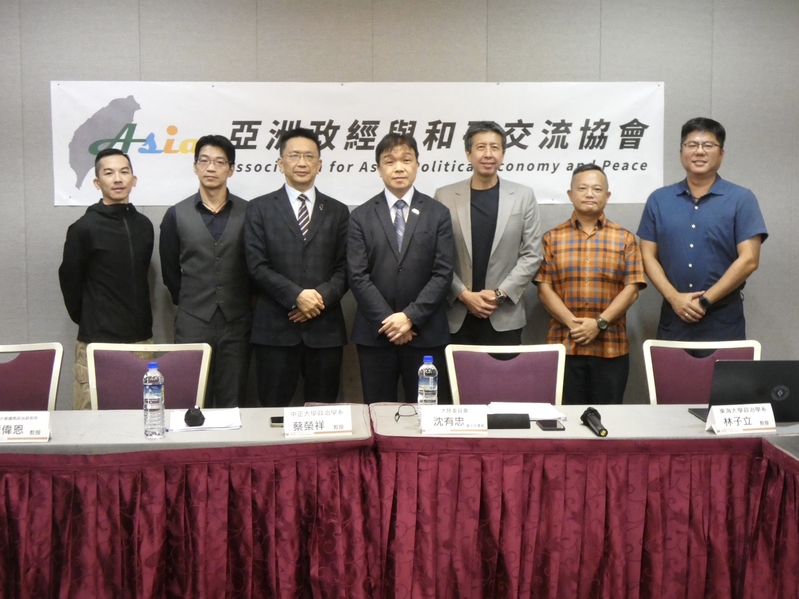
In response to the Chinese Communist Party’s proposed amendment to the “Internet Information Service Management Measures,” Deputy Minister of the Mainland Affairs Council of the Republic of China, Shen Youzhong, emphasized that the CCP’s consecutive introduction of national security and cyber laws aims to suppress cross-border activities. The Taiwanese government strongly opposes the CCP’s extraterritorial jurisdiction and continues to strengthen preventive measures, urging the public to carefully assess the risks of traveling to the mainland.
Shen Youzhong attended a symposium organized by the Asian Political and Economic Peace Exchange Association at the International Conference Center of National Taiwan University Hospital on the 25th, addressing the recent series of national security, cyber, and immigration management regulations implemented by the CCP. He explained the underlying risks of these regulations and declared Taiwan government’s firm stance and response.
Shen pointed out that since the implementation of the “Law on the Promotion of National Unity and Progress” on July 1, the CCP has successively advanced regulations such as the “Internet Information Service Management Measures,” “New Immigration Regulations,” and the “Public Security Organ Network Space Security Supervision and Inspection Measures.” These regulations possess high levels of political control and uncertainty.
He stated that the CCP has politicized technical and industrial security issues, using them as tools to consolidate leadership and internal stability before the upcoming “21st Party Congress.” Furthermore, the enforcement of these laws is conducted under vague and abstract standards, potentially escalating the risks of arbitrary enforcement by delegating authority to grassroots public security and local immigration units.
Moreover, the CCP’s regulations incorporate extraterritorial jurisdiction and clauses promoting reunification (such as Article 63 of the Law on National Unity Promotion and Article 29 of the Internet Management Measures), attempting to weaponize the “One China Principle” and legalize cross-border oppression, triggering high alertness among democratic countries.
Regarding the impact of the CCP’s oppressive laws on Taiwan and cross-strait exchanges, Shen expressed that the government upholds a steadfast position and actively takes concrete actions:
Firstly, firmly opposing cross-border jurisdiction, rendering CCP’s oppressive laws invalid: The Republic of China is a sovereign independent country, and the government staunchly opposes any form of extraterritorial jurisdiction and cross-border oppression. Unilateral legislation by the CCP does not bind the nationals of the Republic of China.
Secondly, cracking down severely on local collaborators, continuously reviewing legal tools: The Taiwanese government will rigorously prosecute local collaborators who assist in implementing the CCP’s oppressive laws in Taiwan. The latest survey by the Mainland Affairs Council also shows that up to 76.4% of Taiwanese people support the government’s legislative efforts to counter cross-border oppression, and the government will continue to enhance relevant legal mechanisms.
Thirdly, initiating cross-departmental assistance mechanisms to fully protect threatened nationals: The Taiwanese government has integrated resources from relevant departments to provide necessary protection measures and substantial assistance to nationals and individuals who are threatened and harmed by cross-border actions of the CCP.
Fourthly, deepening cooperation with democratic allies to continuously expose potential security risks: The Taiwanese government will strengthen intelligence exchange and collaboration to counter actions by the CCP, closely monitor the CCP’s legislative trends, and promptly disclose risk information to the public.
Shen emphasized that the government’s position remains consistent in maintaining peace and stability across the strait, safeguarding national sovereignty, and the free democratic system.
Regarding certain claims that government warnings about exchange risks are exaggerated or intimidating to the public, Shen clarified that cases of Taiwanese individuals being investigated, detained, or even arrested while traveling to the mainland due to political or religious factors have indeed been frequent in recent years. It is the responsibility of the Taiwanese government to honestly alert the public of risks to ensure the safety of their lives and property.
Shen reiterated that promoting healthy and orderly cross-strait exchanges must be based on depoliticization and risk reduction. The Mainland Affairs Council once again urged the public to carefully assess risks before traveling to the mainland, register through the “Dynamic Registration System for Taiwanese People Traveling to Mainland China, Hong Kong, and Macau,” enhance personal and information security awareness, and safeguard their own rights and safety.